

Differential Privacy is a mathematically rigorous framework designed to allow the release of statistical information from datasets while simultaneously safeguarding the personal privacy of every individual data subject.
This topic is typically read by data scientists, researchers, and organizations that are developing systems requiring them to share aggregate patterns derived from sensitive or private user data.
External context
For those working on pages involving data sharing, understanding DP means knowing how to publish group-level insights without revealing specific details about any single person. The process involves injecting carefully calibrated random noise into statistical computations; this technique ensures that the utility of the overall statistic is maintained while mathematically limiting what can be inferred about an individual in the dataset.
Differential privacy Wikipedia contributors, “Differential privacy”, en.wikipedia.orgLicence01What it is and how it works
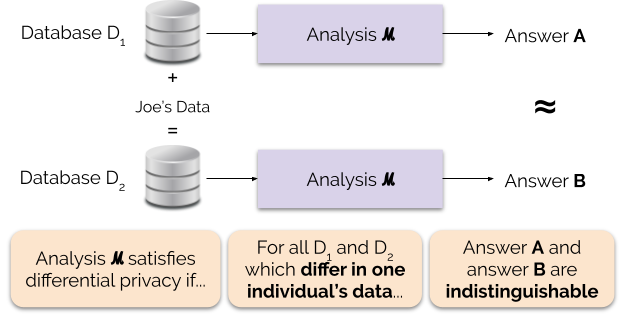
The core idea is to inject carefully calibrated random noise into the results of a data analysis. The noise level is set by a privacy budget (often called epsilon). A low epsilon means strong privacy (more noise) and a high epsilon means weaker privacy (less noise). The algorithm guarantees that the probability of any particular output changes only slightly whether or not any single record is present. This statistical guarantee makes it hard for an attacker to reverse‑engineer an individual's contribution, even with many queries.
It means you hide personal details by mixing them with random data so nobody can tell who contributed what.
02What to do about it
If your brand’s AI‑search product collects user signals, start by reviewing the data pipelines for any raw personal identifiers. Replace direct counts with a differentially private aggregator or use a library that implements the Laplace or Gaussian mechanism. Set an epsilon that balances regulatory compliance with the accuracy you need for ranking signals. Document the chosen budget in your data‑governance wiki and run a small A/B test to confirm that search relevance stays acceptable.
03How it is measured or noticed
A differential privacy implementation typically logs the cumulative privacy budget consumed per user or per day. Look for metrics such as “epsilon spent” in your monitoring dashboard. If you see the budget approaching a predefined cap, the system will either stop answering queries or increase the noise level. Auditors also check the statistical distribution of outputs; unusually low variance can signal that noise is not being applied correctly.
How the record puts it
Differential privacy (DP) is a mathematically rigorous framework for releasing statistical information about datasets while protecting the privacy of individual data subjects.
04Common mistakes
- Setting epsilon too high because you want perfect accuracy – this defeats the privacy guarantee.
- Re‑using the same privacy budget across unrelated datasets – budgets should be tracked per dataset.
- Assuming that adding a single random number is enough – the noise must be calibrated to the query’s sensitivity.
05Limits
Differential privacy does not protect against attacks that use side‑channel information, such as timing attacks or correlated external data. It also does not replace the need for secure storage and access controls. The technique is often confused with anonymization; unlike simple de‑identification, differential privacy provides a provable bound on re‑identification risk, but only for the specific queries you protect.
06Worked example
"We wanted to know how many users searched for the phrase ‘organic shampoo’ in the last 24 hours. Using a Laplace mechanism with ε = 0.5, the raw count of 12 345 became 12 358 after noise was added. The extra 13 queries are meaningless to any single user, yet the trend remains clear for our marketing dashboard."
The entry above is written by GetLoopLoop. What follows is what independent catalogues hold about the same term — none of it is the source of this page.
- Also called
- Differential privacy
The same term on Wikipedia
Catalogued in 12 languages07Frequently asked questions
How does differential privacy differ from simple data anonymization?
It depends on the technique used. Anonymization removes or masks identifiers, but patterns can still be exploited, whereas differential privacy adds mathematically calibrated noise to query results to bound the influence of any single record. This makes re‑identification far harder even when attackers have auxiliary information.
Should we implement differential privacy in our AI‑search product?
It depends on your risk profile and regulatory requirements. If you collect raw user signals that could be linked back to individuals, adding differential privacy helps you meet privacy standards and builds user trust. However, you need to balance the added noise against the accuracy needed for search relevance.
How is the random noise actually added to the search results?
Usually a noise distribution such as Laplace or Gaussian is sampled based on a privacy budget (epsilon) and then added to the aggregate metrics before they are returned. The amount of noise is calibrated so that each additional query consumes a portion of the budget, limiting cumulative exposure. This process is typically handled by a privacy‑preserving library integrated into the data pipeline.
Does differential privacy guarantee that no individual's data can ever be re‑identified?
No, it does not provide absolute immunity. Differential privacy limits the additional risk contributed by any single record, but side‑channel attacks, timing analysis, or correlated external datasets can still reveal information. Proper system design must consider these broader attack vectors.
What are the consequences of setting the privacy budget too high?
If the budget is set too high, the added noise becomes minimal and the privacy protection weakens, making it easier for adversaries to infer individual data points. You may also violate compliance requirements, which could lead to regulatory penalties. Monitoring the budget consumption helps you spot when the protection level drops.
How long does it take for a change in the privacy budget to appear in our monitoring dashboards?
Typically the budget consumption is logged in near real‑time, but the dashboards may refresh every few minutes depending on your infrastructure. You should see the updated totals within the next reporting interval, allowing you to act quickly if the budget is being exhausted. Continuous streaming of metrics can reduce this latency further.
Wikimedia Commons
Related visuals with source and licence credit

08Asked out loud
The same term in the words somebody uses speaking to an assistant rather than typing into a box — written from the situation, which is why each one carries the situation it came from.
Yes, the system currently logs a privacy budget per user and stays within the configured epsilon, so you’re compliant for this release. Keep an eye on the cumulative budget after the update, as new queries will consume additional privacy allowance.
It depends on the recent query volume. If the budget consumption over the past hour is below the daily limit, you have room for more queries; otherwise you may need to pause data collection until it resets. You can ask the assistant to pull the latest budget metric when you’re back at a computer.
Usually that variation is the noise added to satisfy differential privacy guarantees. The amount of noise is proportional to the privacy budget, so higher protection leads to more noticeable fluctuations. If the variation seems excessive, check whether the epsilon value is set too low for your use case.