

Your Target CPA Is Now a Target
Google's 17 August change makes budget-limited campaigns optimise to the number you typed. The arithmetic is unforgiving, and the only question that matters is whether the dearer conversions are incremental.

The short answer
- what
- Google Ads now optimises budget-limited campaigns more strictly toward the Target CPA typed.
- why
- The change ensures campaigns perform more consistently toward the bid target, exposing previous inefficiencies.
- who
- Google Ads users running budget-limited campaigns need to understand the change.
- where
- This affects campaigns globally across Search, Shopping, Performance Max, Demand Gen, and Travel.
- when
- The change took effect from 17 August 2026.
- how
- Smart Bidding now spends the budget toward the target rather than under it, raising the average price paid.
In plain words
Google Ads changed how it spends money in campaigns. Before, it tried to get the cheapest clicks. Now, it spends more to hit the target cost you set. This means you might get fewer clicks for the same money, but they might be better ones.
For years, a budget-limited Google Ads campaign on Target CPA did something nobody wrote down. You typed £35. The system found the cheapest auctions it could reach inside your budget, and delivered £22. You reported £22. Nobody asked why the number you asked for and the number you got were different, because the difference was in your favour.
From 17 August 2026, that stopped. Budget-limited campaigns on Target CPA, Target ROAS, and Target CPC for Demand Gen now optimise more literally toward the target you typed. The £22 drifts back toward £35.
Nothing broke. The system is doing what it was told. What has been exposed is that a great many targets were never targets at all — they were ceilings nobody expected to touch, and the gap between what was typed and what was delivered was carrying weight that nobody had accounted for.
A target you never expected to reach is not a target. It is a wish with a budget attached.
GetLoopLoop editorial principle
What actually changed
Google's wording is that campaigns limited by budget "will more consistently perform toward your bid target, including when you make budget adjustments." The scope is wide: Search, Shopping, Performance Max, Demand Gen and Travel, through the interface, Search Ads 360, DV360, Editor and the API.
The mechanism is worth being precise about, because the reporting has mostly described the symptom. Under a binding budget, Smart Bidding previously had a choice: it could enter every auction it thought would convert at or under the target, or it could enter only the cheapest of them. With the budget as the binding constraint, it took the cheap ones. That produced a flattering CPA and a conversion count limited to the cheap end of the market.
Now the budget is spent toward the target rather than under it. More expensive auctions come into range. The average price paid rises toward the number you typed.
| Before 17 August | After | |
|---|---|---|
| What the bidder did under a binding budget | Took the cheapest auctions it could find | Bids toward the target across the range |
| What you saw | A CPA comfortably under target | A CPA near the target you set |
| What that CPA described | The cheap end of your market | The market you actually asked to buy |
| What it means for volume at a fixed budget | More conversions, all cheap ones | Fewer conversions unless the dearer ones are incremental |
Try it on your own page
See what Voicescope finds on a page of yours
Everything above is measurable on your own work, and the check takes about a minute. Paste one address and read what comes back.
Open VoicescopeFree · no account · one at a time
The arithmetic nobody enjoys
A fixed budget divided by a price is a quantity. That is the whole of the risk here, and it needs no modelling.
Ten thousand pounds at £22 buys 455 conversions. The same ten thousand at £35 buys 286. That is 37% fewer, for the same money, with no change in your product, your landing pages or your market.
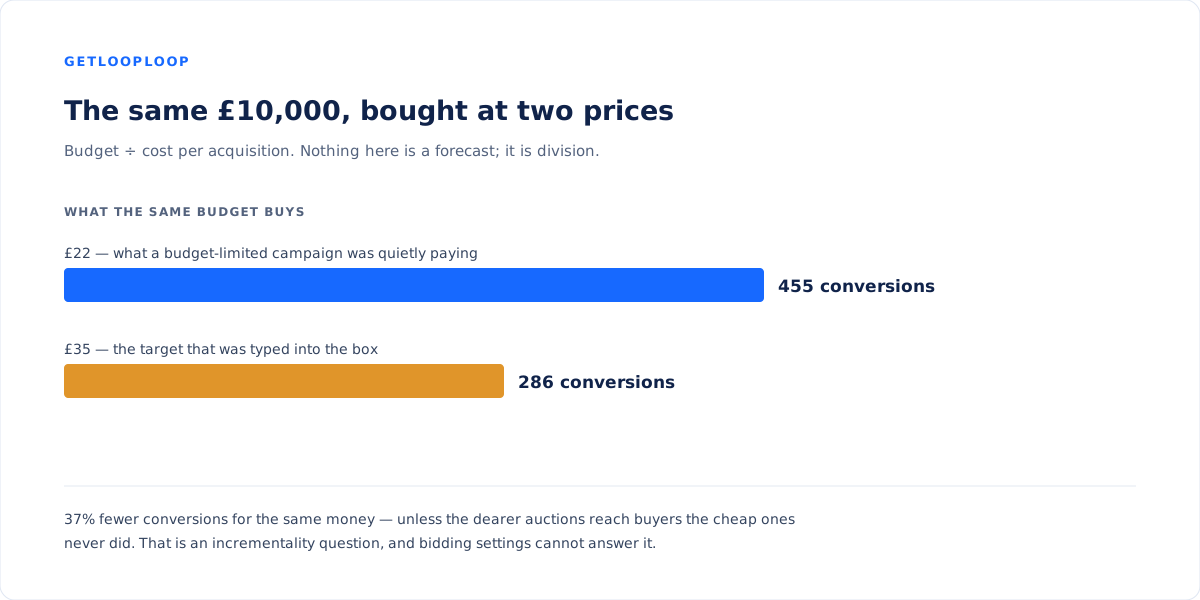
There is one way that arithmetic is not the end of the story, and it is the question the whole change turns on: are the dearer auctions incremental?
If the more expensive impressions reach buyers the cheap ones never did — a different segment, a later stage, a competitor's customer — then 286 conversions at £35 may be worth more to the business than 455 at £22, because more of them are conversions that would not have happened anyway. If the dearer auctions are simply the same buyers bought at a worse price, then you have just paid 59% more per unit for nothing.
A bidding setting cannot tell you which. Only a holdout can.
What to do this week
Re-derive the target from margin, not from last month's actuals. If your reported CPA was £22 because the system was cherry-picking, then £22 was never a business number — it was an artefact of a constraint. Work out what you can afford to pay for a conversion at your contribution margin and your payback period, and type that.
Then decide whether you are buying volume or price. These are now separable in a way they were not before. If the target is right and the budget is binding, you are choosing to buy fewer, dearer conversions. That is a legitimate choice — but it should be a choice, not a surprise in a monthly report.
Run a geo holdout before you conclude anything. The one question that matters — whether the extra spend reaches anybody new — is an incrementality question, and it is answerable in three or four weeks with a split by region. Everything else is inference from a number that changed for a known reason.
And check what your reporting is anchored to. Any dashboard, bonus or agency SLA written against "CPA under £25" is now measuring a different world than the one it was written in.
Conversions bought by a £10,000 budget at two effective prices
Why this is a measurement story and not a bidding one
The reason this change stings is not that a setting moved. It is that a number a lot of teams were judged on turns out to have been describing something other than what everyone believed.
That is an old effect with a name. When a measure becomes a target, it stops being a good measure — and the corollary, less often stated, is that a measure which was never really a target can be quietly holding a lot of weight. Reported CPA was doing exactly that: it looked like a measure of efficiency and was substantially a measure of how binding your budget was.
The fix is the same as it always is. Steer by more than one number, keep one of them out of the bonus, and read direction over months rather than a level on a date.
Questions people ask
Should I lower my Target CPA to bring the old cost back?
No. The old cost came from the bidder beating a target it was never expected to meet. Lowering the target reproduces the accident and buries the real question. Set the target from contribution margin and payback, then decide separately how much budget that market deserves.
Does this mean Smart Bidding got worse?
It means it got more literal. Before, a budget-limited campaign quietly under-delivered on price and over-delivered on efficiency; now it does what the setting always claimed. Whether that is better depends entirely on whether your target was a real number.
Which campaign types are affected?
Target CPA and Target ROAS across Search, Shopping, Performance Max, Demand Gen and Travel, plus Target CPC for Demand Gen — through the interface, Search Ads 360, DV360, Editor and the API. If a campaign is not limited by budget, the change has little to bite on.
How do I find out whether the more expensive conversions are incremental?
A geo holdout: hold the campaign out of a matched set of regions for three to four weeks and compare total conversions, not campaign-attributed ones. It is the only method here that answers 'compared with what?', which is the question the platform's own reporting cannot answer about itself.
We are not budget-limited. Does anything change for us?
Much less. The change bites where the budget was the binding constraint. If yours is not, your effective CPA was already being set by the target rather than by the cheap end of the auction pool.
Conclusions
A target that was never enforced was never a target. For a lot of accounts, the number in the Target CPA box was aspirational and the number in the report was an artefact of a binding budget. Only one of those was ever a business decision, and from 17 August it is the one that governs.
At a fixed budget, price and volume now trade off visibly. £10,000 at £22 is 455 conversions; at £35 it is 286. That is division, not a forecast, and it will show up in the monthly report whether or not anybody plans for it.
The only question worth answering is incrementality. Whether 286 dearer conversions beat 455 cheap ones depends entirely on whether the dearer auctions reach anybody new. A geo holdout answers it in a month. No amount of tuning inside the platform will.
And check what is anchored to the old number. Dashboards, bonuses and agency agreements written against a CPA that the system used to beat by accident are now measuring a different world. Re-anchor them deliberately, before somebody is judged against a figure that no longer means what it did in July.
The product
Watch it on every page, every day
One reading tells you where a page stands today. The product asks the same questions of the same assistants continuously, so a change is something you are told about rather than something you go looking for.
Request an invitationInvite-only while we keep the readings honest
On this topic
Do AI assistants mention us?
Every day The same questions asked of real assistants on a schedule, every answer kept in the evidence store. How the product works
Author
Olexandrauthor
15+ years in marketing and SEO. Dozens of products, mostly the US market. Research and measurement.
LinkedInPass it on
Read in your language
Opens a browser translation of this English article. The original source stays in English.