

01A term of ours, not an established one
This is a coinage. There is no Wikipedia article for it, no paper that named it, and no consultancy that owns it. It is here because the thing it names keeps happening and the existing vocabulary covers only pieces: technical debt is about code, organisational memory is the academic study of what firms retain, and Goodhart's law explains the mechanism but not the specific loss. Context debt is our name for the balance itself.
We say so plainly for the same reason we attribute quotations: an entry that presents a coined term as established vocabulary spends credibility it did not earn, and a reader who checks — as readers of glossaries do — finds nothing and trusts the next entry less.
Every company runs partly on things nobody wrote down: why it works this way, what was already tried, where the usual rule stops being true. Lose the people who hold that, and nothing breaks — until you have to do something new.
02What the balance is made of
Not documentation, and not tickets. Every item below is the kind of thing that gets explained in a corridor, is true for two years, and is never written anywhere.
- Why it is built this way — the constraint that caused the design, long after the constraint stopped being obvious.
- What was already tried — and the real reason it failed, which is almost never the reason in the retrospective.
- Where the rule stops applying — the edge of every heuristic the company operates on.
- Who actually decides — in a market, in an account, in a standards body, as opposed to who is on the org chart.
- What the numbers used to mean — which measures were trustworthy when, and what changed underneath them.
03Why nothing looks wrong
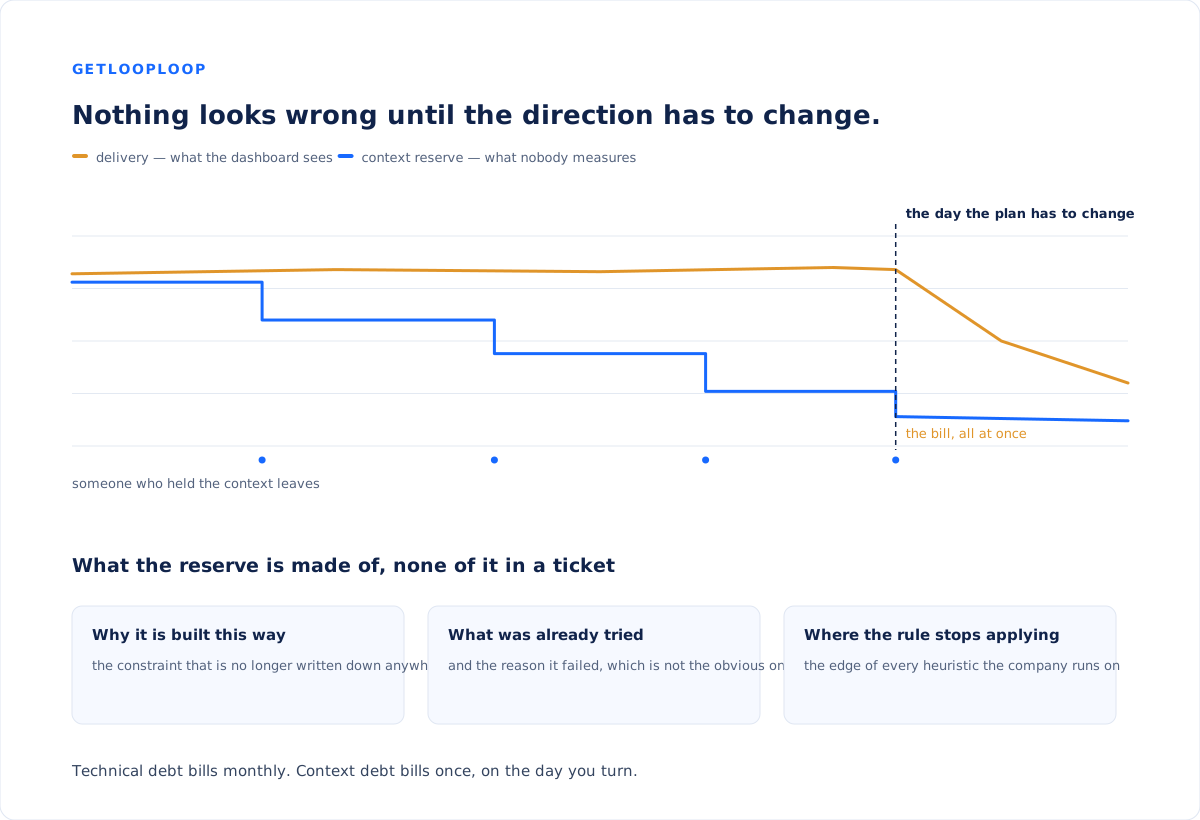
Delivery is the last thing to degrade. Executing a settled plan takes competence and almost no context: the questions have already been asked, the trade-offs already made, the edge cases already found. A team can lose every person who made those decisions and still ship on time for a year, because it is running on decisions rather than making them.
So every dashboard reads healthy. Throughput, cycle time, uptime, cost per unit — all fine, all measuring execution, none of them measuring whether the company could still choose a different direction if it had to. That is not an oversight in the dashboards. It is that the capacity to change direction has no natural proxy, so nobody has one, so nobody watches it.
04How the balance builds
Not through carelessness. Every route below is a normal, defensible decision made for reasons that were good at the time.
Somebody leaves and the handover is a list of systems rather than an account of why they are that shape. A team is reorganised and the person who knew the history of an account now works on something else. A function is outsourced and the vendor is given the process without the reasons behind it. Work is decomposed into tickets, which is efficient and which also means each person sees only their own square. And most sharply: work is automated, and the automation absorbs the task while the reasoning behind the task leaves with the person.
None of these is a mistake. The mistake is treating any of them as free.
05What it costs when it comes due
The bill is specific and recognisable. A company deep in context debt re-runs experiments that already failed, because nobody remembers the first attempt. It re-opens questions that were settled years ago, and settles them differently, without knowing it has. It applies rules past their edge, because the edge was in somebody's head. It cannot tell whether a change worked, because the person who knew what the baseline meant is gone. And it is slow in a way that shows up nowhere: every new decision now needs a research project to reconstruct what used to be known.
From the outside this looks like quiet. No new directions, a product living on what it already had, each quarter resembling the last — and a competitor who kept those people appearing in a niche nobody saw them enter.
- Experiments re-run because the first failure was never recorded.
- Settled questions re-opened and answered differently, with nobody aware it happened.
- Rules applied past the edge where they were known to stop working.
- Results that cannot be judged, because what the baseline meant is gone.
06The part that is not notes
It is tempting to picture this balance as missing documentation. It is not. A company that has spent its context can still generate ideas — often more of them than before, because nothing is holding them back. What it has lost is the ability to tell which of those ideas have purchase on reality and which merely sound new.
That judgement is not a document and cannot be written into one. It comes from having watched this product break, this market move and this customer refuse. Which is why the person who has been inside for years is not the same thing as the old way of working: give them new tools and the room to adapt, and they bring into those tools what an outside specialist cannot yet have — where the product breaks, what has already failed, and which compromise the customer will actually accept.
New expertise without that context produces options. Context turns them into options worth testing.
And the same thing runs in reverse, which is the part nobody counts. A tool handed down with no choice — use it, it is what we do now — makes adoption the target, and Goodhart applies to adoption as readily as to anything else. The experienced person stops offering judgement and starts producing evidence of use, because that is what is being measured. They have been told, in the only language an organisation really speaks, that what they know is not wanted. The context then leaves while the person stays: still on the payroll, no longer consulted, and eventually no longer bothering. That is the cheapest way to spend a context reserve and by far the hardest to notice, because headcount has not moved and nobody has resigned.
- Ideas are not the scarce thing. Sorted ideas are.
- An insider given new tools is expertise with the context; a replacement is expertise without it.
- On a slide the two look identical. They differ entirely in how often the idea survives contact with the market.
07How to pay it down
Cheaply, and mostly by writing down a different thing than companies usually write down. Documentation records what the system does, which the system itself already tells you. What is missing is always the why.
- Record decisions, not states: what was decided, what the alternatives were, and what would make you reverse it.
- Keep a why-not list. The failed attempts are more valuable than the successful ones and are the first thing lost.
- Debrief on the way out, and ask the right question — not 'what do you do' but 'what do you know that nobody has asked you about'.
- Give every system and every account a named owner, and change owners on purpose rather than by attrition.
- When you automate a task, capture the reasoning before the person who held it leaves, not after.
- Retrain the people who have the context before you buy the skill from outside. The skill is the easier half to buy.
- Measure it by proxy: how often does a question that was settled get re-opened? That number is cheap to keep and it is the only early warning there is.
08The case running right now
Payroll cost is a proxy for a company's capacity to do work, and "cut it with AI" has been a target across the industry for two years. The first quarters are genuinely good, because the slack is real — plenty of work should have been automated years ago. What follows is the part this entry is about: the automation takes the task, and the reasoning behind the task leaves with the person.
A model does superbly what has already been formulated. It does not notice that the question is the wrong one, and it will never walk in to say the market moved six months ago. A company that has spent its context reserve keeps executing the previous strategy flawlessly and cheaply, which is exactly why it does not notice the strategy is dead. That is Goodhart's law with a specific bill attached, and the bill is this one.
09Frequently asked questions
How is this different from technical debt?
Technical debt is in the code and it bills every month: every change costs more than it should, visibly, from the day the shortcut is taken. Context debt is in people and bills nothing at all until the direction has to change, at which point it bills the whole balance at once. The interest schedule is the difference, and it is why one gets budgeted for and the other does not.
Isn't this just documentation debt?
No, and the distinction is practical. Documentation records what a system does — which the system can usually tell you itself. Context is why it does it, what was tried instead, and where the rule stops applying. A team with perfect documentation and no context still re-runs the experiment that failed in 2023.
Can it be measured?
Not directly, but a usable proxy is how often a settled question gets re-opened and answered from scratch. Count re-litigated decisions per quarter. It is nearly free to keep, it needs no tooling, and it moves before anything on a dashboard does.
Does automation always create it?
No. Automation absorbs the task; whether it absorbs the reasoning depends on whether anybody captured the reasoning first. Automating a task while the person who understood it is still there, and writing down why the task exists, costs one conversation. The same automation six months after they leave costs the reconstruction.
What is the first sign?
Someone asks why something is the way it is, and the answer is nobody knows. On its own that is one gap. When it is the third time this quarter, it is a balance.
10Asked out loud
The same term in the words somebody uses speaking to an assistant rather than typing into a box — written from the situation, which is why each one carries the situation it came from.
Probably nothing yet, and that is the point. Execution is the last thing to degrade, so a plan that is already made keeps shipping for about a year. Ask instead whether you could still change direction — and write down why things are built the way they are while people who know are still there.
Not a handover of tasks. Ask what they know that nobody has thought to ask about: which constraints caused which decisions, what was tried and really why it failed, and where the usual rules stop applying. That is the part that does not exist anywhere else.
Often because the knowledge that used to make decisions cheap has left the building. When nobody remembers what was already tried, each choice needs a small research project first. Count how often a settled question gets re-opened — if it is rising, that is what you are paying for.