

01What it actually says
Charles Goodhart, then an adviser to the Bank of England, wrote the original in 1975 for a Reserve Bank of Australia conference. His wording is narrower and more careful than the version people quote: "Any observed statistical regularity will tend to collapse once pressure is placed upon it for control purposes." He was writing about monetary aggregates. The relationship between the money supply and inflation held while the Bank was watching it and broke once the Bank started steering by it.
The famous sentence is not his. The anthropologist Marilyn Strathern condensed it in 1997, writing about research assessment in British universities: "When a measure becomes a target, it ceases to be a good measure." That is the form that travelled, and it is worth knowing it is a paraphrase — the original is a claim about statistical relationships under control pressure, not a proverb about KPIs.
Something that reliably went together tends to stop going together once you start pulling on one end of it to move the other. Paying people for the number is one way to pull. It is not the only one, and the law does not depend on it.
Any observed statistical regularity will tend to collapse once pressure is placed upon it for control purposes. — Charles Goodhart, 1975
02Why it happens, mechanically
A regularity is not a law of nature. It is a pattern produced by people acting under the conditions of the moment, and the observation itself is one of those conditions. Steering by the pattern changes what those people are doing, so the pattern that justified the steering is not the pattern you are now steering. Robert Lucas made the same argument about econometric models in 1976, a year after Goodhart, and it is the same argument: a relationship estimated under one policy regime cannot be assumed to survive being used to set policy.
Incentives are the loudest version of this and not the whole of it. Nobody can measure the thing they care about — trust, usefulness, whether an answer helped — so a proxy is chosen because it correlates with the thing under ordinary conditions. Attach a reward and the cheapest route to the number is rarely the route through the thing: the honest route produces the number as a by-product of expensive work, the direct route produces the number and nothing else. But a regularity can also break with nobody being paid at all — because the thing that made it hold was never the thing anyone thought, and steering was what exposed that.
- A regularity holds under some set of conditions, and being observed is one of them.
- Steering by it changes those conditions, so the regularity you measured is not the one you are now using.
- A reward makes this fast and visible: the cheapest way to move a proxy is rarely to move the thing.
- But the collapse does not require a bonus. It requires only that the relationship be leaned on.
03Search has lived through this three times
This is not an analogy in this industry. It is the industry's own history, and each round cost a re-architecture.
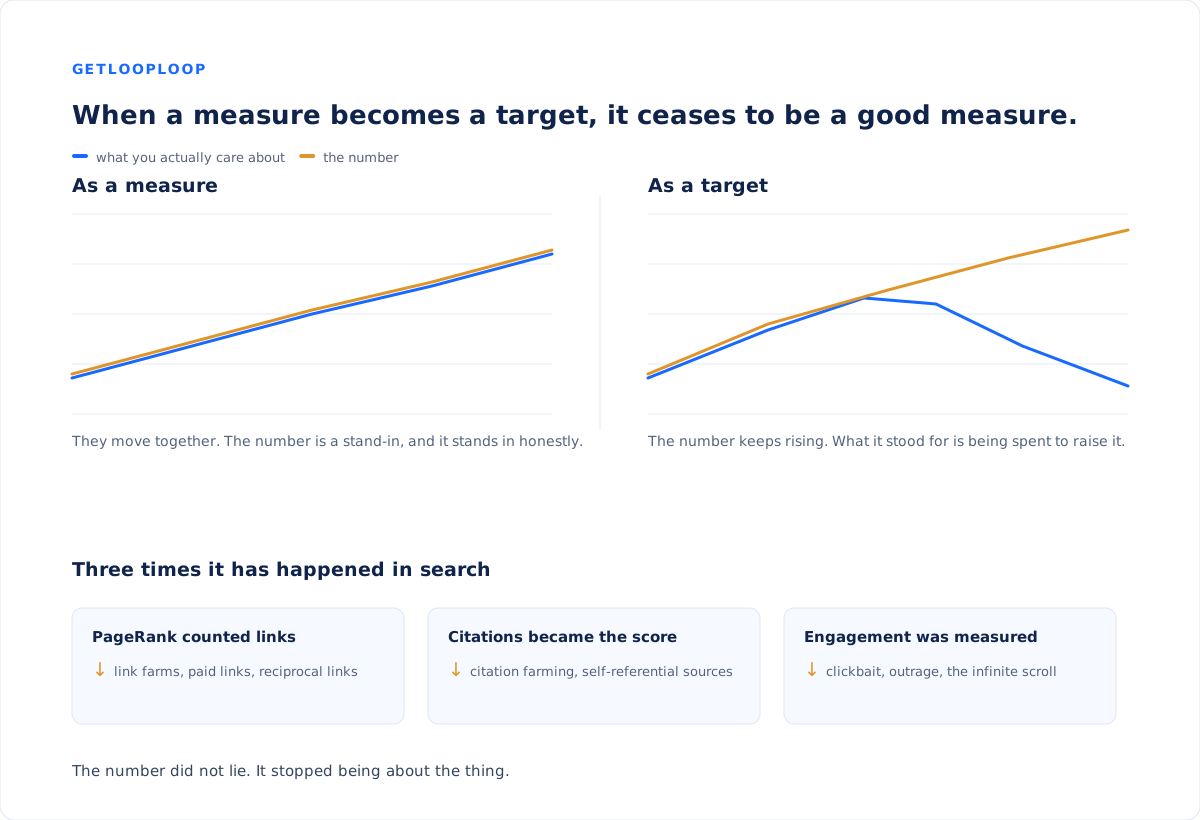
PageRank counted links. A link was a citation, and citations were a decent proxy for standing — until a link had a price. Link farms, reciprocal-link schemes, paid links and private blog networks all followed directly, and Google spent years and two named systems fighting the consequences: Panda in February 2011 for thin content, Penguin in April 2012 for manipulated links.
Content length and keyword coverage became the target. The proxy said a thorough page covers its subject; the cheapest route was to cover the subject at length without knowing anything, and content farms industrialised it.
Engagement was measured. Time on page, clicks, sessions — all reasonable proxies for a reader being served. Priced, they produce clickbait, outrage, chopped-up pagination and the infinite scroll, none of which anybody chose as a goal.
How the record puts it
Goodhart's law is an adage that has been stated as, "When a measure becomes a target, it ceases to be a good measure".
04And it is happening again, right now
Assistants cite sources, so citations are being counted. That makes a citation a target, and the same machinery is assembling around it: pages written to be quotable rather than to be right, sources that cite each other in a ring, text shaped for a retrieval system rather than a reader.
We are not bystanders here. This product reports visibility scores, citation share and share of voice, and every one of those is a proxy that will bend if it is used as a quota. A number on a dashboard is a description; the moment somebody's quarter depends on it, it becomes a target and this law applies to it. Saying so on the page that defines the law is the least we can do.
- Citations counted → citation farming and circular sourcing.
- Brand mentions counted → mentions manufactured where no reader is.
- A visibility score turned into a quota → pages written for the scorer.
05At the scale of a company
A large organisation does not see itself with its eyes. It sees itself through its measures, and the correspondence between a measure and a state of affairs is its eyesight. A target set at the top and enforced through appraisal turns each of those correspondences into a lever — and a lever is not a gauge.
The effect multiplies on the way down. One person sets the target; hundreds look for the cheapest route to it, each in their own area and each inventively. An organisation is a very efficient optimiser of what it actually rewards, which is rarely what the strategy document says.
What is lost first is not revenue. It is the ability to see — and the damage to the business arrives afterwards, on a delay, which is precisely what makes it hard to catch. By the time the numbers that matter move, the instruments that would have explained why have been unreliable for a year, and nobody can say when they stopped being trustworthy. Repair takes longer than the breakage, because confidence in a measure is retrospective: it can only be earned by a run of months in which the measure and reality agreed.
The timing is the cruel part, and it is why this is so hard to resist. The first quarter is usually genuinely good. The cheap routes to the number have not been used up, the slack in the system is real slack, and the figure moves. The second is better still — and by then the rise is being read as proof that the target was the right one, so the pressure is increased rather than questioned. The bill arrives in the year after: the cheap routes are exhausted, the measure stopped corresponding to anything months ago, and nobody can now say which of the last six quarters were real. How bad it gets depends on how much of the business was steered by that one number. For a company that steered by nothing else, this is where it ends.
- A company's eyesight is the correspondence between its measures and the world.
- A target converts a correspondence into a lever, and a lever cannot be read.
- One person sets it; hundreds optimise it, each finding the cheapest local route.
- Blindness comes first and the business damage follows later — which is why it is caught late.
06The example running right now
Headcount cost correlated with something real: a company's capacity to do work. Once "cut the payroll with AI" became the target, the correlation broke. The cost figure falls honestly and the report is true — but it no longer describes capacity. It describes the effort put into reducing it.
The first quarter is genuinely good, and that is not an illusion. Every organisation carries real slack: work that should have been automated five years ago. The cheap routes exist, they get taken, and the number moves for good reasons. The second quarter is better still, because the first was read as proof the course was right and the pressure was raised. Then the cheap routes run out, and the pressure does not.
What is cut after that is not task execution. It is the people who held the context — why it is built this way, what was tried and why it failed, who actually decides in this market, where the rule stops applying. None of that is in a ticket, because it is not work: it is the residue of a decade of failures a model was never present for. A model does superbly what has already been formulated. It does not notice that the question is the wrong one, and it never walks in to say the market moved six months ago. A company that has lost those people goes on executing the previous strategy flawlessly and cheaply, which is precisely why it does not notice the strategy is dead.
The loss does not show up as a crash. It shows up as quiet: no new directions, the product living on what it already had, each quarter resembling the last — and a competitor who kept those people appearing in a niche nobody saw them enter.
- Payroll cost was a proxy for capacity. Made a target, it measures only the effort to cut it.
- The first two quarters are genuinely good, because the slack is real — which reads as vindication.
- What goes next is context: the unrecorded knowledge that lets a company notice its own strategy is stale.
- "This work no longer needs a person" is a decision about work. "Minus 30% of payroll by December" is a decision about a number. Two quarters in, they look identical from outside.
07How to keep a measure honest
The law is not an argument against measuring. It is an argument against a single number — and a single number is what a KPI usually is. One measure, leaned on, is exactly the case Goodhart described: one regularity, put under control pressure, collapsing.
What survives is a basket of measures that are each imprecise and that ought to move together. None of them is the truth; their agreement is the signal, and their disagreement is the alarm. If citation share, referral traffic, branded search and repeat readers all drift upward over a quarter, something real is probably happening. If citation share climbs alone while the other three sit still, nothing real is happening and you have found it early. That is a check no single number can perform, and it is cheap: you already collect all four.
And read the trend, not the level. A level is a target waiting to happen; a direction over months is much harder to manufacture, because manufacturing it means keeping four partly independent measures in step, which costs more than doing the work.
- Steer by a basket, never by one number. Their agreement is the signal; the day they stop agreeing is the finding.
- Read direction over months rather than a level on a date. A level is a target waiting to happen.
- Hold one measure back. Steer by the ones you publish; check them against a measure nobody is rewarded for and nobody sees.
- Measure the thing itself sometimes, even when it is expensive — read the answers, ask the customers, look at the pages.
- Prefer a measure that is expensive to fake. A citation from a source that has something to lose is worth ten that do not.
- Test for incrementality rather than movement: did the number rise because the thing changed, or because attention moved to the number?
- Rotate what you steer by. A proxy that has been the target for two years is already compromised.
- Write down what the proxy stands for. When a measure drifts, the first thing lost is the memory of what it was for.
08A worked example
A team is told to raise citation share in AI answers from 8% to 20% in a quarter. Two routes are open.
The honest route is to publish work worth citing: original measurement, a method somebody can check, a claim that is true. It takes most of the quarter to produce and most of the following one to be picked up. Citation share at the end of the quarter: perhaps 11%.
The direct route is to publish forty near-identical pages tuned to the phrasing assistants retrieve, syndicate them across owned domains, and cite them from each other. Citation share at the end of the quarter: 22%. Target met, bonus paid.
A year later the second team's pages are cited by nothing outside their own ring, the assistant vendors have adjusted for exactly this pattern, and the number has fallen below where it started — while the first team's eleven per cent has kept compounding, because it was made of the thing rather than of the measure. Both quarters looked like success on the dashboard. Only one of them was.
The entry above is written by GetLoopLoop. What follows is what independent catalogues hold about the same term — none of it is the source of this page.
- Named after
- Charles Goodhart
- Kind of thing
- adage
The same term on Wikipedia
Catalogued in 22 languages09Frequently asked questions
Is Goodhart's law the same as Campbell's law?
They are two independent statements of the same effect. Donald Campbell, a social psychologist, published his in 1976: the more a quantitative indicator is used for social decision-making, the more it will distort and corrupt the process it was meant to monitor. Goodhart came at it from monetary policy a year earlier. Campbell's version is the more explicit about corruption; Goodhart's is the one that stuck in business.
Does it mean I should stop setting targets?
No. It means a target should not sit on the same number you use to understand what is happening. Steer by published measures, keep at least one unpublished measure that nobody is rewarded for, and treat a gap between the two as the signal it is.
How do I tell whether a measure has already gone bad?
Look for the number rising while the thing it stands for does not. Citation share up and referral traffic flat. Engagement up and returning readers down. Rankings up and revenue unmoved. A proxy that has separated from its subject usually announces it as a divergence somewhere else on the same dashboard.
Why does this matter more in AI search than in classic SEO?
Because the feedback is slower and the surface is narrower. A page either is or is not in a generated answer, there are only a handful of citations in it, and you find out weeks later. Slow, coarse feedback is exactly the condition under which a proxy can drift a long way before anybody notices.
Is a metric that cannot be gamed possible?
Not in general, but cost is a real defence. A measure that is expensive to fake relative to the reward stays useful for longer — which is why a citation from a source with a reputation at stake outlasts a citation from a site with none.
Who was Charles Goodhart?
A British economist, born 1936, an adviser to the Bank of England and later a member of its Monetary Policy Committee. The law was a remark in a 1975 conference paper on UK monetary management, not the centrepiece of his work — he spent his career on monetary policy and financial regulation.
Wikimedia Commons
Related visuals with source and licence credit
10Asked out loud
The same term in the words somebody uses speaking to an assistant rather than typing into a box — written from the situation, which is why each one carries the situation it came from.
Usually yes, and the reason has a name. One number with a reward attached stops describing the channel and starts describing the effort aimed at it. Give them the number, and one more that nobody is scored on, so you can both see when the two stop agreeing.
Be suspicious first. A citation count that rises while traffic, mentions and revenue stay flat is the classic shape of a measure that has come loose from what it stood for. Check where the citations are coming from before you report the doubling.
Tell them the score is a description, not the goal, and that the fastest way to move a score is almost never the way that moves the business. It has a name — Goodhart's law — and search has lived through it three times already: link farms, content farms, clickbait.