

SWOT Analysis is a structured decision-making technique used to identify an organization or project's internal strengths and weaknesses alongside external opportunities and threats.
Individuals involved in strategic planning, corporate management, and marketing often read this information when developing comprehensive business strategies.
External context
For those working on their own pages, understanding SWOT provides a systematic way to evaluate a brand’s current standing. It helps users visualize the relationship between internal factors (strengths and weaknesses) and external market conditions (opportunities and threats). This evaluation is crucial for prioritizing actions and guiding strategic decision-making.
SWOT analysis Wikipedia contributors, “SWOT analysis”, en.wikipedia.orgLicence01What it is and how it works
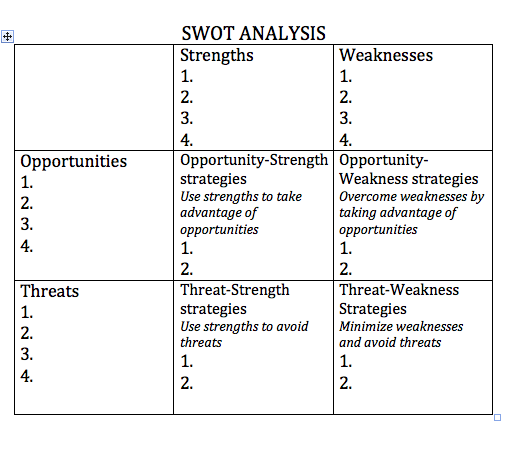
The framework splits analysis into four quadrants. Strengths and weaknesses are internal factors — resources, capabilities, brand perception, cost structure. Opportunities and threats are external — market trends, competitor moves, regulatory shifts, technology changes. Teams usually fill a 2×2 matrix in a workshop, then rank items by impact and certainty. The output is a visual map that shows where to invest, defend, explore, or monitor.
SWOT lists what a brand does well, what it does poorly, what chances exist in the market, and what risks could hurt it.
02What to do about it
Turn the matrix into a short‑term plan this week.
- Pick the top two strengths and align a campaign to amplify them.
- Assign an owner to fix the highest‑impact weakness within 30 days.
- Validate the biggest opportunity with a quick test (e.g., a landing‑page experiment).
- Create a monitoring dashboard for the most likely threat.
- Schedule a 30‑minute review with stakeholders to confirm priorities.
03How it is measured or noticed
You know the SWOT is working when the matrix drives concrete KPI changes. Track strength‑linked metrics (share of voice, repeat purchase rate) for growth. Watch weakness‑linked metrics (support ticket volume, churn) for decline. Measure opportunity tests by conversion lift or pipeline addition. Monitor threat indicators such as competitor ad spend spikes or regulatory filings. A quarterly refresh of the matrix should show movement in at least two quadrants.
How the record puts it
In strategic planning and strategic management, SWOT analysis is a decision-making technique that identifies the strengths, weaknesses, opportunities, and threats of an organization or project.
04Common mistakes
- Listing generic items like “good brand” without evidence.
- Treating the matrix as a one‑off exercise instead of a living document.
- Mixing internal and external factors in the same quadrant.
- Ignoring low‑certainty, high‑impact items because they feel speculative.
- Failing to assign owners and deadlines to each action item.
05Limits
SWOT does not replace quantitative models such as conjoint analysis or attribution modeling. It cannot capture dynamic interactions — e.g., a strength that becomes a threat when a competitor copies it. It is often confused with PESTLE (which only covers external macro factors) or Porter’s Five Forces (which focuses on industry structure). Use SWOT for quick alignment, not for precise forecasting.
06Worked example
"Our strength is a loyal community of 150k newsletter subscribers. The weakness is a 40% open‑rate drop after the last redesign. The opportunity is a rising demand for short‑form video tutorials. The threat is a new competitor launching a free AI‑generated content tool. We will A/B test a video series for the newsletter, assign a designer to fix the template, and set up a weekly alert on the competitor’s product updates."
The entry above is written by GetLoopLoop. What follows is what independent catalogues hold about the same term — none of it is the source of this page.
- Part of
- strategic management
- Kind of thing
- type of analysis, technique, analysis
The same term on Wikipedia
Catalogued in 60 languages07Frequently asked questions
How does SWOT differ from PESTLE analysis?
SWOT focuses on internal strengths and weaknesses plus external opportunities and threats for a specific brand, while PESTLE examines only macro‑environmental factors. Choose SWOT when you need an internal‑external view tied to your organization.
When should a marketing team run a SWOT instead of a competitive audit?
Run a SWOT when you need a quick, cross‑functional snapshot to align stakeholders; a competitive audit is deeper and slower. It depends on timeline and scope.
Who typically facilitates a SWOT workshop and what preparation is required?
A product manager or strategist usually facilitates, and participants should bring recent performance data and customer feedback. Preparation takes a few hours.
Does SWOT still add value in data‑driven organizations?
Yes, it structures qualitative insight that pure metrics miss, but it must be paired with quantitative validation. It depends on how rigorously the output is tested.
What happens if a SWOT misses a critical threat?
The brand may allocate resources to the wrong initiatives and lose market share before the gap is noticed. You would notice it through unexpected KPI drops.
How long before a SWOT’s recommendations show measurable impact?
Usually 4‑8 weeks for short‑term actions, while strategic shifts take a quarter or more. Track leading indicators weekly in the meantime.
Wikimedia Commons
Related visuals with source and licence credit

08Asked out loud
The same term in the words somebody uses speaking to an assistant rather than typing into a box — written from the situation, which is why each one carries the situation it came from.
Use a rapid SWOT template on your phone and fill in the four quadrants in under ten minutes. Focus on the top two items per quadrant to keep it actionable.
Open a shared note and list the four quadrants bullet‑style; it reads instantly and can be edited live. Highlight the two most urgent items for immediate discussion.
Extract the top three metrics from the report, map each to a quadrant, then validate with a colleague before the client call. This keeps the view concise and reduces blind spots.