

AI reads your page in pieces. Three free skills show which ones
Vectorscope, AI Search Audit Lite and AI Search Audit Full are open-source Agent Skills that run on your own agent. They show what a retriever keeps of a page, what it drops, and which published rules the page breaks, with no score and nothing sent to us.
The short answer
- what
- Three open-source Agent Skills at version 2.106: Vectorscope, which shows how a retriever reads one page; AI Search Audit Lite, which lists one page's problems; and AI Search Audit Full, which explains each problem, audits up to 50 pages and keeps a history.
- why
- Because AI assistants answer from passages, not pages, and most of the loss happens before any model reads a word. Classic SEO rules and AI-search readiness overlap, but they are not the same list.
- who
- Marketers who need to know whether a page can be quoted, SEOs who audit pages against Google, Bing and AI crawler rules, and developers who build or fix the pages.
- where
- On GitHub under the MIT licence, installable with one command into Claude Code, Codex, opencode and other agents that load SKILL.md skills, or as a zip for claude.ai.
- when
- Released in October 2026. The example runs quoted here were made on 16 and 17 October 2026, and every quotation was checked against its live source on 17 October 2026.
- how
- Deterministic Node scripts do the fetch, extraction, chunking and checks with no model or embedding calls; the agent running the skill writes the judgement parts, which the report marks as its own. Nothing is sent to GetLoopLoop.
In plain words
When you ask an AI assistant a question, it does not read whole websites. A program first downloads the page, throws away the menus and buttons, and cuts the rest into pieces about a page of a book long. It keeps only the first 26 pieces. The assistant then answers from those pieces. These three free tools let you see the pieces of your own page: which ones exist, which parts never made it into any piece, and which simple rules from Google and the AI companies the page gets wrong. They run on your own computer, with your own AI helper.
Ask an AI assistant about your product and it will not read your page. It will read a few pieces of it. Before any model sees a word, a crawler fetches the HTML, a cleaner throws away what looks like furniture, and a chunker cuts what is left into passages. A retriever then picks the passages that look like answers. Whatever did not survive those steps cannot be quoted, however good it is.
We built the Vectorscope to make that reading visible, and this month we released it, and two audits built on it, as open-source Agent Skills. They run on your own agent, on your own machine, free. The scripts call no model and no embedding API, and nothing is sent to GetLoopLoop. Below: what each one is for, what they found on real pages, our own included, and three simulations on synthetic pages.
Why now
The rules for being shown by search engines and the rules for being quoted by AI assistants have started to diverge, and the published documentation says so plainly.
Google's own guidance for AI Overviews and AI Mode ties them to ordinary Search. Its page AI features and your website sets one technical requirement:
To be eligible to be shown as a supporting link in AI Overviews or AI Mode, a page must be indexed and eligible to be shown in Google Search with a snippet.
Google Search Central, AI features and your website (last updated 10 December 2025)
The same page is equally direct about what is not needed. No special file, no new markup:
You don't need to create new machine readable files, AI text files, or markup to appear in these features.
Google Search Central, AI features and your website
In June Google added a note on llms.txt to its documentation updates: such files "aren't needed for Google Search", though it is fine to keep them for other systems. And some markup that used to earn a richer result no longer does. The FAQ rich result, which many sites added FAQPage structured data for, is gone:
This feature will no longer appear in Google Search starting May 7, 2026.
Google Search Central, documentation updates, entry of 8 May 2026
Meanwhile the AI companies run several crawlers each, and they do different jobs. OpenAI's crawler documentation separates OAI-SearchBot, which decides whether a site can appear in ChatGPT's search answers, from GPTBot, which collects training data, and says that "each setting is independent of the others". Anthropic describes ClaudeBot, Claude-User and Claude-SearchBot the same way, and Perplexity documents PerplexityBot for search and Perplexity-User for requests a person makes.
Sites that are opted out of OAI-SearchBot will not be shown in ChatGPT search answers
OpenAI, Overview of OpenAI crawlers
Disabling Claude-SearchBot on your site prevents our system from indexing your content for search optimization
Anthropic, Does Anthropic crawl data from the web, and how can site owners block the crawler?
So a page can pass an SEO checklist and still be invisible to an assistant, because one line in robots.txt blocks the crawler that answers people. And it can pass every crawler rule and still lose its best paragraph past the point where the retriever stops reading. The two lists overlap; they are not the same list. The skills check both, locally.
An assistant quotes a passage, not a page
The figure below is the pipeline the Vectorscope reproduces, with the real character counts from the skill's three committed example runs of 17 October 2026: our own Vectorscope page, MDN's guide to HTTP caching, and Wikipedia's article on large language models.
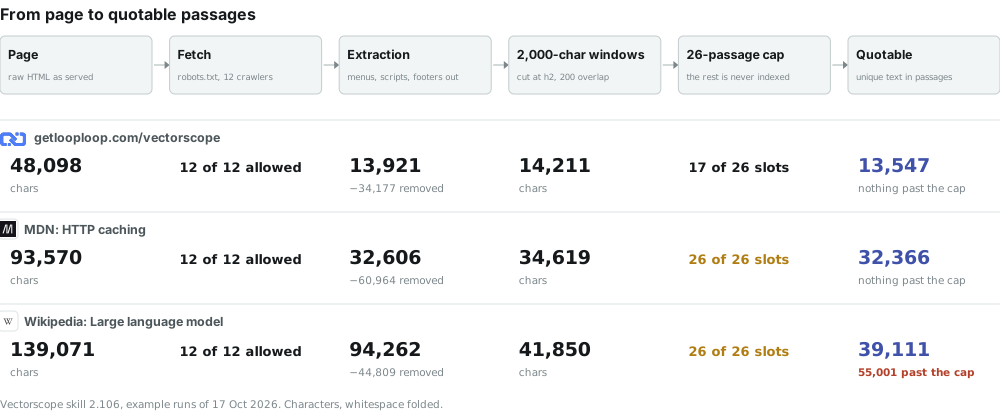
Most of what a crawler downloads is not text: on our page, 32,534 of the 34,177 removed characters were scripts and styles. What the cleaner keeps is cut at h2 headings into windows of at most 2,000 characters, with 200 of overlap, and at most 26 passages per page are indexed. MDN fills every slot and ends exactly there. Wikipedia fills every slot and keeps going for 55,001 characters that no passage holds.
The 26 is the Vectorscope's cap, not a number any assistant publishes. A fixed, known cap makes the question measurable: which part of this page would a capped retriever never reach? (More in the glossary: chunking and retrieval-augmented generation.)
Vectorscope: how a retriever reads one page
What it does. The Vectorscope skill runs the product's exact fetch, extraction, chunking and 26-passage cap on any public URL, checks robots.txt for twelve crawlers from GPTBot and OAI-SearchBot to Claude-SearchBot, PerplexityBot, Google-Extended and CCBot, with RFC 9309 matching, and runs structure checks: FAQ answers that lost their questions, passages that start mid-sentence, menu lines inside the text, thin sections, a claim repeated everywhere, canonical, JSON-LD and meta description.
What differs from the web tool. The web Vectorscope groups passages by their embeddings. The skill makes no embedding calls, so the agent running it reads the passages and groups them by subject, and the report says so on every group.
Who it is for. Writers who want to know whether a page's key paragraphs reach a passage at all, SEOs explaining why a long page underperforms in AI answers, and developers who want to see what their markup does to the text.
What the report shows. One self-contained HTML file in English or Ukrainian. Every number is tagged measured, derived (a fixed formula) or judgement (the agent's), and a "?" beside it opens the formula. A folded section, Where the text goes, follows the characters from raw HTML to passages: what the cleaner removed, element by element, and how much of each section reached a passage. Then the agent's part: topic groups, a test of 5 to 10 typical questions with the exact words a retriever could quote, and a rewrite plan with before and after text. Compare mode puts 2 to 5 pages on one topic table.
Here is the folded section for Wikipedia's article on large language models, read on 17 October 2026.
Try it on your own page
See what Vectorscope finds on a page of yours
Everything above is measurable on your own work, and the check takes about a minute. Paste one address and read what comes back.
Open VectorscopeFree · no account · one at a time
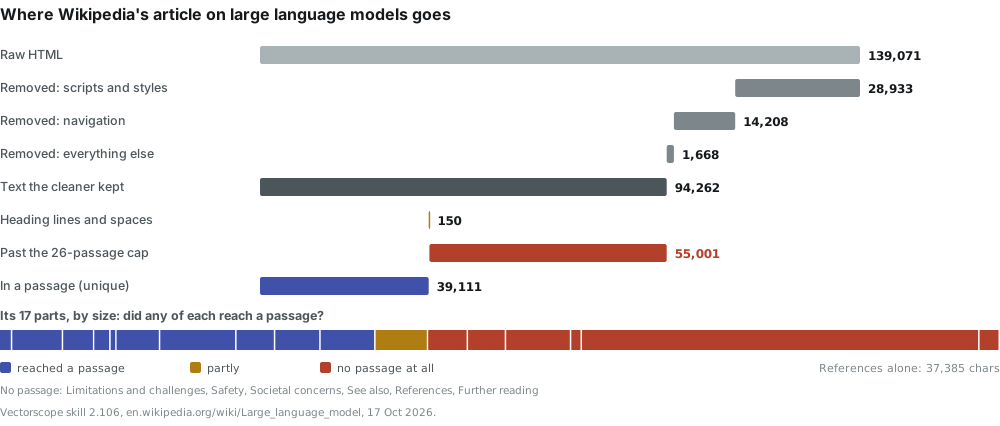
The fair reading of this figure matters, because a number like "55,001 characters lost" is easy to overstate. Of the six parts that reach no passage, References is 37,385 characters on its own, and nobody needs a retriever to quote a reference list. But three of them are prose: Limitations and challenges, Safety and Societal concerns, 13,448 characters together, and Evaluation reaches a passage for 3,801 of its 4,952. A capped retriever reading this article in page order would know a great deal about how language models are built and nothing about what is wrong with them. That is the kind of finding the tool exists for: not a score, but a place.
Our own Vectorscope page, read the same day, needs 17 passages and loses nothing to the cap. It is not clean, though. The skill flags two passages that start mid-sentence, a run of six menu lines inside the text (the pipeline's own step labels, "1. Fetched" to "5. Grouped"), a 139-character section too short to stand on its own, and one phrase repeated across three topic groups. We are leaving those in the example on purpose.
AI Search Audit Lite: one page against the published rules
What it does. Lite checks one public page against the rules Google, Bing and the AI companies publish, with the Vectorscope reading alongside: robots.txt for search and AI crawlers, noindex and snippet controls, the sitemap; a 35-cell Google and Bing checklist, from title length and heading order to broken links, images, URL variants and response headers; structured data against the properties Google lists, with retired rich results dated; language versions, each hreflang alternate fetched to see whether it links back; and E-E-A-T presence, meaning whether an author, About and Contact links and the organisation's details exist, not a judgement of the expertise behind them.
Three readings only an AI can make. The agent running the skill writes 8 to 12 questions people ask about the topic, and the script checks each against a passage with a verbatim quote. The agent's model then answers five buyer questions about the brand from its own knowledge, and states what it believes about the brand's ratings on twelve review platforms plus one invented control platform: a rating for a platform that does not exist is a hallucination. This is one model's view, labelled with its name; the web Brandscope and Reviewscope ask three assistants.
What it does not do. Each problem is a short label, a severity and a place on a map of the page. No score, no advice. A list of errors with evidence is something two people can agree on; a score invites an argument about the weights.
Who it is for. Anyone who has to answer "is anything broken on this page?" and hand the list to whoever fixes it.
Lite ships with five real runs, made on 17 October 2026. Three of them are our own pages.
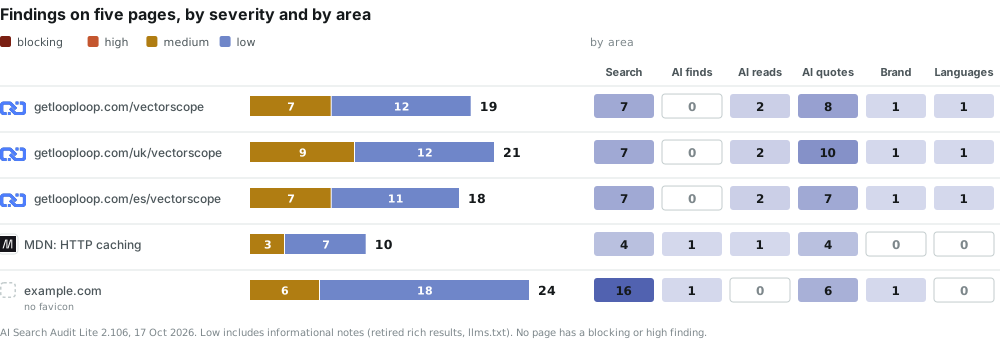
Our English Vectorscope page has 19 findings, none blocking. The two most concrete are embarrassing in the useful way: two links from the page to articles that return 404, and SoftwareApplication markup missing the fields Google requires for that type. The page also still carries FAQPage and HowTo markup for rich results Google no longer shows, which Lite reports as informational rather than as an error. Two of the twelve questions the agent wrote have no answer anywhere on the page. And the model that ran the audit, Claude Opus 5.5 in Claude Code, did not know GetLoopLoop from its own knowledge and said so: the audit records that as brand_unknown, which is the honest outcome for a young product, and a reason to make the page answer what a model cannot.
example.com, the reserved documentation domain, has the most findings, 24, mostly the absence of things a real site would have: no h1, no description, no favicon, http and www variants that do not redirect. MDN has the fewest, 10, and its medium findings are about the reading, not the rules: six passages start mid-sentence.
AI Search Audit Full: the explanation, the site and the history
Full runs every Lite check and adds what a specialist needs in order to act.
Three layers per problem. What goes wrong, in plain words, with no advice. What the rule says, a short verbatim quote from the official source with its link and the date it was checked, or a note that the threshold is the skill's own where nobody publishes one. And a fix direction, terse and technical, folded inside the details for specialists. Release 2.106 carries 83 quotes, each matched word for word against its live page on 17 October 2026.
Up to 50 pages. From a URL list or a sitemap, read one at a time, at least a second apart, and only where robots.txt allows. The site report adds problems repeated across pages and checks only a set of pages can make: duplicate titles, orphan pages, link depth, hreflang pairs, canonical chains.
Before/after and history. --compare old-export.json gives fixed, new and unchanged findings. Every run is also saved as a snapshot on your machine, so each report shows what changed since the last one, down to the passages.
Its example is a three-page site audit of getlooploop.com: the Vectorscope page in English, Ukrainian and Spanish.
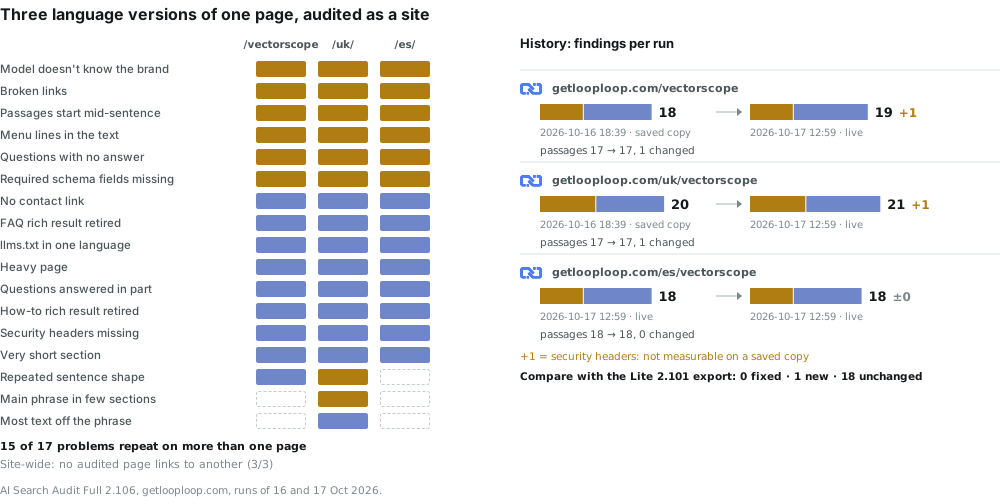
Fifteen of the seventeen problem types repeat on more than one page, which is the practical value of a site report: a problem that appears on every language version is one fix in a template, not three tickets. The site-wide check found something no single-page audit can: none of the three versions links to another, so each one is an orphan within the audited set. (The skill adds the caveat itself: a page may be linked from outside the set.)
The history needs a careful reading. Between the two runs /vectorscope went from 18 findings to 19, and nothing got worse: the first run read a copy saved the day before, a saved file has no HTTP response headers, so the headers check was reported as not measured; the live run measured them and found three security headers missing. The drift shows the words going from 2,463 to 2,469 and the one passage of 17 that changed. The compare against a Lite 2.101 export of the same page says the same in its own terms: 0 fixed, 1 new, 18 unchanged, the new one being the check 2.102 added.
For the page's FAQ markup, the explanation says the markup does no harm but no longer earns the result it was added for, quotes Google's documentation updates with the link and the date checked, and gives the specialist a direction: nothing required for Google; keep it if another consumer reads it, or remove it to lighten the page.
Which one to run
The three skills share a core. Lite and Full carry the Vectorscope's reading code unchanged, so a passage count or a past-the-cap figure means the same thing in all three reports. They differ in the question they answer.
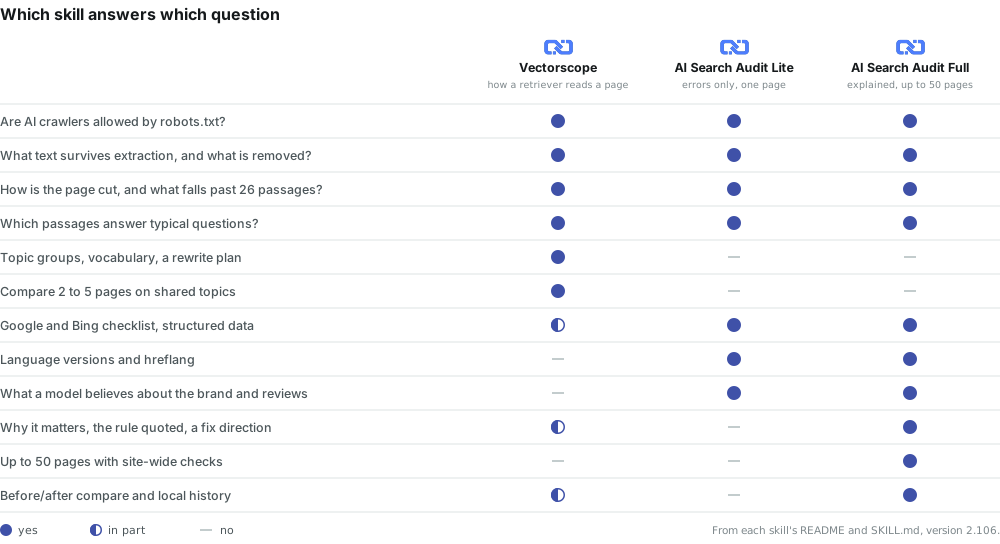
- A marketer or content lead with one page that matters wants the Vectorscope: which paragraphs reach a passage, which questions the page answers in quotable words, and how to rewrite the weak ones.
- An SEO wants Lite for the list and Full for the report: the rule quoted from its source settles "says who?", and the site report turns fifty pages of findings into a few template fixes.
- A developer gets Full's fix directions, and the Vectorscope's removals table, which names each removed element, its CSS path and its characters.
Three simulations on synthetic pages
Real pages show what the tools find; synthetic pages show how they behave, because you can change one thing and watch one finding appear or go. We wrote small HTML pages on a fictional topic, home bicycle maintenance, at the reserved domain example.com, and ran each through AI Search Audit Lite 2.106 in saved-copy mode (--html for the page, --robots for robots.txt): nothing fetched, no model called, the same numbers on any machine. The text comes from sentence templates, and the tool notices: every page draws a repeated_sentence_shape finding, which is correct and stays in the counts.
1. A 40-section guide against the 26-passage cap
One page, 40 h2 sections of about 1,400 characters each, from tyre pressure to a pre-ride check. Every section fits in one window, so the page needs 42 passages: one for the title, one for the lede, and one per section.
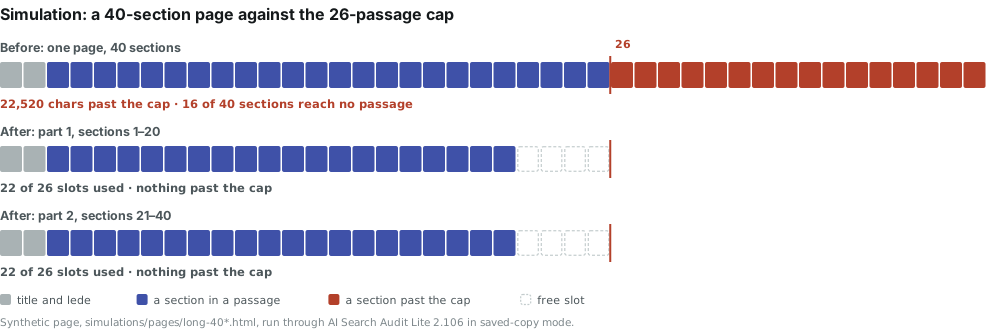
The cap cut the guide after section 24. Sections 25 to 40, from Saddle setback to A pre-ride check, reach no passage: 22,520 of the 56,789 characters the cleaner kept. Lite reports it as its only high finding, cap_overflow, and its verdict line reads "1 problem hides text from AI". Split into two pages of 20 sections, each part uses 22 of 26 slots, nothing is past the cap, and the high finding is gone: 8 findings before, 7 per part after, the rest being the template finding and the markup a synthetic page lacks. Splitting is not the only fix; moving the sections people ask about higher changes which 24 make it in. On a long page, order is a decision about what a capped retriever will never read.
2. robots.txt that blocks the wrong crawler
A short ordinary page, run twice with two robots.txt files. The first blocks two crawlers and allows everyone else:
User-agent: OAI-SearchBot
Disallow: /

User-agent: ClaudeBot
Disallow: /

User-agent: *
Allow: /| robots.txt | Findings | Blocking | What the audit says |
|---|---|---|---|
| Blocks OAI-SearchBot and ClaudeBot | 8 | 1 | OAI-SearchBot blocked (blocking); ClaudeBot blocked (low) |
| Allows everyone | 6 | 0 | Nothing about crawlers |
The two blocks are not weighed the same, and that is the point. Blocking OAI-SearchBot keeps the page out of ChatGPT's search answers, so Lite marks it blocking and its verdict reads "1 problem blocks search or AI". Blocking ClaudeBot only stops a training crawler: Anthropic's search crawler, Claude-SearchBot, has its own token and is still allowed by the * group. So Lite reports it as low, a choice the owner may have made on purpose. Each finding links to the vendor's crawler page, so the reader can check the distinction for themselves.
3. FAQ answers that lose their questions
Six questions and answers in an accordion. In the first version each question is the label of a <button> that opens its panel, a common pattern. In the second, each question is the <summary> of a <details> element. The visible page is the same.
| Markup | Findings | High | Characters removed | What the passage holds |
|---|---|---|---|---|
| Questions in <button> | 4 | 1 | 402 | 6 answers, 0 questions |
| Questions in <summary> | 3 | 0 | 146 | 6 answers with their questions |
A retriever's cleaner removes buttons, because on most pages a button is furniture: "Subscribe", "Accept cookies", "Next". Here that rule takes the questions with it. The difference in removed characters, 256, is exactly the length of the six questions. What is left is a passage of answers that begin "Yes, if your bike has carbon parts" and "No, not for long", with nothing to say what they answer. The skill's lost_faq_questions check catches it as high: six answer openers and no question mark in the passage. With the questions in <summary>, the finding is gone.
We also wanted to simulate hreflang that does not point back, and left it out. That check fetches each alternate, saved-copy mode fetches nothing, and the skill refuses local addresses on purpose, so a simulation would have been our script, not the skill.
Install and run
Each skill needs Node 20.18 or later and no npm install: the scripts are bundled. With the skills CLI, one command installs a skill for Claude Code, Codex, opencode and other agents that load SKILL.md skills:
npx skills add Olexan-art/getlooploop-skills --skill vectorscope
npx skills add Olexan-art/ai-search-audit
npx skills add Olexan-art/ai-search-audit-full
Then ask your agent in plain words: "run vectorscope on https://example.com/page" or "an AI search audit of https://example.com/page". For claude.ai and the Claude desktop app, download the release zip (vectorscope.zip, ai-search-audit.zip or ai-search-audit-full.zip), turn on code execution, and upload it under Customize > Skills without unpacking it. The sandbox needs network access to the site it reads; each README gives the settings.
The repositories, all MIT-licensed: getlooploop-skills for the Vectorscope, ai-search-audit for Lite and ai-search-audit-full for Full. The setup is also on Agent Skills for SEO, GEO and marketing teams. Under the hood the agent runs two scripts, with its own judgement files in between:
node dist/read.mjs https://example.com/page --out reading.json
# the agent writes questions.json, brand.json and reviews.json
node dist/audit.mjs reading.json --questions questions.json \
  --brand brand.json --reviews reviews.json --html report.html

# no network: audit a saved copy instead
node dist/read.mjs https://example.com/page --html page.html \
  --robots robots.txt --out reading.json

# Full only: up to 50 pages, then a site report
node dist/read.mjs --urls urls.txt --out-dir readings
node dist/audit.mjs --site readings/site.json --questions-dir questions --out-dir report
What they don't do
- No score. None of the three ranks a page or gives it a number out of 100. They report findings, each with its evidence and the rule it rests on.
- No predictions. They do not say what ChatGPT, Gemini or Perplexity will answer about you. The brand and review readings are one model's knowledge at its training time, labelled with that model's name, and not a measurement of any assistant.
- No detection of AI-written text. The writing-pattern checks count stock phrases and repeated sentence shapes, with positions. They are signals for an editor, not a verdict on who wrote the page.
- The judgement layers are one agent's reading. The topic groups, the questions, the verdicts on whether a passage answers them, and the rewrite plan are written by the agent running the skill. The scripts validate them (every quote must be verbatim from its passage) and the report marks them, but another model could group the same passages differently.
- No field data and no index status. Core Web Vitals and "is this page in Google's index" are always reported as not measured: they need real-user data and Search Console.
- Only public pages. No login, no cookies, no local or private addresses. Every cap (30 links, 20 images, 10 language versions, 50 pages) is named in the report, never applied silently.
Where the live product goes further
The skills answer what a page is, today, to a machine reading it. They cannot answer what the assistants people use actually say, and how that moves. That is what GetLoopLoop does: it asks real assistants the questions your buyers ask, on a schedule, and records which brands and pages they cite, so you see your share of answers over weeks rather than one model's opinion once. The web Vectorscope adds the embedding-based map the skill deliberately leaves out, and Brandscope and Reviewscope ask three assistants instead of one. How we measure is written down in the methodology.
But start with the page. Run one of the skills on the page that matters most to you, read where its text goes, and fix the first thing it finds. If our own pages are any guide, there will be something.
The product
Watch it on every page, every day
One reading tells you where a page stands today. The product asks the same questions of the same assistants continuously, so a change is something you are told about rather than something you go looking for.
Request an invitationInvite-only while we keep the readings honest
On this topic
Is my page ready for AI search?
Every day Crawls with the Vectorscope reading beside every page, re-checked after each fix. How the product works
Author
Olexandrauthor
15+ years in marketing and SEO. Dozens of products, mostly the US market. Research and measurement.
LinkedInPass it on
Read in your language
Opens a browser translation of this English article. The original source stays in English.