

We crawled 190 SEO sites: what they tell AI bots and what their servers do
A GLLmolfar crawl of 190 SEO publications, tool blogs and agencies: who blocks AI crawlers and why, where robots.txt and the server disagree, who has llms.txt, and the technical basics on 6,442 pages.

The short answer
- what
- A crawl of their robots.txt, llms.txt, server answers to AI crawlers and 6,442 pages of HTML.
- why
- SEO sites set the advice the rest of the web follows, so their own files show what that advice looks like in practice.
- who
- 190 sites that publish about search: news outlets, SEO tool blogs, experts, agencies and official search blogs.
- where
- Six groups of sites in English, German, French, Spanish, Polish and Ukrainian.
- when
- Crawled on 4 November 2026, five days after Google and Microsoft backed a shared AI training token.
- how
- GLLmolfar's crawl engine at its defaults, 50 pages a site, with robots.txt read for 14 AI crawlers.
In plain words
We sent a robot to visit 190 websites that write about search engines, and looked at the signs on their doors for AI robots. Most sites let AI robots in. The few that keep AI out mostly use a sign their web host printed for them. Some sites say "come in" on the sign but shut the door anyway. About a third leave a special note for AI called llms.txt. Their articles are well labelled, but many pages still have small faults, like links a screen reader cannot name.
Sites that write about search are the ones the rest of the web copies. So we pointed GLLmolfar at 190 of them on 4 November 2026 and read what they actually serve: news outlets such as Search Engine Roundtable and PPC Land, the blogs of Ahrefs, Semrush, Moz and 62 more tool makers, experts, agencies, Google's and Microsoft's own search blogs, and SEO sites in five other languages.
For each site we read robots.txt for the 14 AI crawlers the app tracks, fetched llms.txt, requested the start page as a browser and as four AI crawlers, and crawled up to 50 pages from the news or blog section. 156 sites answered with HTML; that gave 6,442 pages, 1,643 of them articles from 111 sites.
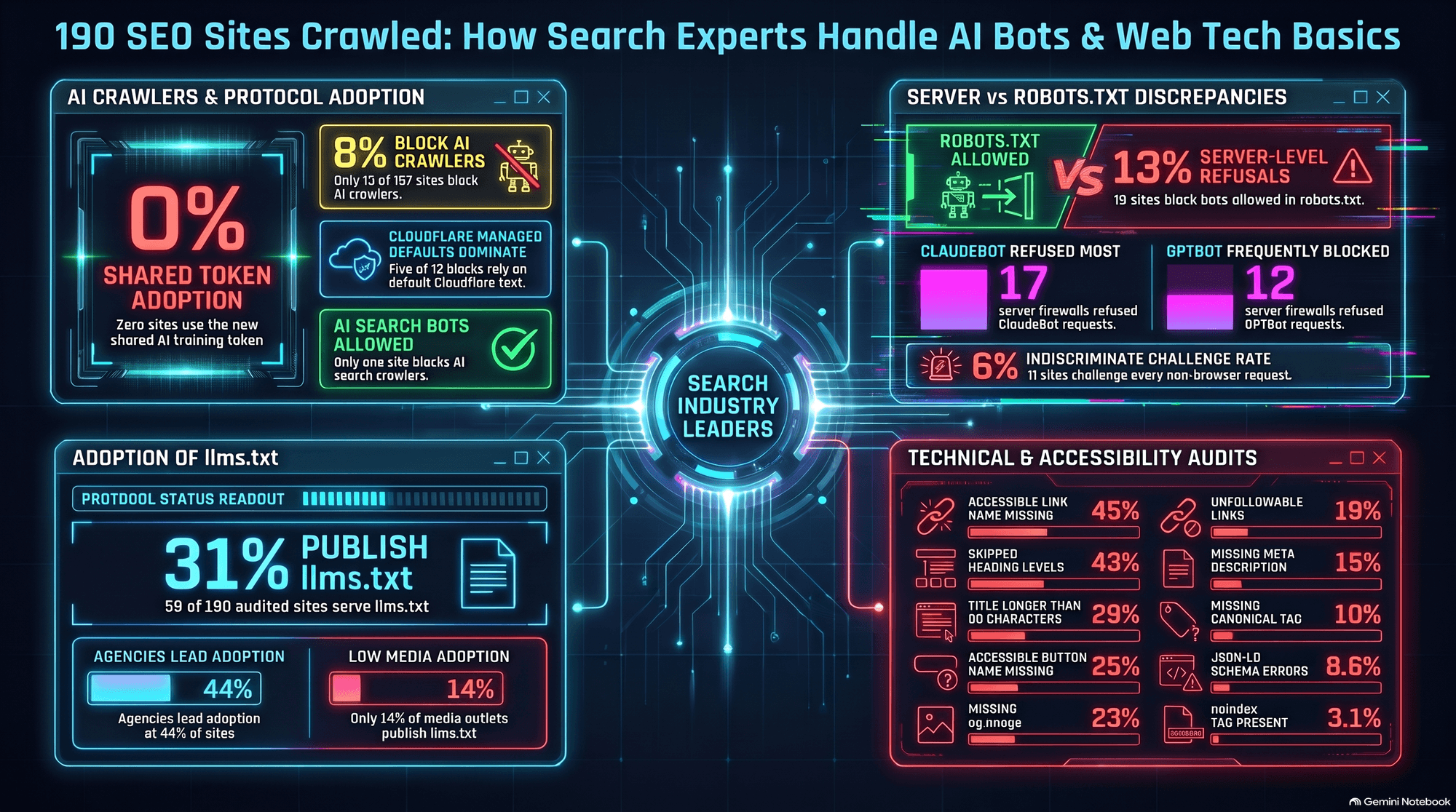
| Measure | Result | Base |
|---|---|---|
| Sites that use the shared __usage_ai-training token | 0 | 157 robots.txt files |
| Sites that block at least one AI crawler in robots.txt | 13 (8%) | 157 |
| …of them, with Cloudflare's managed robots.txt | 5 | 13 |
| Sites that block an AI search crawler (OAI-SearchBot, PerplexityBot, Claude-SearchBot) | 1 | 157 |
| Sites that refuse an AI crawler their robots.txt allows | 19 (13%) | 147 that answered a browser |
| Sites that challenge every non-browser request | 11 (6%) | 190 |
| Sites with an llms.txt | 59 (31%) | 190 |
| Articles with an Article-family schema type | 94% | 1,643 articles |
1. Five days in, nobody uses the shared training token
On 30 October Google and Microsoft backed a shared robots.txt token that opts a site out of AI training across providers: a group for User-Agent: __usage_ai-training. On 4 November not one of the 157 robots.txt files we could read contained it. None of the home pages carried Bing's new ai-training or ai-grounding values in a robots meta tag either.
That is not a verdict on the token — Google says it aims to support it in 2027 — but it is a useful baseline. If you add it now, you are ahead of every SEO publication we looked at.
Twelve sites already use a different mechanism: a Content-Signal line, the format Cloudflare promotes. Five of them carry Cloudflare's managed text word for word (search=yes, ai-train=no, use=reference). Three say the opposite — ai-train=yes, ai-input=yes — and invite AI use explicitly. Three allow AI answers but not training, and one refuses both.
2. Most AI blocks are someone else's default
Only 13 of 157 sites block any AI crawler in robots.txt. The blocks are concentrated in one group: 7 of 22 marketing and media outlets block GPTBot, against 1 of 57 tool vendors. Five of the 13 blocking files contain the line # BEGIN Cloudflare Managed content and the same list of eight training crawlers — GPTBot, ClaudeBot, Google-Extended, Applebot-Extended, CCBot, Bytespider, meta-externalagent and Amazonbot. Those sites did not write a policy; they turned one on.
Every one of the 11 sites that block GPTBot leaves OAI-SearchBot open. The split between training and answering, which took a year of argument, is now the default shape: only one site in the sample, WebmasterWorld, blocks an AI search crawler at all.
AI crawlers blocked in robots.txt, sites out of 157
Try it on your own page
See what Vectorscope finds on a page of yours
Everything above is measurable on your own work, and the check takes about a minute. Paste one address and read what comes back.
Open VectorscopeFree · no account · one at a time
The lists are also old. 15 robots.txt files name anthropic-ai or Claude-Web, tokens that Anthropic's current crawler documentation does not list; 13 of them name ClaudeBot as well. Only 5 name Claude-SearchBot and 6 name Claude-User, the two agents that fetch pages for Claude's answers. A robots.txt that was copied once and never revisited says no to crawlers that no longer come and nothing to the ones that do.
3. robots.txt says yes, the server says no
We then asked each start page for its HTML four more times, with the user agents of GPTBot, ClaudeBot, PerplexityBot and OAI-SearchBot. Of the 147 sites that answered a browser, 19 (13%) refused at least one AI crawler that their own robots.txt allows: a 403, a 429 "too many requests" on the first request, or a Cloudflare block page. ClaudeBot was refused most often.
Start page refused to an AI user agent, sites out of 147
Read this with one caution. Our requests carried the crawlers' names but came from our own address, not from the crawlers' published IP ranges, and some firewalls block exactly that: a request that claims to be GPTBot from somewhere GPTBot never crawls from. So a refusal here does not prove the real crawler is refused. What it does prove is that robots.txt is not the whole policy. The rules that decide whether an AI crawler gets a page often sit in a firewall or a CDN that a robots.txt audit never sees, and the only place to check them is your server logs.
4. Some SEO sites cannot be audited by an SEO crawler
Eleven sites (6%) answered every request that did not come from a real browser with a Cloudflare challenge — our crawler's own user agent and a browser user agent from a plain HTTP client alike. They include Search Engine Land, Search Engine Watch, Neil Patel, WordStream, The Drum and Marketing Week. Two more, Marketing Dive and Social Media Today, served the browser user agent and challenged the crawler's.
Three of the eleven publish an llms.txt for AI systems, and one of them says ai-train=yes, ai-input=yes in its robots.txt. The invitation is written in one layer and withdrawn in the next. Verified crawlers from Google, Bing and OpenAI may pass the check; a desktop SEO crawler, a monitoring script or a smaller AI service will not.
5. One in three has an llms.txt, and they are not alike
59 of 190 sites (31%) serve an llms.txt. Agencies lead with 11 of 25 (44%), then tool vendors with 26 of 65 (40%); 4 of 29 media outlets have one, and among the official search blogs only Microsoft Advertising does.
The files disagree about what llms.txt is for. The median file lists 65 links, the smallest 4. Six list more than 500, and one nearly 5,000 — a sitemap with a different name, which defeats a format meant to point a model at the few pages that explain a site. Two sites publish an llms.txt and block the training crawlers in robots.txt, which is the consistent version of the policy: answer from my pages, do not train on them.
Sites with an llms.txt, % of each group
6. The articles are well marked up — except for Discover
On the 1,643 articles the crawl found, the trust signals are nearly universal: 94% carry an Article-family schema type, 95% name an author, 88% describe the author as a Person, and 91% state a modified date. The median article is 1,978 words with 7 H2 headings and 8 links out to sources; 57% have at least one heading phrased as a question.
The gap is in the robots meta tag. A third of the articles (33%) do not carry max-image-preview:large, the setting that lets Google Discover show a large image. Among news outlets, 126 of 196 articles are typed NewsArticle; the rest use the generic Article.
7. The basics, on 6,442 pages
Across every HTML page the crawl read — articles, category pages, landing pages — the familiar faults are still there, and the ones that matter for assistive technology are the most common.
| Check | Pages affected |
|---|---|
| A link with no accessible name (no text, alt or aria-label) | 45% |
| A heading level skipped (H2 then H4) | 43% |
| Title longer than 60 characters | 29% |
| A button with no accessible name | 25% |
| No og:image | 23% |
| Links search engines do not follow (javascript: or no href) | 19% |
| No meta description | 15% |
| No canonical tag | 10% |
| JSON-LD with an error | 8.6% |
| noindex | 3.1% |
The JSON-LD errors cluster in three places: breadcrumb items without a position (180 pages), JSON-LD that does not parse at all (115 pages), and SoftwareApplication markup on tool pages without a rating or review (102 pages), which makes it ineligible for the rich result it was added for.
The pages are heavy but fast. The median HTML document is 178 KB before any script or image, and one in ten is over 554 KB; the median server answered in 300 ms, one in ten took over 1.3 seconds.
What to do with this
1. Decide training and answers separately, per crawler. Write the decision in robots.txt, and if you want the shared token, add the __usage_ai-training group now. 2. Check that the server agrees with robots.txt. Look for GPTBot, ClaudeBot, Claude-SearchBot, OAI-SearchBot and PerplexityBot in your logs, and for 403 and 429 answers to them in your CDN or firewall. 3. Prune the old tokens. Replace anthropic-ai and Claude-Web with the agents that exist today. 4. If you turned on a managed robots.txt, read it. It is a policy with your name on it. 5. Keep llms.txt short. A handful of links to the pages that explain what you do, not your sitemap. 6. Add `max-image-preview:large` to articles if you want Discover traffic. 7. Give every link and button a name. It is the most common fault in this sample and the cheapest to fix.
How this was measured, and its limits
The list of 190 sites is ours: news and trade outlets, SEO tool blogs, experts, agencies, the official search blogs, and SEO sites in German, French, Spanish, Polish and Ukrainian. 34 sites gave no HTML (a challenge, a 404 at the address we used, or no answer) and are left out of the page figures. The crawl took up to 50 pages a site from its news or blog section, so the page figures describe those sections, not whole sites. JavaScript was not run; word counts are of the HTML as served. robots.txt was read for 14 AI crawlers; the AI user-agent requests were made once, from one address.
Everything here can be repeated in GLLmolfar: the AI readiness view reads robots.txt for each AI crawler and checks llms.txt, and the Issues view lists the page checks above for any site you crawl.
Questions about this study
Do SEO sites block AI crawlers?
Mostly not. 13 of 157 sites whose robots.txt we read block at least one AI crawler, and the blocks are almost all training crawlers. Only one site blocks an AI search crawler.
Has anyone adopted the shared AI training token yet?
Not in this sample. On 4 November 2026 none of 157 robots.txt files contained a User-Agent: __usage_ai-training group, five days after Google and Microsoft backed it.
Why can a site refuse a crawler that its robots.txt allows?
Because a firewall or CDN can block by user agent, address or rate before robots.txt is ever consulted. 19 of 147 sites refused an AI user agent their robots.txt allows; some of those refusals may target requests that only claim to be the crawler.
How many SEO sites have an llms.txt?
59 of 190, or 31%. Agencies and tool vendors lead; media outlets and official search blogs mostly have none. The median file lists 65 links.
What is the most common technical fault on SEO sites?
Links without an accessible name, on 45% of the 6,442 pages crawled, followed by skipped heading levels on 43%.
The product
Watch it on every page, every day
One reading tells you where a page stands today. The product asks the same questions of the same assistants continuously, so a change is something you are told about rather than something you go looking for.
Request an invitationInvite-only while we keep the readings honest
On this topic
Do AI assistants mention us?
Every day The same questions asked of real assistants on a schedule, every answer kept in the evidence store. How the product works
Author
Olexandrauthor
15+ years in marketing and SEO. Dozens of products, mostly the US market. Research and measurement.
LinkedInPass it on
Read in your language
Opens a browser translation of this English article. The original source stays in English.