

What Agent Skills Are and Why They Matter for Marketing Teams
A plain-language guide to reusable agent procedures, what makes a skill useful and how a search or marketing team should review one.
The short answer
- what
- Agent skills package reusable instructions, references and checks for a defined workflow.
- why
- Explicit procedures reduce forgotten checks and make an agent's work easier to review.
- who
- Search and marketing teams that use AI agents for recurring work.
- where
- Skills live in directories with instructions and optional scripts, references or assets.
- when
- Use a skill when a task repeats often enough to deserve a reviewed procedure.
- how
- Choose one scoped task, inspect the files and keep human decisions and evidence visible.
In plain words
A skill is a small guide that helps an AI agent do a repeat job in the same careful way. It can include instructions and files. People should still read it before letting it change anything important.
A skill is a reusable way of working
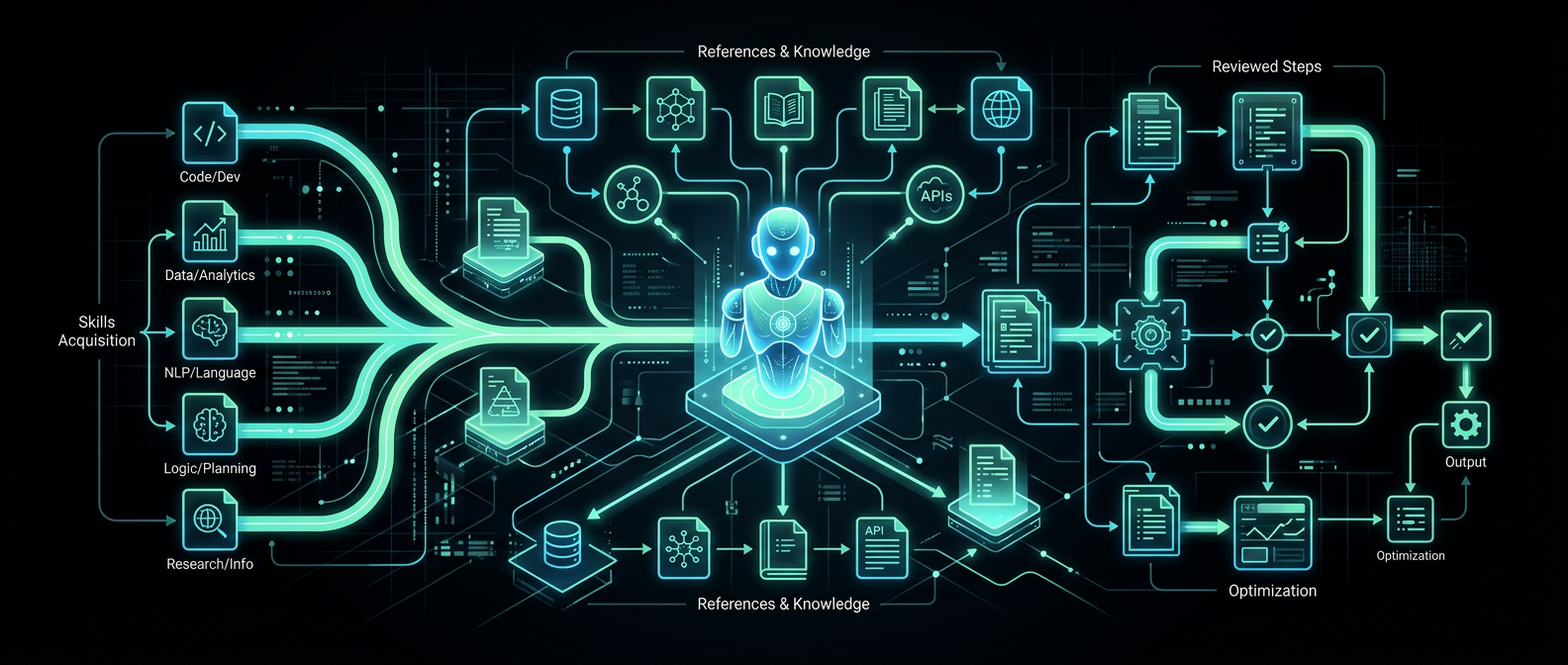
An AI agent can write, browse, call tools and change files. That does not mean it knows how your team wants each recurring job done. A skill gives the agent a small package of procedural knowledge: what the task is for, when to use it, which steps matter, and which checks stop a plausible result becoming a bad one.
In practical terms, a skill is often a directory with a SKILL.md file and optional scripts, references or assets. The Agent Skills specification describes this structure, and Anthropic's documentation explains how a skill's frontmatter and instructions help an agent decide when it applies. Read the format.
The useful mental model is not “a prompt saved in a folder.” A good skill is a repeatable working agreement. It turns a task that otherwise depends on someone remembering the right questions into a procedure an agent can follow and a person can review.
Why skills matter for search and marketing work
Search and marketing teams repeat more procedures than they usually name: inspect a page before changing it, turn a brief into a structured outline, check redirects, read a Search Console export, compare a claim with a source, or prepare a clean handover. An agent can help with each of these, but the quality depends on the instructions, context and guardrails it receives.
Skills make those choices explicit. A skill can say which source is authoritative, which output format is expected, when a human must decide, and what a good result cannot claim. That last part is often more valuable than a clever prompt. It keeps the agent from turning a partial observation into a confident conclusion.
Anthropic's current platform documentation describes skills as reusable, filesystem-based expertise for domain-specific workflows. See the platform documentation. The shared format is useful because the procedure can be reviewed as text rather than hidden in a chat history.
Try it on your own page
See what Vectorscope finds on a page of yours
Everything above is measurable on your own work, and the check takes about a minute. Paste one address and read what comes back.
Open VectorscopeFree · no account · one at a time
A useful skill has three visible parts
What makes a skill worth installing
Start with scope. The best skills do one coherent job and name the moment that job begins. A vague skill that claims to “improve SEO” forces the agent to guess. A focused skill that checks internal-link evidence before drafting recommendations gives it a concrete route.
Then inspect the files. Instructions are code-adjacent: they influence what an agent reads, writes and runs. The Agent Skills specification allows bundled resources such as scripts and reference documentation, which makes review more important, not less. Read what will execute. Check whether a skill asks for credentials, downloads code, changes production files or makes outbound requests.
Finally, keep provenance visible. The Skills directory at GetLoopLoop does not mirror other people's files. It reads public listings from skills.sh, keeps the source link on each row, records the directory's install counts and audits as their data, and labels our own categories and trends as ours. Browse the Skills directory.
| A strong skill | A risky skill |
|---|---|
| Names one job and when to use it | Promises a broad outcome without a procedure |
| Shows instructions, scripts and references | Hides important actions behind vague wording |
| Separates facts, assumptions and human decisions | Treats generated text as verified evidence |
| Can be reviewed before installation | Requests access that the task does not require |
Skills are not a replacement for judgement
A skill can preserve a process, but it cannot make a weak process sound. If the source data is incomplete, if the instruction is vague, or if the decision needs business context, a person still has to own the call. The right aim is a more repeatable first pass: fewer forgotten checks, clearer handovers and a traceable way to improve the procedure next time.
That is especially important in SEO and AI search. A recommendation should say whether it came from a measured fact, a derived calculation or a modelling choice. The language may be generated, but the basis should be inspectable. Skills are most valuable when they make that discipline easier to repeat.
Tomorrow we will publish a practical companion to this guide: how to read a skills directory without confusing install count, audit status and editorial judgement.

Questions people ask about agent skills
Are skills the same as prompts?
A skill contains instructions, but it is designed to be reusable, triggered for a defined job and optionally accompanied by scripts or references.
Should I install a skill without reading it?
No. Treat instructions and bundled scripts as something that can affect your files, tools and data. Review the scope and permissions first.
Can a skill improve SEO automatically?
It can make a repeatable SEO procedure easier to run. It cannot replace evidence, editorial judgement or a clear business decision.
The product
Watch it on every page, every day
One reading tells you where a page stands today. The product asks the same questions of the same assistants continuously, so a change is something you are told about rather than something you go looking for.
Request an invitationInvite-only while we keep the readings honest
On this topic
Do AI assistants mention us?
Every day The same questions asked of real assistants on a schedule, every answer kept in the evidence store. How the product works
Author
Olexandrauthor
15+ years in marketing and SEO. Dozens of products, mostly the US market. Research and measurement.
LinkedInPass it on
Read in your language
Opens a browser translation of this English article. The original source stays in English.