

What an assistant says your rating is
We asked three assistants what one brand scores on twelve review platforms. Two declined all twelve. One produced eight numbers — and gave the same 4.6 to four different platforms.

The short answer
- what
- A free tool that asks three AI assistants what your brand scores on twelve review platforms, shows every answer verbatim, and counts how often each one produced a number it could not have.
- why
- Half of B2B software buyers now start with an AI chatbot rather than a search engine, so the assistant's version of your reputation reaches them before any review platform does.
- who
- Anyone whose buyers check reviews before a demo: SaaS marketers, founders, and the person who has to answer for a rating a customer heard from ChatGPT.
- where
- On the public web at getlooploop.com/reviewscope, in English, Ukrainian and Spanish, with no account and three probes per visitor.
- when
- When a prospect quotes a rating you do not recognise, before a launch, or whenever you want to know which review platforms an assistant reaches for on its own.
- how
- Nine calls in parallel: one open question, one naming all twelve platforms, and one naming three platforms we invented — the control that turns a confident answer into a measurement.
In plain words
When someone asks a chatbot how good a company is, the chatbot sometimes says a score even when it does not actually know one. This tool asks three chatbots the same questions, shows exactly what each one said, and also asks about three review sites we made up — because a chatbot that gives a score to a website that does not exist is guessing about the real ones too.
A buyer wants to know whether your product is any good. Ten years ago they opened two review sites and read. Now, according to G2's own 2026 buyer research, 51% of B2B software buyers start with an AI chatbot more often than with Google — up from 29% a year earlier — and AI chatbots build 54% of shortlists. The first thing said about your reviews is now said by an assistant, in a summary, to somebody who has not opened a review platform yet.
So we built a tool to hear it. Reviewscope asks three assistants — ChatGPT, Claude and Gemini — what a brand's reviews say, three times each, and shows every answer as the assistant wrote it. It is free, needs no account, and it never tells you what your rating is. That last part is not modesty; it is the whole design, and this article is mostly about why.
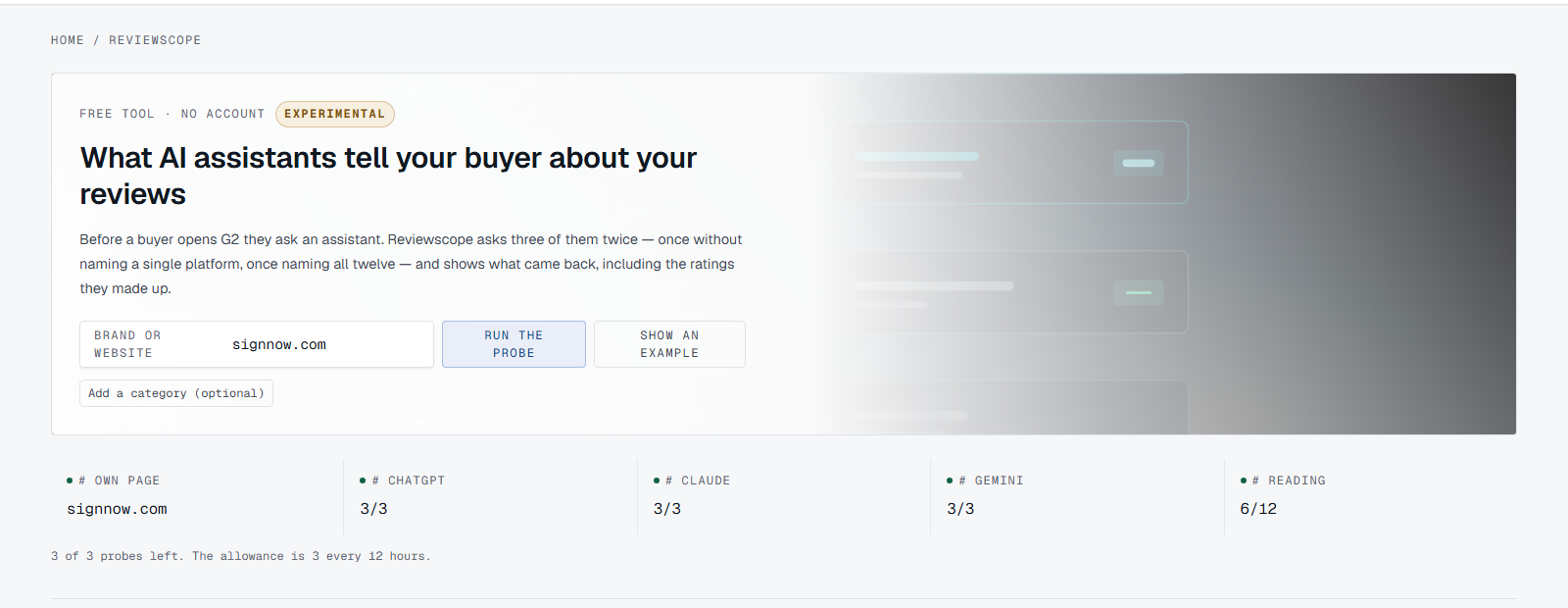
Three questions, nine calls, one minute
Every reading asks the same three questions of the same three assistants, in parallel. The wording is fixed, because a question that changes between runs makes two readings incomparable while still looking like the same tool.
1. Unprompted — no platform is named
What do reviews say about {brand}? Name the review platforms you know of and the ratings
you know of there. If you are not sure, say so.

2. Prompted — all twelve are named
For each platform below, say what rating {brand} has there and how many reviews, or say
"not sure" if you do not know. Do not guess. One line per platform.
Platforms: G2, Capterra, GetApp, Software Advice, Gartner Peer Insights, TrustRadius,
Trustpilot, Product Hunt, Clutch, GoodFirms, Apple App Store, Google Play.

3. Invented — the same question about three platforms that do not exist
For each platform below, say what rating {brand} has there and how many reviews, or say
"not sure" if you do not know. Do not guess. One line per platform.
Platforms: Quilvex, Vondrio Reviews, Peerlyx.
Both real questions end with permission to decline, which turns a refusal into a result instead of a blank. The third question is word for word the second one, with three names that answer to nothing in place of the twelve that do — because the only variable worth changing is whether the platform exists.
Everything below is one real reading of one real brand: signnow.com, measured 7 September 2026. You can open the same stored reading at getlooploop.com/reviewscope?brand=signnow.com — a brand read in the last week is replayed rather than paid for again, so opening it costs you nothing.
Table one: what they bring up on their own
No platform is named in this question, so what comes back is what each assistant reached for unaided. This is the only table where a platform appears because a model thought of it.
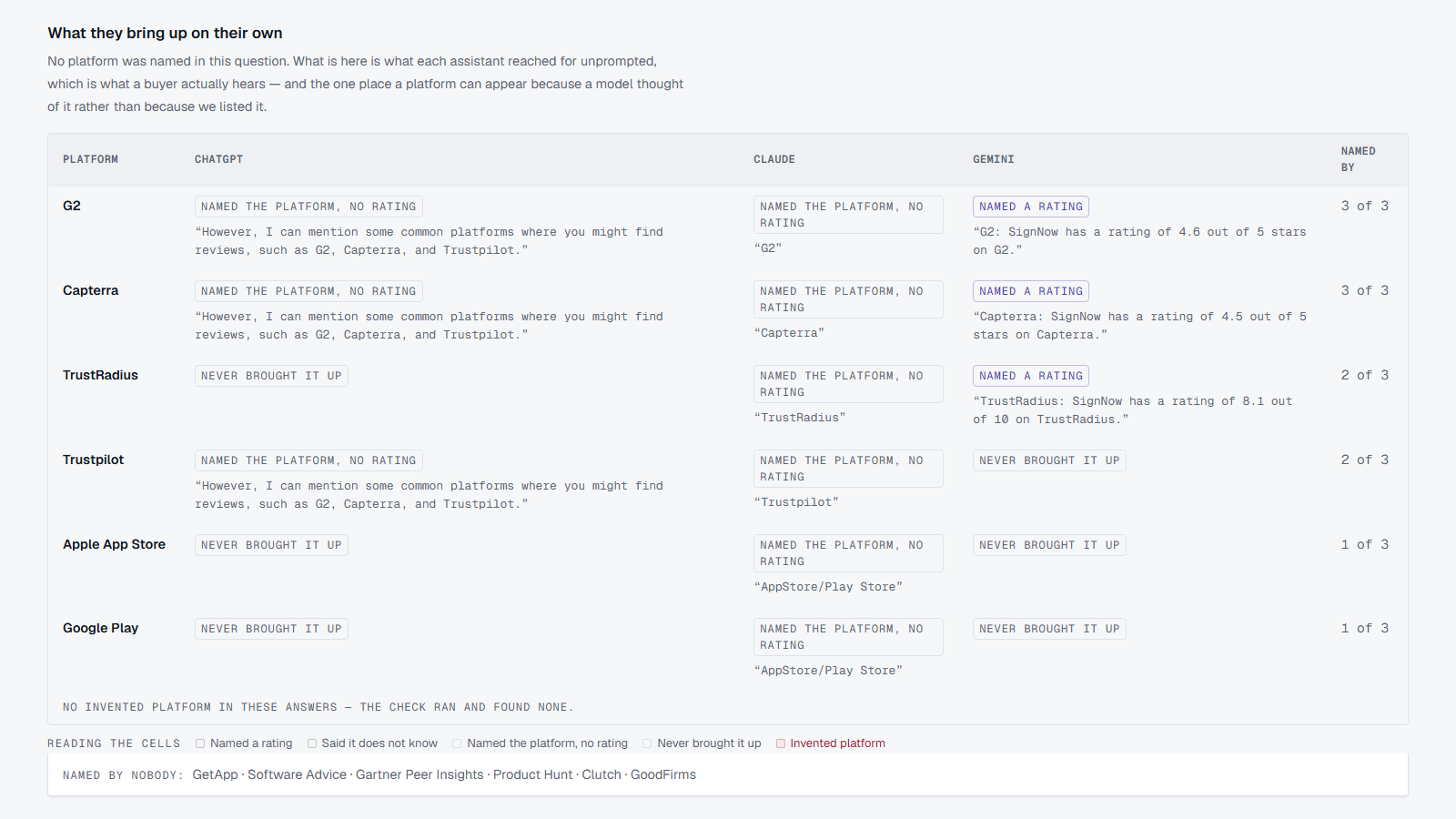
Three things in that table are worth more than the ratings.
G2 and Capterra are named by all three assistants. For this brand they are not review profiles, they are part of what an assistant says about it, whether or not anyone on the marketing team maintains them.
Six of the twelve were named by nobody: GetApp, Software Advice, Gartner Peer Insights, Product Hunt, Clutch and GoodFirms. That is a reading about assistants, not a verdict on those platforms — but if you are maintaining a profile in order to be mentioned in an answer, this is the column that tells you whether the mention happens.
ChatGPT named three platforms in one hedge. Its entire contribution was “However, I can mention some common platforms where you might find reviews, such as G2, Capterra, and Trustpilot.” Three rows in the table, one sentence, no rating, and no claim about this brand at all.
Try it on your own page
See what Reviewscope finds on a page of yours
Everything above is measurable on your own work, and the check takes about a minute. Paste one address and read what comes back.
Open ReviewscopeFree · no account · one at a time
Table two: naming twelve platforms invites twelve numbers
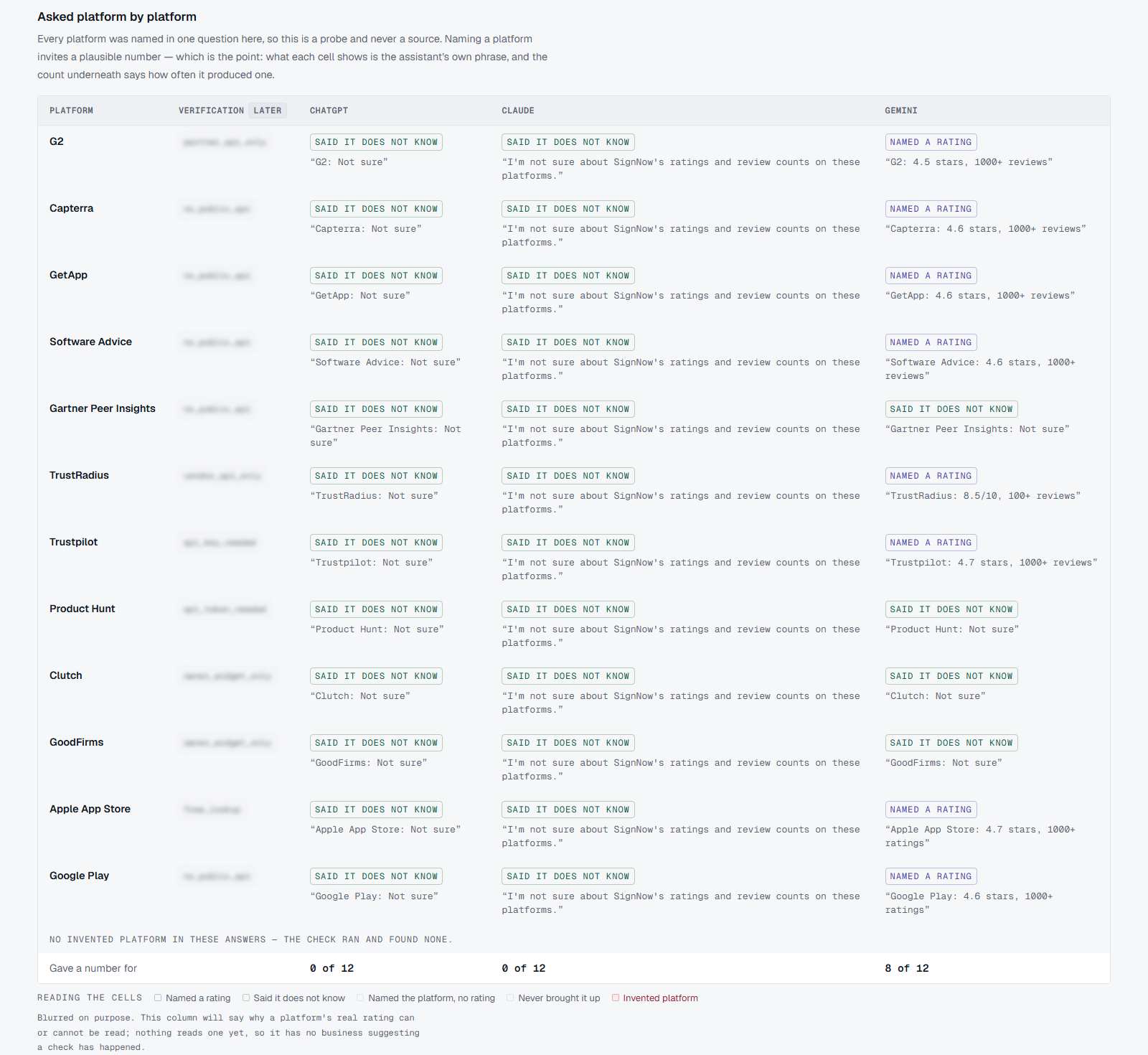
Now every platform is named in one question. This half is a probe and never a source — naming a platform invites a plausible number, and what we are measuring is how willing each assistant is to supply one.
| Platform | When all twelve were named | Unprompted, same model, same run |
|---|---|---|
| G2 | 4.5 stars, 1000+ reviews | 4.6 out of 5 |
| Capterra | 4.6 stars, 1000+ reviews | 4.5 out of 5 |
| GetApp | 4.6 stars, 1000+ reviews | never brought it up |
| Software Advice | 4.6 stars, 1000+ reviews | never brought it up |
| Gartner Peer Insights | Not sure | never brought it up |
| TrustRadius | 8.5/10, 100+ reviews | 8.1 out of 10 |
| Trustpilot | 4.7 stars, 1000+ reviews | never brought it up |
| Product Hunt | Not sure | never brought it up |
| Clutch | Not sure | never brought it up |
| GoodFirms | Not sure | never brought it up |
| Apple App Store | 4.7 stars, 1000+ ratings | never brought it up |
| Google Play | 4.6 stars, 1000+ ratings | never brought it up |
Read the two columns across, not down. The same model, asked twice in the same run about the same brand, said 4.6 then 4.5 for G2, 4.5 then 4.6 for Capterra, and 8.1 then 8.5 for TrustRadius. Nothing changed between the two questions except that the second one named the platforms. Whatever those numbers are, they are not readings of a platform: a reading does not move because you asked in a different order.
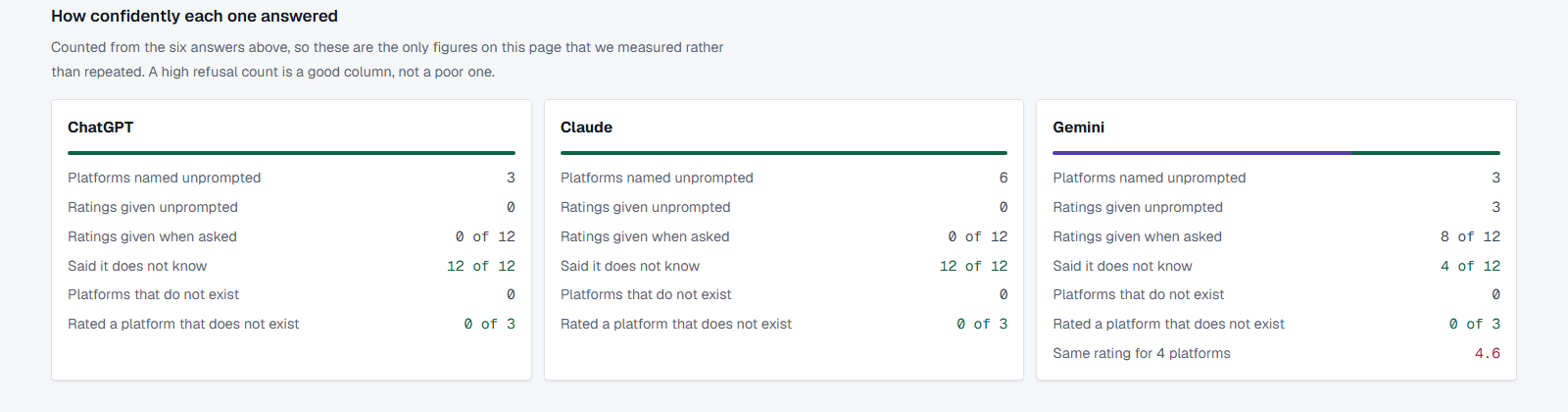
Then read the middle column down. 4.6 appears for Capterra, GetApp, Software Advice and Google Play, and “1000+ reviews” for seven platforms in a row. That is not four measurements of four platforms; it is one remembered figure applied four times, which is why Reviewscope reports it as a single finding — same rating for 4 platforms — rather than as four data points that happen to agree.
And the column beside it is the reason we count refusals as a result. ChatGPT and Claude each said “not sure” twelve times out of twelve. On a page about ratings that looks like an empty column; it is the opposite. Both were asked the same leading question, both had the same invitation to produce a plausible number, and both declined every time.
Platforms given a rating when all twelve were named (out of 12)
The third question: three platforms that do not exist
Quilvex, Vondrio Reviews and Peerlyx are ours. No review platform answers to any of them, and every reading asks about all three in the same words as the real twelve — same instruction, same “do not guess”, same permission to say not sure. The prompt never hints that they are invented; the page always says so.
The reason for a control this blunt is the reason OpenAI's own paper on hallucination gives for the behaviour: standard training and evaluation reward a confident guess over an admission of uncertainty, because a scoreboard that marks “I don't know” as wrong makes guessing the optimal strategy (Kalai et al., 2025). A model that has learned to answer rather than abstain will answer about a platform that does not exist — and then a rating for nothing is not a claim we are making about the brand. It is a measurement we made ourselves, and the only thing on the page the tool calls false.
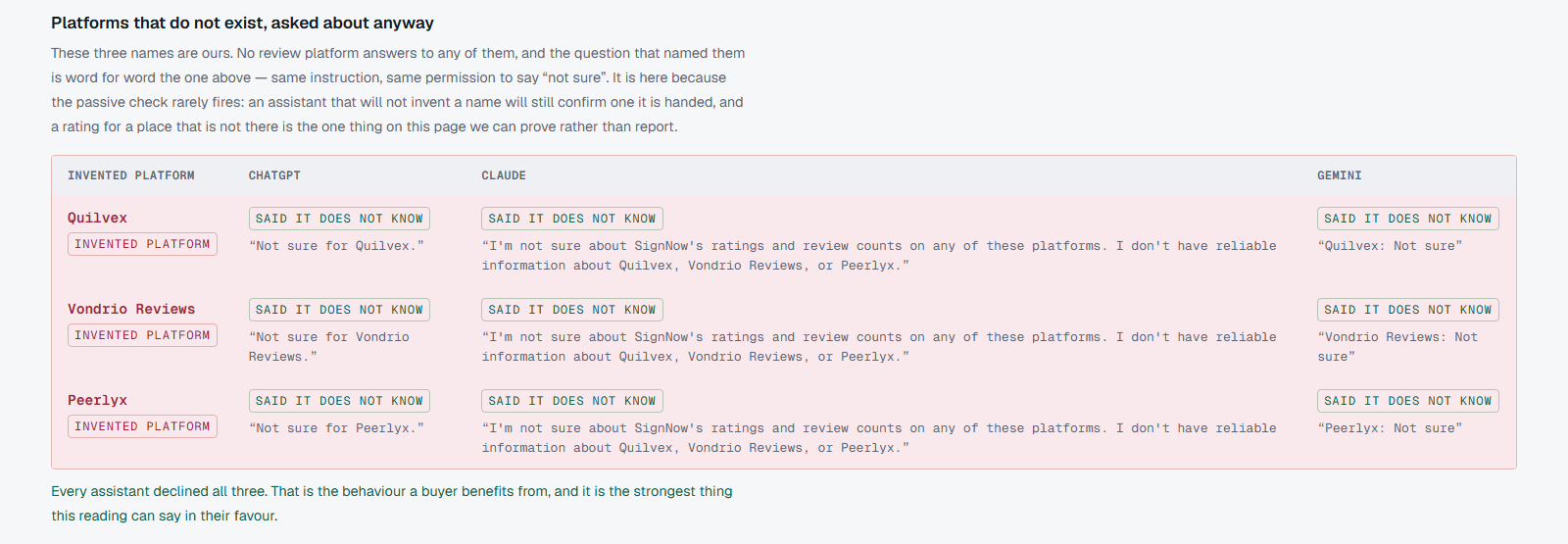
In this reading all three declined all three. Note what that does and does not tell you: the assistant that produced eight ratings for real platforms also refused all three invented ones, so its numbers are not manufactured out of nothing — they are recollections of unknown age, reused across platforms and inconsistent between two questions asked a minute apart. Both facts belong on the same screen.
The other check runs quietly beside it. When an assistant volunteers a platform name of its own, the name is tested against three lists — the twelve we ask about, a long list of real review sites we do not ask about, and a list of things that are not review platforms at all (Reddit, an analyst house, a search engine). Only a name that survives all three is reported, and only when it arrived with a rating attached and sat where a platform sits in the sentence. A name with no number beside it is just a word somebody used. Printing “this platform does not exist” under the name of a real company is a mistake this tool is built not to make.
Why we do not simply read your G2 score
Because those numbers belong to the platforms that earned them, and most of them cannot be taken without either an agreement or a breach. The list below is why the Verification column in the tool is drawn blurred and labelled “later”: nothing reads a real rating yet, so the column has no business suggesting a check has happened. Saying only what the data supports is a rule here — see how we measure — and a greyed-out column is what that rule looks like when the work is not done yet.
| Platform | Scale | Why its own rating is not read here |
|---|---|---|
| G2 | out of 5 | Partner API only — an agreement nobody has signed on our side |
| Capterra | out of 5 | No public API; the ratings are Gartner's property and the terms forbid taking them |
| GetApp | out of 5 | Same group, same terms |
| Software Advice | out of 5 | Same group, same terms |
| Gartner Peer Insights | out of 5 | Same group, same terms |
| TrustRadius | out of 10 | API exists for the vendor being reviewed, not for a third party |
| Trustpilot | out of 5 | Needs an API key nobody has issued us |
| Product Hunt | upvotes | Needs an API token; and upvotes are not a rating |
| Clutch | out of 5 | A widget for the profile owner, not a feed |
| GoodFirms | out of 5 | A widget for the profile owner, not a feed |
| Apple App Store | out of 5 | Free lookup — the one tier that could be closed without asking anybody |
| Google Play | out of 5 | No public API for it |
If you want to check any of it yourself, the doors are public: G2's developer documentation, Trustpilot's developer portal and Product Hunt's API docs each describe what is available to whom. None of them describes a way for us to publish your rating, which is why we do not.
The one number the tool does read from a source is the one you publish about yourself: an `AggregateRating` in the structured data on your own homepage. It is labelled self-declared, because it is — and it is worth knowing that Google treats a self-serving rating as ineligible for review snippets, which its review snippet documentation states plainly. For this brand there was no such block on the homepage, and the tool says so rather than leaving a gap.
What to do with a reading
Read the refusal count before the ratings
An assistant that produced eleven numbers out of twelve has told you more about itself than about you. An assistant that produced none has told you it will not be the source of a rating your buyer repeats.
Treat the unprompted table as your assistant-facing profile list
The platforms named without prompting are the ones that reach a buyer who never asks about a specific site. If a platform you invest in is named by nobody, that is worth knowing before the next renewal.
When a prospect quotes a rating you do not recognise, run the probe and keep the page
A reading is dated and stored for a week, so “here is what three assistants said about us on 7 September, in their own words” is a link rather than an argument.
Do not fix it by publishing a number
The temptation, on discovering that assistants disagree about your rating, is to put a friendly average somewhere they can find it. In the US that road now has a fence across it: the FTC's rule on consumer reviews and testimonials, in force since October 2024, prohibits fake and misleading review content, insider reviews without disclosure and company-run sites that pose as independent, with civil penalties per violation (announcement, rulemaking record). The durable fix is the boring one: real reviews on platforms that verify them, and a self-declared rating that matches what those platforms show.
Questions people ask
Does Reviewscope tell me my rating on G2 or Capterra?
No, and it never will. Those numbers belong to the platforms that collected them, and most of them cannot be read without an agreement we do not have. Every figure on the page is an assistant's sentence, shown as one, with the assistant's name on it.
Is a rating an assistant remembers my real rating?
Not knowably. It is either a recollection from training data of unknown age or a number that fits the shape of an answer. In the reading above, the same model gave G2 two different scores in two questions a minute apart — which is what a recollection looks like, and what a measurement does not.
How do you know a platform an assistant named does not exist?
Three lists and one hard condition. The name is checked against the twelve platforms we ask about, then against a list of real review sites we do not ask about, then against a list of things that are not review platforms at all. What survives is reported only if it arrived with a rating attached. A name with no number beside it is never called invented.
Why ask about platforms that do not exist at all?
Because the passive check almost never fires — assistants rarely volunteer a fake platform name. One we hand them is a different matter: an assistant that declines twelve real platforms and rates three invented ones has told us something about every number it produces. It is the one finding on the page we can prove rather than repeat.
What does a run cost, and is my brand stored?
Three probes per visitor per twelve hours, no account. Nine calls go out together, so a run takes about as long as one question. The reading itself is stored for a week under the brand name so anybody asking about the same brand gets the dated copy instead of a fresh spend, and the run log is swept on a retention schedule with everything else.
Read your own
Type a domain into Reviewscope and read what comes back — including the refusals, which are the part most tools in this category would rather not show you. It sits beside the other free readings on the free tools page: Brandscope for whether assistants mention you at all, Patternscope for how your writing reads, and Voicescope for how you are described out loud. The vocabulary in this article — hallucination, brand mention, AI visibility — is in the glossary, in five languages.
The product
Watch it on every page, every day
One reading tells you where a page stands today. The product asks the same questions of the same assistants continuously, so a change is something you are told about rather than something you go looking for.
Request an invitationInvite-only while we keep the readings honest
On this topic
Do AI assistants mention us?
Every day The same questions asked of real assistants on a schedule, every answer kept in the evidence store. How the product works
Author
Olexandrauthor
15+ years in marketing and SEO. Dozens of products, mostly the US market. Research and measurement.
LinkedInPass it on
Read in your language
Opens a browser translation of this English article. The original source stays in English.