

Federated Learning is a machine learning approach that allows multiple entities to collaboratively train an algorithm using their local, decentralized datasets without needing to pool or send raw data to a central server.
Professionals interested in advanced data privacy techniques, distributed computing, and edge AI often read this material alongside guides on system architecture and decentralized model deployment.
External context
For those developing systems, understanding Federated Learning is vital because it enables collaborative model training while preserving the privacy of local datasets. A key technical consideration is data heterogeneity; practitioners must account for the fact that client data samples may not be statistically uniform or identically distributed.
Federated learning Wikipedia contributors, “Federated learning”, en.wikipedia.orgLicence01What is it and how does the process work?
The core mechanism of FL involves multiple participants—often called 'clients'—who possess unique datasets. The central server (the orchestrator) sends out a current version of the global model to all participating clients. Each client then trains this model locally using its proprietary data set. Crucially, the raw data never leaves the client’s secure environment. Once training is complete, the client calculates an update—a small adjustment or gradient based on its local learning. Only these aggregated updates are sent back to the central server. The server then uses a process called 'aggregation' (like Federated Averaging) to combine all these individual model updates into one improved global model. This new, improved model is then redistributed for the next round of training. This iterative cycle allows the overall AI system to improve its performance using data it otherwise could never access due to privacy or regulatory barriers.
Imagine several different websites or apps each having valuable user search data. Instead of collecting all that data in one giant, private database—which is difficult and risky—Federated Learning allows an AI company to train a single, better model by sending only the updates (the learned weights) back to a central point, not the raw searches themselves.
02What can a marketer do about Federated Learning?
As a brand owner, you cannot directly control the FL mechanisms used by search engines or AI platforms. However, you must adapt your content strategy to assume that model training is happening on diverse, decentralized data sources. Focus on creating highly structured and unique signals within your web presence. Ensure your core messaging is unambiguous because the model might be trained on fragmented local inputs. Furthermore, optimize for 'local context'—the specific search intent or query type common in a niche segment of users. If you know an AI system relies heavily on localized data patterns (like regional slang or product variations), ensure that content variation is robust and easily discoverable through structured schema markup.
- Check: Implement comprehensive
LocalBusinessandProductschema across all relevant pages to provide machine-readable context for local search signals. - Check: Develop 'pillar' content hubs that address broad topics, but ensure each pillar has deep, unique sub-sections tailored to specific geographic or demographic nuances.
03How is brand performance measured in an FL environment?
Measuring visibility influenced by FL requires looking beyond simple click-through rates (CTR) or traditional search rankings. Since the model learns from decentralized inputs, your success signals are often related to model confidence and signal diversity. Look at metrics that indicate how consistently and deeply your brand is associated with a query across different simulated 'local' environments. Key indicators include: 1) Semantic Breadth: Are you appearing for variations of your core topic in unexpected contexts? 2) Signal Persistence: Does the association remain strong even when the user query is highly specific or unusual? 3) Structured Feature Presence: Is your brand consistently populating knowledge panels, featured snippets, or specialized AI answer boxes that require deep entity recognition?
How the record puts it
Federated learning is a machine learning technique in a setting where multiple entities collaboratively train a model while keeping their data decentralized, rather than centrally stored.
04Common mistakes to avoid regarding FL signals
Mistaking the mechanism of data collection for the quality of your content is a major pitfall. Simply having lots of pages does not guarantee strong model representation if those pages are thin or repetitive. The underlying assumption must be that every piece of unique, authoritative information contributes to the global knowledge base.
Warn
Assuming high volume automatically equals high signal quality. Low-quality, high-volume content dilutes your localized training signals.
Warn
Ignoring schema markup. If you don't explicitly label data points (e.g., pricing, author, review score), the AI model must guess, leading to weaker association weights.
05When does Federated Learning not apply or what is it confused with?
FL is a training methodology, not a direct ranking factor. It should not be confused with traditional SEO tactics like keyword stuffing or link building, which manipulate visible search results. FL deals with how the underlying AI model learns patterns from data sources; it does not dictate the final display order directly. Furthermore, while related to privacy, it is distinct from simple anonymization. Anonymization removes identifiers; FL ensures that raw data never needs to be centralized for training purposes in the first place.
06A worked example of FL impact on brand visibility
Consider a local plumbing company. In traditional SEO, you optimize for 'plumber near me.' With FL, the model learns from thousands of decentralized interactions: a user searching in Miami using slang for a specific fixture; another user in Tampa needing service after a storm; and a third user researching historical pipe types. The AI doesn't just see 'plumbing services'; it sees patterns across these disparate local inputs—the regional slang, the local disaster patterns, and the historic data types—and builds a much richer, more robust understanding of what defines expertise in that region.
The AI's ability to connect 'tropical local disaster patternss' (from one client) with 'historic copper piping' (from another client) allows it to surface your brand as the definitive expert across multiple distinct local use cases.
The entry above is written by GetLoopLoop. What follows is what independent catalogues hold about the same term — none of it is the source of this page.
The same term on Wikipedia
Catalogued in 14 languages07Frequently asked questions
How is Federated Learning different from traditional centralized machine learning models?
Federated Learning differs fundamentally in where the computation happens. Instead of pooling all raw user data onto a single server for model training, FL sends the model to the data source—the 'client' device or local server. This allows the system to learn patterns across massive datasets while ensuring that the sensitive, underlying data never leaves its private location.
Does my content need specific technical optimizations just because search engines use Federated Learning?
No, you should not focus on optimizing for the FL mechanism itself. Your primary goal remains creating high-quality, authoritative, and comprehensive content that satisfies user intent. The underlying quality of your material is what contributes to the model's overall performance, regardless of how the training data was aggregated.
Who controls or manages the implementation of Federated Learning in a major search platform?
Major platforms control and manage the core infrastructure of FL. These models are designed by large tech companies using vast internal resources, making them inaccessible to external marketers. As a brand owner, you only interact with the results of this complex process, not its operational mechanics.
If search engines use decentralized data sources, how can I verify that my visibility improvements are real and attributable?
Attributing visibility solely to FL is nearly impossible because it's a background training methodology. Instead, focus on measuring holistic brand signals—such as sustained organic traffic growth, increased direct searches, and mentions across diverse platforms. These metrics provide a stronger signal of overall brand health than any single search ranking metric.
What is the biggest risk if my local data or content niche isn't unique enough to contribute meaningfully to an FL model?
The primary risk is that your brand signals become indistinguishable from generic noise, limiting its positive impact on the overall model. If your data contribution lacks novelty or depth, the AI system may not prioritize it during training updates. This means the search engine gains less unique insight from your presence.
Wikimedia Commons
Related visuals with source and licence credit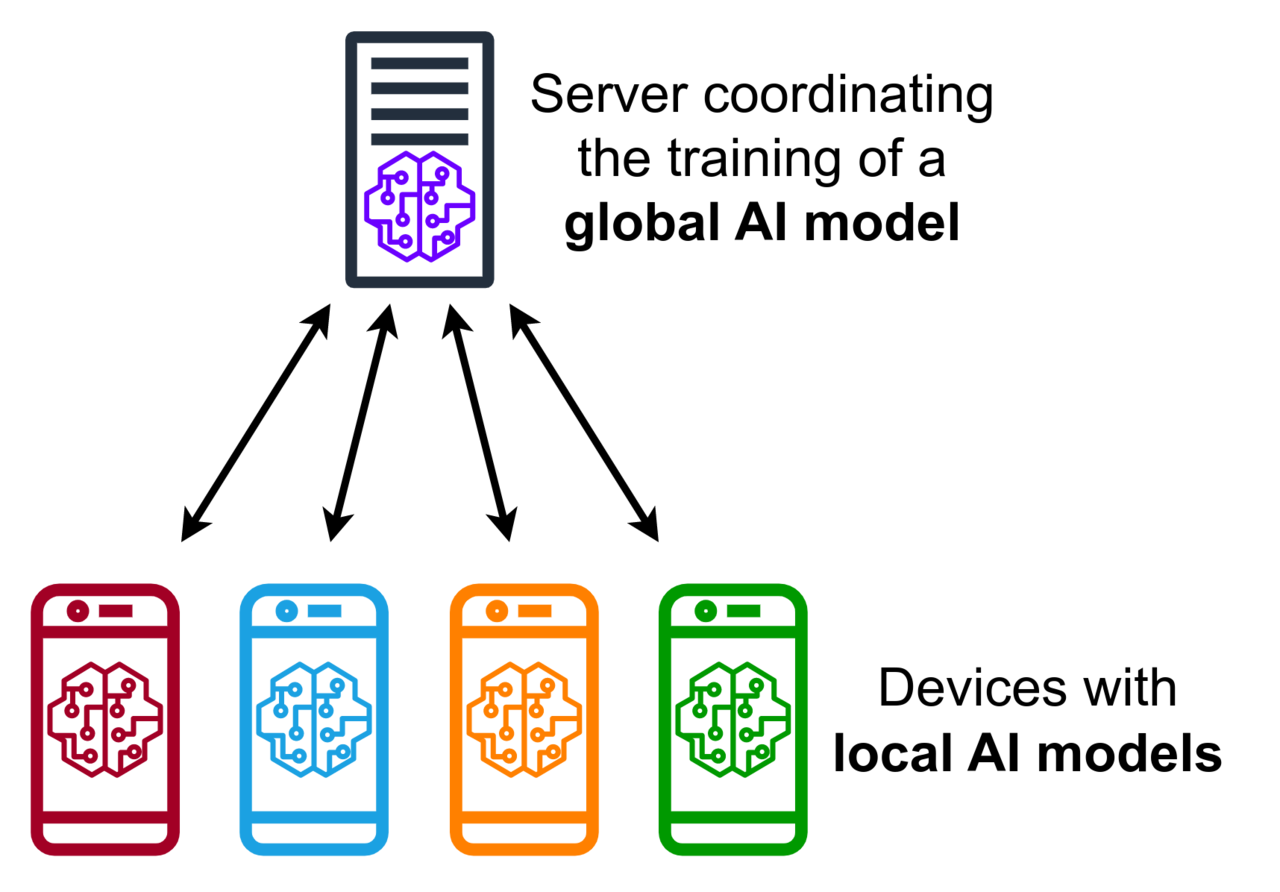


08Asked out loud
The same term in the words somebody uses speaking to an assistant rather than typing into a box — written from the situation, which is why each one carries the situation it came from.
Yes, you need to understand that modern AI systems are designed for privacy first. They use techniques like Federated Learning, which means they train models locally on your device rather than sending all your raw information back to a central server. This approach keeps your data secure while still allowing them to learn useful patterns.
It depends on what kind of shifts have occurred recently. Because modern AI models use decentralized data training, it is extremely difficult for a marketer to pinpoint causality down to a single factor. You must look at multiple long-term signals—like overall site authority and user behavior—rather than just short-term ranking fluctuations.
No, you shouldn't assume the sudden drop was due to missing a specific technical signal. Visibility changes are usually complex outcomes of evolving search algorithms, especially those trained using decentralized data methods. Focus instead on auditing your core content quality and addressing any significant gaps in user experience or topical authority.