

Signal Observatory
AI Mode earns less, and Google sells it in ten more countries
Google told investors that AI Mode earns less than classic search, then took its ads to ten more countries. Two studies showed one AI-visibility check is noise, and Majestic deleted hundreds of billions of spam links.
Signal readout
Topic mix
- AI: 27%
- Google & Search: 33%
- PPC: 16%
- Analytics: 14%
- Brands: 10%
- AI27%
- Google & Search33%
- PPC16%
- Analytics14%
- Brands10%
Share of the issue's words about each topic, counted section by section.
Why it matters
Google Ads reports AI Mode inside ordinary Search and Shopping campaigns, so an advertiser cannot see what an AI Mode click costs or converts at. If your cost per conversion moved this quarter on broad match or AI Max, AI Mode traffic is one of the explanations you cannot yet separate out.
The short answer
- What
- Alphabet's third quarter and what it said about AI Mode; ads in AI Mode in ten more markets and in follow-up questions; Microsoft, Meta, Amazon and Reddit ad news; studies by Ahrefs, SISTRIX, TJ Digital and Muck Rack on AI citations; Google's new guidance on shared and generated pages; Majestic's purge of link spam.
- Why
- Because the company that sells most search ads now says its newest search surface earns less, while it fills that surface with more ads, and because the measurements of AI visibility turned out to need many questions, not one.
- Who
- Advertisers on Google, Microsoft, Meta, Amazon and Reddit; site owners tracking how often AI answers cite them; brands working on press and reviews; link builders and anyone who reads backlink tools.
- Where
- Google Search, AI Mode, AI Overviews, Google Discover, Google Ads, Microsoft Advertising, Meta, Amazon Ads, Reddit, ChatGPT, Gemini, Perplexity and Copilot, and the Majestic index.
- When
- 26–30 October 2026, plus one study dated 25 October and reported inside the window.
- How we know
- Google's and Microsoft's own blogs and help pages, Alphabet's earnings post, Search Engine Roundtable, Search Engine Journal and PPC Land, and the studies' own pages at Ahrefs, SISTRIX, TJ Digital, Muck Rack, DEJAN and Majestic.
In plain words
Google makes most of its money from ads next to search results. This week it said that its new chat-style search, AI Mode, brings in less money per search than the old kind, and that this slowed its growth. It still started showing ads there in ten more countries. Two research teams found that AI chatbots name different websites from one day to the next, so checking once tells you very little. And a company that maps links between websites threw away a huge pile of fake links that spammers had made to advertise themselves.
This week Google put a number on what AI search does to its business. Search revenue grew 12% in the third quarter, down from 17% in the second, and Google said the fast growth of AI Mode was part of the reason. The same day it announced ads in AI Mode for ten more countries. On the measurement side, two studies showed that a single check of your AI visibility is mostly noise. On links, Majestic cleaned a spam wave out of its index, and Google repeated that random spammy links are safe to ignore.
Google's quarter: AI Mode grows, and earns less per search
Alphabet reported its third quarter on 28 October. Sundar Pichai's post leads with demand: "our year-over-year query growth rate is the highest it’s been in the last five years." He added that "Queries in AI Mode are on average three times longer than traditional searches," that "one in five AI Mode searches globally use voice, images, or documents", and that the Gemini app "is now at one billion users".
The money moved the other way. PPC Land, on 29 October, reports Search revenue of $63.4 billion, with growth slowing to 12% from 17% in the second quarter, and total ad revenue of about $82 billion, up 10.5%. On the call, chief business officer Philipp Schindler tied part of the slowdown to AI Mode. He named exchange rates first: "First, there was FX. It was the single largest driver of search deceleration relative to Q2." Then came the sentence advertisers will remember.
It's worth noting that the strong growth in AI Mode queries had an impact because of the lower monetization
Philipp Schindler, Alphabet earnings call, 28 October 2026, as quoted by Search Engine Roundtable on 29 October
The rest of the industry reported in the same days. Put next to each other, the ad growth rates for the quarter look like this. They are not like for like: Google Search is one product line, Microsoft's figure is search and advertising revenue without traffic acquisition costs, and Amazon's and Reddit's are their whole ad businesses.
Ad revenue growth in Q3 2026, year over year, % (company reports via PPC Land and Search Engine Roundtable)
Ads in AI Mode: ten more countries, and ads in follow-up questions
On 28 October Shashi Thakur, who runs Search ads at Google, announced ads in AI Mode for "Australia, Canada, India, Kenya, Malaysia, New Zealand, Nigeria, Pakistan, the Philippines, and Singapore". The post adds: "In Q4 2026, we plan to expand to additional locales, including Brazil, Mexico, and the United Kingdom." In the US Google is starting multiturn ads, which show on the answers to follow-up questions: "To allow ads in follow-up queries in AI Mode, we are launching multiturn ads in the U.S."
Google's case to advertisers rests on one sentence without a number: "click-through rates are already similar between sponsored and organic product list items within AI Mode." The next day Search Engine Roundtable showed a test that mixes the two in one Shopping unit, with paid listings marked; Google called it an experiment and said "All sponsored listings are labeled".
Two more Google Ads changes bear on targeting. Search Engine Journal reported on 27 October that Google's privacy policy now lets data from Gmail and Photos, for users who turned on Personal Intelligence, shape ads in AI Mode, in a test for Performance Max, Shopping and broad-match Search. And on 26 October Google widened its customer lifecycle goals: High Value acquisition now works in Shopping, and three retention modes, Re-engagement, Loyalty and Retention-only, are rolling out across Performance Max, Search and Shopping.
| Platform | What changed | Status | Date |
|---|---|---|---|
| Google Ads | Ads in AI Mode in 10 more countries; Brazil, Mexico, UK in Q4 | Announced | 28 Oct |
| Google Ads | Multiturn ads on follow-up questions in AI Mode, US | Launching | 28 Oct |
| Google Ads | Sponsored and organic products in one AI Mode unit | Experiment | 29 Oct |
| Google Ads | Gmail and Photos data can shape AI Mode ads (Personal Intelligence users) | Policy live, ads in test | 27 Oct |
| Google Ads | Customer lifecycle goals: High Value in Shopping, three retention modes | Rolling out | 26 Oct |
| Google Ads | Child safety policy rewritten, covers AI-generated content | Enforced from 11 Jan 2027 | 27 Oct |
| Microsoft Advertising | Age and gender targeting in Performance Max | Generally available | 28 Oct |
| Microsoft Advertising | Device targeting; audience exclusions in Performance Max | Rolling out; open pilot | 28 Oct |
| Microsoft Advertising | Up to 40 messaging guidelines for AI-written copy | Available | 28 Oct |
| Meta | On-device conversion counting switched on by default | From 12 Nov, opt-out | 28 Oct |
Microsoft gives Performance Max the controls, Meta changes the count
Microsoft's October update, published 28 October, reads like a list of what Google advertisers ask for. "Age and gender targeting is now generally available on Performance Max." Device targeting "is rolling out to all advertisers in the coming weeks", and audience exclusions "are now in open pilot". Advertisers can "provide up to 40 guidelines to help steer generated copy and protect your brand", and search term landing page reporting "is rolling out to advertisers starting mid-November."
Meta's change is quieter and will move numbers. PPC Land reported on 28 October that "Meta switches on device-side conversion counting by default on November 12", under a setting called "Measure conversions on customer devices". "Advertisers who do not want it have to opt out." The same piece carries a Resemble AI scan of 37,768 Facebook and Instagram ad files from 509 companies: 3,379, or 8.9%, were flagged as AI-generated or manipulated, and only two of them mentioned AI in the ad copy. Resemble sells detection software, so read the flag rate as its tool's verdict.
Amazon and Reddit reported on 29 October. Amazon's ad revenue was $19.64 billion, up 10.9%, which Amazon puts down to "timing anomalies" after Prime Day moved into the second quarter; it guides: "We expect year-over-year advertising revenue to grow in the high teens in fourth quarter 2026." Reddit's ads grew 54% to $847 million, but its growth has slowed for three quarters, and its letter to shareholders warns about the traffic Google sends: "During October, we have seen that search traffic has dropped by more than 1 million referrals on average per week."
Reddit ad revenue growth by quarter, year over year, % (PPC Land)
Try it on your own page
See what Vectorscope finds on a page of yours
Everything above is measurable on your own work, and the check takes about a minute. Paste one address and read what comes back.
Open VectorscopeFree · no account · one at a time
AI visibility: one check tells you almost nothing
Two measurement studies came out a day apart and agree. Ahrefs, on 29 October, asked five AI tools the same questions every day for 20 days and followed every site cited on the first day: about 37,500 citations across AI Mode, ChatGPT, AI Overviews, Gemini and Copilot. Half or more were gone the next day.
Day-one AI citations gone by day two, % (Ahrefs, 20 days of daily checks)
Ahrefs' own advice is blunt: "Don't judge AI visibility from one check." It suggests counting instead: "Count how many of the last seven days you were cited." One finding links AI citations back to ordinary search: on AI Overviews and AI Mode, pages that ranked anywhere in Google for the same question "were about seven times more likely" to keep their citations for at least a week.
SISTRIX, on 28 October, asked how many questions a measurement needs. It simulated a brand whose true share of answers is 25%. Asking one prompt on 20 days, the result "could land anywhere between 0 and 59 per cent"; 20 different prompts on one day land between 16 and 35; 100 prompts between 21 and 29. In its words the typical error is "±34 percentage points for one prompt, ±9.5 for 20 prompts and ±4.2 for 100."
Typical error of an AI-visibility share, ± percentage points, by number of prompts (SISTRIX)
Individual answers fluctuate heavily, but the figure across many prompts stays stable.
Johannes Beus, SISTRIX, "Measuring AI visibility", 28 October 2026
SISTRIX adds one more warning for anyone who reports AI visibility to a client: of all brands that appeared in a prompt's answers, "70 per cent show up on fewer than one in five days." A tracker with a handful of prompts chosen by the brand itself will mostly measure luck. Hand-picked sets also flatter: "the brand performs better in its own set in three out of four cases, usually by a clear margin."
What gets a page cited
TJ Digital's study, dated 25 October and written up by Search Engine Journal on 28 October, compared pages that AI answers cited with pages they passed over: 193,507 answers from ChatGPT, AI Mode and AI Overviews, collected weekly from 27 August to 21 October, for 4,167 buyer questions that name no brand. "The cited page opened with a direct answer 20% of the time, compared with 5% for the passed-over page." Search Engine Journal's own caution belongs next to every number below: it is an agency's client data and shows "associations, not proof that any page trait causes citations."
| Page trait | Odds of being cited | Source wording |
|---|---|---|
| Year in the title | more than 2× | "more than twice the odds of being cited" |
| Published or updated in the past 12 months | +88% | "88% higher odds" |
| Has a table | +69% | "69% higher odds" |
| Has an author byline | −28% | "28% lower odds" |
The same study shows how far apart the engines are. Of the pages in Google's top ten for a question, AI Overviews cited 24%, AI Mode 17% and ChatGPT 7%. A good Google ranking helps most in Google's own AI answer and least in ChatGPT.
Brand: most of what AI reads about you is not on your site
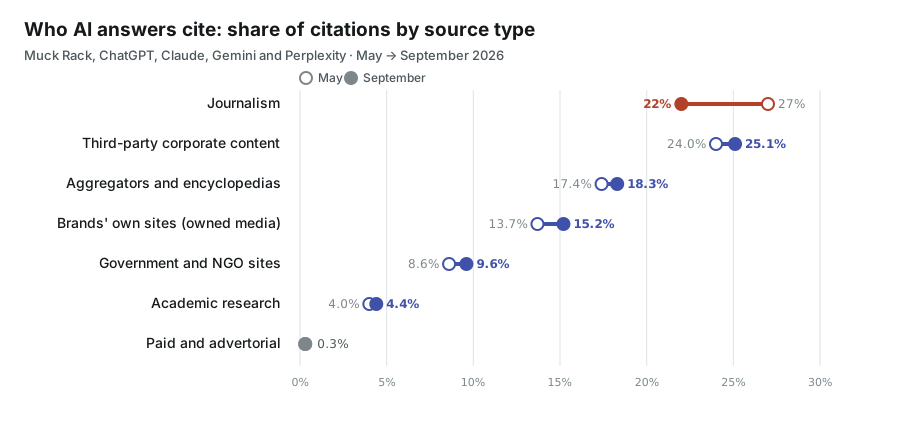
Muck Rack's October edition of "What Is AI Reading?", last updated 28 October, sorts the citations in AI answers by who published them. Journalism's share fell from 27% in May to 22% in September, while brands' own sites rose from 13.7% to 15.2%. Third-party sources still dominate, and the report's conclusion is short: "Brands cannot build meaningful AI visibility from their website alone."
Two more findings from the same report concern access. "Among major publishers blocking Claude's search crawler, 81% received almost no Claude citations", against 12% of publishers that allow it. And on 28 October Dan Petrovic of DEJAN published research suggesting that AI Mode receives whole Knowledge Graph biographies of people and companies as results without a URL. His summary: "A fact that only exists in the Knowledge Graph reaches AI answers without a link to you." Google has not commented, and the author himself notes that the schemas show "the data structures exist", not how Google uses them. If a knowledge panel about your company is wrong, though, this is one more reason to fix it.
SEO: Google names shared and generated pages in its spam guide
On 26 October Google updated its guidance on user-generated spam. Search Engine Journal reports that the guide now covers "tools that let users publish shared pages, generated content, or web apps", and has a new section, "Only index content meant for Search". Pages made for sharing, collaboration or utility should be noindexed or blocked by default, platforms should verify their site in Search Console to get manual action and security alerts, and they should watch the Page Indexing report for unexpected spikes. A follow-up in Search Engine Journal on 28 October cautioned that the guidance "does not establish that a crackdown is imminent."
Other Google changes this week were smaller and confirmed. Search Engine Roundtable noticed on 27 October that the favicon documentation now says "Googlebot must be able to crawl the home page, follow any redirects from there to the page where the favicon is specified". In Discover, the experiment that made source links unclickable is over. Rajan Patel of Google wrote: "this was a bug in a Discover experiment. We’ve turned off the experiment, and the experience works as intended again." And John Mueller said a Page Indexing report that had not updated since 16 October was nothing to worry about: "Indexing doesn’t change quickly, and when it does, you see that reflected in the performance reports first."
Rankings moved without an announcement. Search Engine Roundtable wrote on the morning of 27 October that a shift "seems to have started about 12 hours ago, but Google hasn't officially confirmed anything yet", and on 29 October that volatility "continues to get more heated by the day". Google's Search Status Dashboard lists nothing after the September 2026 spam update. Rank trackers themselves are noisier than usual: Semrush wrote on 27 October about "poisoned" results pages, some of which look normal at first and hold pages that only loosely match the search, and said "Google hasn’t commented publicly." Check a sudden move against Search Console before acting on a tracker.
Link building: Majestic deletes a spam wave, Google says ignore it
On 26 October Majestic said it had removed a wave of spam built to get into backlink tools themselves: "This year, we've seen a HUGE increase in toxic link spam that specifically targets backlink indexes like Majestic." In this wave "over 10,000 sites appear to have been deployed in an attempt to insert adverts for link building services" into the indexes, and "the number of backlink URLs removed from the index is in the hundreds of billions." Many sites will see their referring domain counts drop and Trust Flow shift, but "the core Trust Flow mechanics remain unchanged."
Google's view of the same kind of links came three days later. Asked why spammy links shown in a third-party tool are missing from Search Console, John Mueller answered: "I wouldn't anchor on whether Search Console shows them", and "if these are random spammy links on the web, I'd just ignore them."
The Ahrefs citation study speaks to links too. Long-lived and short-lived AI citations came from similarly strong sites, typically Domain Rating 64 to 78, and "Domain Rating and links to the page made little difference" to how long a citation lasted. Ahrefs' conclusion for link builders is to "prioritize link building that supports search rankings rather than chasing backlinks solely for AI visibility." The link from backlinks to AI answers, on this data, runs through rankings. Muck Rack's numbers point the same way from the other side: third-party coverage, which is what digital PR earns, is most of what AI engines cite.
Our news: let an AI agent read your site's technical SEO
Three threads of this week meet in one place. Google wants pages made for sharing kept out of the index, so somebody has to find the ones that slipped in. Majestic's purge showed that a third-party index of your links can change overnight for reasons that have nothing to do with your site. And Ahrefs and SISTRIX both found that a single look proves little. All three argue for reading your own site directly, all of it, and more than once.
That is what GLLmolfar, our desktop crawler, is for. It crawls your site on your own computer and sorts what it finds by impact: indexability, redirects, canonicals, internal links, structured data, and how pages read to AI search. It also runs an MCP server, so an AI agent such as Claude Code or Codex can ask it for the overview, the fix list, the URLs behind each fix and why each one matters, then hand you a plan or a ticket. The clip shows that loop in 14 seconds.
Also this week
- Gemini stopped tagging its links. Search Engine Roundtable reported on 30 October that Gemini stopped adding utm_source=gemini around 28 September, after starting in early September. The desktop web still passes a referrer; the iOS app sends none, so those visits land in Direct. Not confirmed by Google.
- AI Overviews tests. On 29 October Search Engine Roundtable showed a test without the citations card and refinement bubbles that open AI Mode instead of changing the query. Both unconfirmed.
- Restaurants control ordering partners. Google lets restaurants switch third-party ordering providers off on their Business Profile themselves, with separate switches for pickup and delivery. Before, the provider had to process the request, and Google's help page gave it five business days. Search Engine Journal, 28 October.
- Fake Googlebots. Gary Illyes said on a podcast, reported on 30 October, that AI made crawler impersonation worse, and that firewalls and CDNs "are not perfect" at spotting it. Verify Googlebot by reverse DNS, not by user agent.
- ChatGPT as a search engine. seoClarity estimated on 28 October that ChatGPT's search-like activity is "approximately 7.5% of Google's search-query volume". It is a model built on OpenAI's own message data, not a measured count.
Questions people ask
Did Google say AI Mode makes less money than normal search?
Yes. On the 28 October earnings call Philipp Schindler said the strong growth in AI Mode queries had an impact on Search growth because of their lower monetization. Search revenue grew 12% in Q3 against 17% in Q2; Google named exchange rates as the largest single cause.
Where can I buy ads in AI Mode now?
In the US and, from 28 October, Australia, Canada, India, Kenya, Malaysia, New Zealand, Nigeria, Pakistan, the Philippines and Singapore. Google plans Brazil, Mexico and the UK in Q4 2026. AI Mode results are reported inside normal Search and Shopping campaigns.
How many prompts do I need to measure AI visibility?
SISTRIX puts it at about 70 prompts for a result within ±5 points and about 200 for ±3. One prompt checked daily can miss a true 25% share by 34 points either way. Ahrefs found 50–83% of citations gone the next day, most of them back within 20 days.
My backlinks dropped in Majestic this week. Did I lose links?
Probably not. On 26 October Majestic removed hundreds of billions of spam backlink URLs from more than 10,000 sites built to advertise link building services. Referring domain counts fell for many sites; Trust Flow's mechanics did not change.
Sources
Every claim above is dated and linked. Where a number comes from a measurement rather than an announcement, whoever measured it is named.
- Alphabet Q3 2026 earnings: CEO remarks — Google, 28 October 2026
- Google's ad growth slows to 10.5% as AI Mode ads go to 10 more markets — PPC Land, 29 October 2026
- Google: AI Mode ads earn less — Search Engine Roundtable, 29 October 2026
- Ads in AI Mode are expanding globally — Google, 28 October 2026
- Google AI Mode tests sponsored and all products together — Search Engine Roundtable, 29 October 2026
- Google privacy policy: connected apps and AI Mode ads — Search Engine Journal, 27 October 2026
- Google Ads expands customer lifecycle goals in Search and Shopping — Search Engine Journal, 26 October 2026
- Google Ads child safety (CSAE) policy — Search Engine Roundtable, 27 October 2026
- What's new in Microsoft Advertising this October — Microsoft Advertising, 28 October 2026
- Microsoft earnings: search and advertising — Search Engine Roundtable, 28 October 2026
- Meta Pixel counts more sales from Nov 12 as AI ads go undisclosed — PPC Land, 28 October 2026
- Amazon ad revenue growth drops to 11% after Prime Day moves to June — PPC Land, 29 October 2026
- Reddit ad revenue gains 54% to $847m as daily users stall — PPC Land, 29 October 2026
- How stable are AI citations? — Ahrefs, 29 October 2026
- Measuring AI visibility — SISTRIX, 28 October 2026
- 2026 AI citation study — TJ Digital, 25 October 2026, and Search Engine Journal's write-up, 28 October 2026
- What is AI reading? October 2026 — Muck Rack, last updated 28 October 2026
- Knowledge Graph biographies in AI Mode — DEJAN, 28 October 2026
- Google's indexing advice for shareable pages in the spam guide — Search Engine Journal, 26 October 2026, and the follow-up, 28 October 2026
- Googlebot must follow redirects from the home page to the favicon — Search Engine Roundtable, 27 October 2026
- Rajan Patel: disabled Discover source clicks were a bug — Search Engine Journal, 27 October 2026
- Google responds to concern over Search Console indexing reports — Search Engine Journal, 27 October 2026
- Google search ranking volatility — Search Engine Roundtable, 27 and 29 October 2026, and Google's Search Status Dashboard
- Poisoned SERPs — Semrush, 27 October 2026
- Fighting referring domain spam — Majestic, 26 October 2026
- Search Console does not show all links — Search Engine Roundtable, 29 October 2026
- Gemini UTM parameters gone — Search Engine Roundtable, 30 October 2026
- Citations cards in AI Overviews and query refinement bubbles — Search Engine Roundtable, 29 October 2026
- Restaurants can opt out of ordering providers — Search Engine Journal, 28 October 2026
- Google: AI made bot impersonation worse — Search Engine Roundtable, 30 October 2026
- ChatGPT vs Google search volume — seoClarity, 28 October 2026
- GLLmolfar — GetLoopLoop, desktop crawler, preview
The product
Watch it on every page, every day
One reading tells you where a page stands today. The product asks the same questions of the same assistants continuously, so a change is something you are told about rather than something you go looking for.
Request an invitationInvite-only while we keep the readings honest
On this topic
What changed in classic search?
Every day Search Console beside the assistants' answers. How the product works
Author
Olexandrauthor
15+ years in marketing and SEO. Dozens of products, mostly the US market. Research and measurement.
LinkedInPass it on
Read in your language
Opens a browser translation of this English article. The original source stays in English.