

Signal Observatory
AI Overviews pass 80% as the clicks stay thin
Three trackers put AI Overviews on more than 80% of Google searches, three studies found AI assistants still send a sliver of Google's traffic, and Google started rewriting the sources too.
Signal readout
Topic mix
- AI: 24%
- Google & Search: 32%
- PPC: 10%
- Analytics: 14%
- Brands: 20%
- AI24%
- Google & Search32%
- PPC10%
- Analytics14%
- Brands20%
Share of the issue's words about each topic, counted section by section.
Why it matters
If a brand query now opens with an AI Overview, the page that gets cited is often not the homepage. Check which of your pages the Overview quotes for your own brand name, and make sure those pages answer the question on their own.
The short answer
- What
- AI Overview coverage studies from Semrush, SE Ranking and seoClarity; three traffic studies on AI referrals; AI-written citation cards; a Discover test that stops taps on sources; ChatGPT ads through Amazon DSP; Meta's delayed terms; studies by Graphite, Searchable and SISTRIX on what AI answers cite; unconfirmed ranking volatility on 24 October.
- Why
- Because the AI answer is now the normal first thing on a Google results page, while the traffic AI assistants send is still small, and the text that decides a click is increasingly written by the platform.
- Who
- Site owners and SEOs whose queries now carry an AI Overview, publishers on Discover, advertisers on ChatGPT and Meta, and anyone deciding how much to spend on AI visibility.
- Where
- Google Search, AI Overviews, Google Discover, ChatGPT and its ads, Meta's business terms, and AI answers about UK towns.
- When
- 22–26 October 2026, plus two studies dated 21 October and reported inside the window.
- How we know
- Search Engine Roundtable, Search Engine Journal and PPC Land; the studies' own pages at Semrush, SE Ranking, Marie Haynes, Graphite, SISTRIX and Press Gazette; Google's help documents; and Google's Search Status Dashboard.
In plain words
Google now shows its own AI answer above the links on most searches — more than eight in ten, by three different counts. At the same time, people who studied website traffic found that AI chatbots still send very few visitors compared with Google, even if those visitors buy more often. Google also started rewriting the little descriptions of the pages it cites, so a website's own words show up less. And Meta gave itself three more weeks before its new rules let it visit advertisers' websites.
This week the numbers on AI Overviews moved from "often" to "almost always": three trackers now count them on more than 80% of the searches they follow. The traffic numbers moved much less. Three studies published the same week found AI assistants still send a small fraction of what Google organic sends, and Google spent the week testing ways to put its own words where the publisher's used to be.
AI Overviews now appear on more than 80% of searches
On 26 October Search Engine Roundtable put three datasets side by side and headlined the result: "AI Overviews now show up for over 80% of Google Searches". For comparison the same post recalls "50% in June of last year" and, earlier still, "about 15%".
Semrush followed a fixed panel of 400 commercial keywords in banking, ecommerce and software, on US desktop results, from September 2025 to August 2026. Its study, dated 21 October, says: "AI Overview coverage reached 88% in August 2026, up from 45.75% in September 2025." Weighted by search volume the figure is higher: "AI Overviews appeared on 97.08% of estimated commercial searches in August 2026". Ecommerce moved fastest, from 32.62% to 85.11%. Semrush measured whether an Overview appeared, not who clicked, a limit PPC Land pointed out on 23 October.
SE Ranking, on 22 October, looked at brand names: 1,000 US and 1,000 German brand keywords across 17 industries, each checked three times on desktop in October 2026.
| Who measured | What | AI Overview share | Date |
|---|---|---|---|
| Semrush | 400 commercial keywords, US desktop | 88% (97.08% by search volume) | Aug 2026, published 21 Oct |
| SE Ranking | 1,000 US brand keywords | 82.5% | Oct 2026, published 22 Oct |
| SE Ranking | 1,000 German brand keywords | 40.4% | Oct 2026, published 22 Oct |
| seoClarity | Queries tracked, by industry | over 62% (55%–84%) | Via Search Engine Roundtable, 26 Oct |
Two details in SE Ranking's data matter more than the headline. Smaller brands get more Overviews: "AI Overviews appeared for 85.2% of brand keywords with fewer than 50,000 US searches, versus 63.3% for those with over 1 million." And the Overview cites different pages from the ones that rank: "Homepages make up 71.1% of the brand-site URLs in the organic top 10, but only 36.8% of brand-site citations in AIOs." The pages an Overview quotes are more often product pages, About pages and help pages. We could not open seoClarity's own data; its figures here come from Search Engine Roundtable's write-up.
Three studies: AI assistants still send a sliver of Google's traffic
On 22 October Search Engine Roundtable gathered three studies that reach the same conclusion. The most detailed is Marie Haynes', published on 21 October under the title "GEO is a distraction". She writes: "I looked at 12 months of GA4 data across 100 different websites of varying sizes with over 145 million sessions." In that data, "sessions from ChatGPT amounted to just 0.62% of the volume driven by Google Organic." The visitors ChatGPT did send converted better — "ChatGPT visitors converted at a rate of 13.8%" against 3.02% for Google organic — but "Google still drove 96.5% of the total conversions across all channels analyzed".
SEO Works found organic search delivered 39 times the traffic of AI assistants, and 3.2 AI conversions for every 100 organic ones. Kevin Indig, working with 12 sites, wrote that "we also can't yet find a reliable relationship between AI Visibility and branded search or direct traffic." We saw both of these only in Search Engine Roundtable's summary.
sessions from ChatGPT amounted to just 0.62% of the volume driven by Google Organic.
Marie Haynes, "GEO is a distraction", 21 October 2026
Try it on your own page
See what Vectorscope finds on a page of yours
Everything above is measurable on your own work, and the check takes about a minute. Paste one address and read what comes back.
Open VectorscopeFree · no account · one at a time
Read with the coverage numbers above, the picture is consistent rather than contradictory. The AI answer sits on top of most Google searches, and it is Google that still sends the visits. Being cited in an AI Overview, ChatGPT or Perplexity decides whether a brand is named; it does not yet replace the click. All three samples are small, and an absence of measurable branded lift is not proof that none exists. A budget split between SEO and generative engine optimisation still has to be argued from a site's own analytics, not from either side's headline.
Google is rewriting the sources, too
Two tests this week replace a publisher's words or a publisher's link with Google's own.
On 23 October Brodie Clark noticed that the citation cards beside AI Overviews sometimes show a short AI-written description of the cited page instead of the page's own text. Search Engine Roundtable reproduced it on some queries and not others, and wrote that "Google seems to be testing or rolling out AI-generated summaries within AI Overviews citation cards." In Clark's words, the description "is being summarised based on the information that Google thinks is most relevant to the query." Google has not commented.
On Discover, Damien Andell reported on 23 October a test in which tapping "sources" under an AI summary card no longer opens the mini-feed of articles behind it; the flag he found reads "This disables clicks on sources and no longer opens the mini-feed". Search Engine Roundtable could not reproduce it, and Google has said nothing. It is a test, not a launch.
ChatGPT ads: a "Learn more" link, Amazon DSP and an auction that reads the conversation
On 26 October Search Engine Roundtable reported two changes to ChatGPT's ads. Brodie Clark spotted a text-ad format with a "Learn more" link and an arrow. Juozas Kaziukėnas reported that some ChatGPT ads are bought through Amazon DSP, which he inferred "because the click target URL goes through Amazon's click-tracking server", adding that "creative control is the same as regular ChatGPT ads."
On 22 October Search Engine Journal summarised an OpenAI post on how the ad system works: a separate orchestrator model writes queries and checks eligibility before an auction, the system can use earlier turns of the conversation, and an ad that wins the auction can still be dropped by a relevance check afterwards. OpenAI's own page refused our request, so this paragraph rests on Search Engine Journal's account.
Meta delays its crawl terms to 20 November and keeps the crawl
Meta moved the start of its updated Commercial Terms and Self-Serve Ad Terms from 30 October to 20 November. The clause that lets it crawl advertisers' websites, which we covered last week, is still in both documents. Search Engine Journal, quoting Nieman Lab, gives Meta's reason as wanting "to allow more time for us to explain to our partners and stakeholders what's changing and what's not." The UK's Competition and Markets Authority said: "We will continue to scrutinize these terms and engage with Meta and others as we consider our next steps." WAN-IFRA's chief executive Stig Ørskov called the postponement "a welcome step, but it does not address our concerns." Nieman Lab's page refused our request, so these quotes come from Search Engine Journal.
What gets a brand named, and what gets a page cited
Three studies this week looked at the inside of AI answers rather than the traffic they send.
Graphite analysed 3,115 entity-and-question pairs in logged-out ChatGPT and about 957,000 fan-out queries. Its finding: "Parametric knowledge visibility predicts search visibility at every level of cited-page mention rate." Brands ChatGPT rarely names from memory "reach only 11% median visibility with search when their visibility without search is in the lowest band, 0–25%" — even when they appear on the pages it cites. Graphite sells answer-engine optimisation, which Search Engine Journal notes, and the study does not control for brand awareness. The study itself is dated 16 October; the write-up appeared this week.
Searchable, reported by Press Gazette on 22 October, ran 30,000 prompts about 100 UK towns and cities through ChatGPT, Perplexity, Gemini, AI Mode and AI Overviews and logged 244,725 citations. ChatGPT used council or government sources for 81.3% of questions and local news for 0.9%. On crime questions, police websites supplied 57.8% of answers.
SISTRIX, on 22 October, compared 96,418 cited and uncited URLs from 17,380 domains in the German-speaking market. Pages with a table of contents were "cited 1.7 times as often"; Article schema came out at 1.6, FAQPage schema at 1.5, an author box with a photo at 1.4. For llms.txt, "there is no measurable effect on AI citations." SISTRIX presents all of this as correlation, and warns against trusting "a GEO study with fewer than 5,000 URLs."
| Page feature (SISTRIX, 96,418 URLs) | Cited, relative to pages without it |
|---|---|
| Table of contents | 1.7× |
| Article schema | 1.6× |
| FAQPage schema | 1.5× |
| Author box with photo | 1.4× |
| Breadcrumb, HowTo, QAPage schema | 1.0× |
| llms.txt | No measurable effect |
Taken together: being on a cited page is not enough to be named (Graphite), the cited page for a local question is usually an official one (Searchable), and the features that go with being cited are the plain, cheap ones — a contents list, a named author, clear structure (SISTRIX). None of the three shows cause, and each measures a different market.
Ranking volatility on 24 October, unconfirmed
On 25 October Search Engine Roundtable reported that "we saw some significant ranking volatility captured by many of the third-party Google tracking tools" on Saturday 24 October, and that the trackers and the forum chatter together suggested "some Google Search ranking adjustment". Google has confirmed nothing, and its Search Status Dashboard lists no October entry; the last one is the September 2026 spam update. If traffic moved around 24 October, that is the date to check against.
Also this week
- AI review summaries in Search ads. Google published a help page on 26 October for review summaries in ads; Search Engine Roundtable quotes it: "These summaries are positive only". They run on Google.com Search campaigns in English in the US, Australia, the UK and India.
- AI Mode lost "Export to Docs". Android Authority reported on 22 October that the shortcut is gone from the three-dot menu; Google has not commented.
- Google Business Home, a closed beta. Google's help page says it is "available only to select business categories in the US and the UK", bringing Business Profile, Merchant Center, YouTube and Ads together. A redesigned Business Profile performance report is also being tested.
- Pichai on agents. In the Sources podcast, as reported by Search Engine Journal on 22 October, Sundar Pichai said agents will reach sites both through web pages and through protocols: "I think you have both ways and they're going to develop".
- Google pauses ads for Russia-based advertisers worldwide. Google's help page now reads that it will "pause ads on Google properties and networks globally for advertisers based in Russia" (Search Engine Roundtable, 22 October).
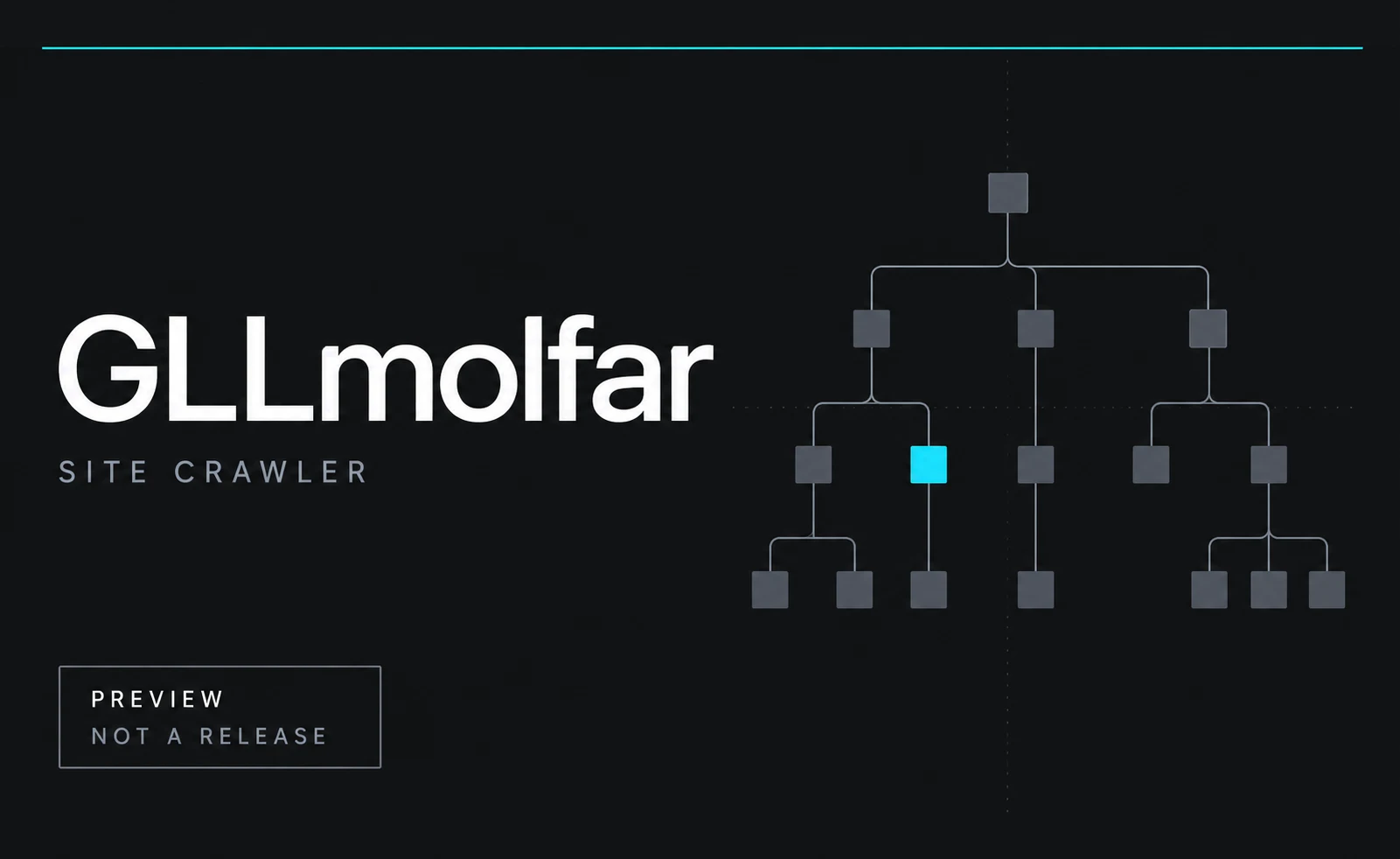
Our news: GLLmolfar 0.7.28, a preview, not a release
GLLmolfar is the desktop crawler we build at GetLoopLoop. Its two latest preview versions, 0.7.27 and 0.7.28, came out on 26 October for Windows and for Macs with Apple silicon. They are previews: the app works on real sites, but features, limits and file formats will change from one version to the next, and something may break. The builds are not code-signed yet, so Windows and macOS warn before the first start.
0.7.27 connects Google Search Console read-only, with the same Google account the app is signed in with. It shows the Performance report, the queries that appeared, vanished, rose and fell this week, pages that lost clicks with the likely reason, and queries that two or more of a site's pages compete for. Query clusters are built on the computer.
0.7.28 adds:
- planned crawls, with a calendar of runs and a choice of what to do when the computer was off;
- export of any table to a new spreadsheet in Google Sheets;
- accessibility checks on every crawled page;
- a Feedback button for bug reports with a screenshot, with replies coming back to the app.
The accessibility checks are read from each page's HTML: form fields without a label, links and buttons without a name, broken ARIA, the page language, heading order. Colour contrast and focus order need a rendered page and are not covered yet.
Crawls stay on the computer that ran them. The GLLmolfar page has the download and the full list of what changed.
Questions people ask
How often does Google show an AI Overview now?
Semrush counted AI Overviews on 88% of 400 commercial keywords in August 2026, and SE Ranking on 82.5% of 1,000 US brand searches in October. In Germany SE Ranking found 40.4% for brand searches.
Does ChatGPT send much traffic compared with Google?
In Marie Haynes' data from 100 sites, ChatGPT sessions were 0.62% of Google organic's, though ChatGPT visitors converted at 13.8% against 3.02%.
Does llms.txt help a page get cited by AI?
SISTRIX found no measurable effect across 96,418 URLs. Tables of contents, Article schema and author boxes correlated with more citations.
Is GLLmolfar 0.7.28 a finished release?
No. It is a preview: features, limits and file formats will change between versions, and the builds are not code-signed yet.
Sources
Every claim above is dated and linked. Where a number comes from a measurement rather than an announcement, whoever measured it is named.
- Over 80% Of Google Searches Have AI Overviews & Growing — Search Engine Roundtable, 26 October 2026
- AI Overviews Appear on 82.5% of US Brand Searches — SE Ranking, 22 October 2026
- AI Overviews commercial modifiers study — Semrush, 21 October 2026
- Google AI Overviews reach 88% of commercial searches as AI clicks stay thin — PPC Land, 23 October 2026
- 3 New Studies Suggest AI Visibility & Search Not Worth Investing In — Search Engine Roundtable, 22 October 2026
- GEO is a distraction — Marie Haynes, 21 October 2026
- Google AI Overview Citation Cards With AI-Generated Summary Snippets — Search Engine Roundtable, 23 October 2026
- Google Discover Tests Disabling Clicks In Sources Section — Search Engine Roundtable, 26 October 2026
- ChatGPT Ads With Learn More Arrow Link; Some Served Through Amazon DSP — Search Engine Roundtable, 26 October 2026
- Inside ChatGPT's Ad Auction: How Relevance, Bids, And Memory Decide Placement — Search Engine Journal, 22 October 2026
- Meta Delays The Terms That Let It Crawl Business Sites — Search Engine Journal, 26 October 2026
- Some Brands On ChatGPT's Cited Pages Still Got Few Mentions — Search Engine Journal, 26 October 2026
- Parametric knowledge optimization — Graphite, 16 October 2026
- AI answer engines often bypass local news outlets — Press Gazette, 22 October 2026
- Citation Worthiness: Which GEO Tactics Hold Up Across 96,418 URLs — SISTRIX, 22 October 2026
- Google Search Ranking Volatility Gets Heated October 24th — Search Engine Roundtable, 25 October 2026
- Google Search Status Dashboard — Google
- Google Ads AI review summaries help document — Search Engine Roundtable, 26 October 2026
- AI Mode no longer offers Export to Docs — Android Authority, 22 October 2026
- Google Business Home — Search Engine Roundtable, 22 October 2026, and Google's help page
- Pichai: AI agents will use both browsing and protocols — Search Engine Journal, 22 October 2026
- Google Ads pauses Russia-based advertisers globally — Search Engine Roundtable, 22 October 2026
- GLLmolfar — GetLoopLoop, preview 0.7.28, 26 October 2026
The product
Watch it on every page, every day
One reading tells you where a page stands today. The product asks the same questions of the same assistants continuously, so a change is something you are told about rather than something you go looking for.
Request an invitationInvite-only while we keep the readings honest
On this topic
What changed in classic search?
Every day Search Console beside the assistants' answers. How the product works
Author
Olexandrauthor
15+ years in marketing and SEO. Dozens of products, mostly the US market. Research and measurement.
LinkedInPass it on
Read in your language
Opens a browser translation of this English article. The original source stays in English.