

PageRank in 2026: how link weight flows through a site, with proof
What the 1998 formula says, what Google has confirmed since, what the 2024 leak does and does not show, and how weight actually spreads across 500 pages of our own site — measured, with screenshots and a plan recomputed before and after.
The short answer
- what
- How PageRank passes weight between pages, what Google has said about it on the record, and a measurement of one real site.
- why
- Internal linking is the one ranking input a site fully controls, and most advice about it is repeated rather than sourced.
- who
- Site owners, SEOs and developers who decide what links where.
- where
- Google Search; the measured site is www.getlooploop.com in five languages.
- when
- Sources read on 9 November 2026; the site crawled on 8 November 2026.
- how
- Primary sources quoted and linked; a six-page worked example; a 500-URL crawl with PageRank computed per page; a linking plan recomputed before and after.
In plain words
Imagine someone clicking links on a website at random, forever. Pages they land on often are the important ones. Every page shares its importance with the pages it links to, a little leaks away at each step, and pages that everybody links to collect the most. That is PageRank. Google still uses a version of it, and you can measure it on your own site.
Few ideas in SEO are quoted as often and sourced as rarely as "link juice". This article does the opposite. Every statement about Google below is a quotation from a primary source — the original papers, the patents, Google's documentation, and Google employees on the record — with a link, and with the caveats those sources carry. Where something is only reported second-hand, we say so; where we could not verify it, it is not here.
Then we measure. We crawled 500 pages of our own site, computed PageRank for each, and found something we did not expect: the pages holding the most internal weight are our legal pages. The screenshots are from GLLmolfar, the desktop crawler we make, so read that part knowing whose tool it is. The method is the published formula; any crawler that computes PageRank should land close to the same numbers.
1. The formula, as it was published
PageRank was described by Sergey Brin and Lawrence Page in The Anatomy of a Large-Scale Hypertextual Web Search Engine, presented at the WWW7 conference in Brisbane in April 1998 (archived copy). The formula in the paper:
PR(A) = (1-d) + d (PR(T1)/C(T1) + ... + PR(Tn)/C(Tn))
T1…Tn are the pages linking to A, and C(T) is the number of links going out of page T. Read it in words: a page gives its rank away, split evenly among the pages it links to, and a page's rank is the sum of what it receives, scaled by d, plus a small constant every page gets for free.
We assume there is a "random surfer" who is given a web page at random and keeps clicking on links, never hitting "back" but eventually gets bored and starts on another random page.
Brin and Page, The Anatomy of a Large-Scale Hypertextual Web Search Engine, 1998
The damping factor d is the probability the surfer keeps clicking. The paper: "The parameter d is a damping factor which can be set between 0 and 1. We usually set d to 0.85." The companion technical report, The PageRank Citation Ranking: Bringing Order to the Web by Page, Brin, Motwani and Winograd (Stanford InfoLab 1999-66; the PDF is dated 29 January 1998), states the same choice the other way round: "We have performed most experiments with an E vector that is uniform over all web pages with ||E||1 = 0.15" — a 15% chance at every step of jumping to a random page.
Two slips in the 1998 paper are worth knowing, because they are copied into many explanations. The paper says the PageRanks "form a probability distribution" summing to one; with the (1-d) form as printed they sum to the number of pages, and only the (1-d)/N form sums to one. It also calls d "the probability at each page the 'random surfer' will get bored"; under the formula, getting bored is 1-d. The idea is right; the sentence is not.
The method was patented: US 6,285,999, "Method for node ranking in a linked database", inventor Lawrence Page, assigned to Stanford, filed 9 January 1998, granted 4 September 2001. Its abstract: "The rank assigned to a document is calculated from the ranks of documents citing it." Google licensed it; its 2004 S-1 filing says: "Stanford University, which owns a patent to PageRank. We hold a perpetual license to this patent." Google Patents lists the patent as expired, with an anticipated expiration of 9 January 2018.
2. Does Google still use it? What is on the record
PageRank stopped being visible in 2016, which is where the "PageRank is dead" belief comes from. The record says otherwise, and it is consistent across nine years.
| When | What was said | Source |
|---|---|---|
| Jun 2009 | "Although we still refer to it as PageRank, Google's ability to compute reputation based on links has advanced considerably over the years." | Matt Cutts, PageRank sculpting |
| Mar 2016 | Toolbar PageRank removed; "the company still uses PageRank data internally within the ranking algorithm" (Google to Search Engine Land). It went dark on 15 April 2016. | Search Engine Land, 8 Mar 2016 |
| Jul 2016 | "30x redirects don't lose PageRank anymore." | Gary Illyes on X |
| Feb 2017 | "DYK that after 18 years we're still using PageRank (and 100s of other signals) in ranking?" | Gary Illyes on X |
| May 2024 | Leaked API docs name a production PageRank field, PagerankNS; Google confirms the documents are authentic and warns against out-of-context readings. | hexdocs, The Verge |
| Dec 2025 | "PageRank … continues to be part of our core ranking systems." | Google, ranking systems guide |
PageRank, one of our core ranking systems used when Google first launched… How PageRank works has evolved a lot since then, and it continues to be part of our core ranking systems.
Google, A guide to Google Search ranking systems, last updated 10 December 2025
That page is the strongest evidence there is, because it is Google's own documentation, not a remark. Note what it also says: PageRank "has evolved a lot". Nobody outside Google knows its present form, so everything below treats the published formula as a model — the right shape, not the exact weights.
What the 2024 leak shows, and what it does not
In May 2024 thousands of pages of internal Google API documentation (the Content Warehouse API) became public. The documentation itself is still readable on hexdocs. On PageRank it says, in the GDocumentBase model: "Pagerank-NearestSeeds is a pagerank score for the doc, calculated using NearestSeeds method. This is the production PageRank value teams should use." The older field is described as "long-deprecated in favour of Pagerank_NS". The PerDocData model stores, for every document, "The page-rank of the homepage of the site", and still has a field for the old toolbar value, "A value between 0 and 10 (inclusive)".
What it does not show: how much any of these fields weighs in ranking. The documentation describes data, not the use of it. Google confirmed to The Verge that the documents were genuine, and its spokesperson added: "We would caution against making inaccurate assumptions about Search based on out-of-context, outdated, or incomplete information." Mike King's reading (iPullRank) that the homepage PageRank "likely" stands in for a new page until it earns its own is a plausible guess, and he labels it as one. One widely shared summary says PagerankNS is the deprecated field; the documentation says the opposite.
3. How weight moves, on six pages
The formula is easier to trust once you watch it work. Take a six-page site: a home page linking to Pricing, three articles and a Privacy page, each of which links back home. Compute PageRank with d = 0.85 and normalise it so the six pages add up to 100%. Then make two changes a real site makes all the time.
Try it on your own page
See what Vectorscope finds on a page of yours
Everything above is measurable on your own work, and the check takes about a minute. Paste one address and read what comes back.
Open VectorscopeFree · no account · one at a time
| Page | A. Home links to all | B. + footer link to Privacy on every page | C. B + one in-text link from each article to Pricing |
|---|---|---|---|
| Home | 47.3% | 38.9% | 35.8% |
| Pricing | 10.5% | 9.1% | 15.9% |
| Article1 | 10.5% | 9.1% | 8.6% |
| Article2 | 10.5% | 9.1% | 8.6% |
| Article3 | 10.5% | 9.1% | 8.6% |
| Privacy | 10.5% | 24.6% | 22.6% |
Adding one footer link — the kind every site has — more than doubles Privacy, from 10.5% to 24.6%, and takes it from the home page, which falls from 47.3% to 38.9%. Nothing about Privacy became more important; it became more linked. Then three ordinary links inside the articles lift Pricing from 9.1% to 15.9%. That is the whole mechanism of internal linking in one table: a page's share depends on how many pages link to it and how many other links those pages carry.
Matt Cutts described the leak at each step in 2009: "you could think of it as 10-15% of the PageRank on any given page disappearing before the PageRank flows along the outlinks" — the 1-d of the formula.
Six-page example: Privacy's share of weight, % (d = 0.85)
4. The rules that changed the arithmetic
Nofollow does not save weight; it loses it. Before about 2008, a page with ten links, five of them nofollow, passed its weight to the other five — so SEOs "sculpted" PageRank by nofollowing links they did not care about. Cutts, in PageRank sculpting: "Originally, the five links without nofollow would have flowed two points of PageRank each… More than a year ago, Google changed how the PageRank flows so that the five links without nofollow would flow one point of PageRank each." The nofollowed share is simply gone. His advice: "In general, I would let PageRank flow freely within your site." Since 2019, nofollow is a hint, not a directive: "All the link attributes, sponsored, ugc, and nofollow, now work today as hints for us to incorporate for ranking purposes."
Redirects pass weight. Gary Illyes, July 2016: "30x redirects don't lose PageRank anymore." Google's redirects documentation does not mention PageRank, but says a permanent redirect is "a signal that the redirect target should be canonical", and the canonicalization page says canonicals let search engines "consolidate the signals they have for the individual URLs (such as links to them) into a single, preferred URL". A chain of redirects still costs a crawl; it no longer costs weight.
Not every link is equal — probably. The random surfer clicks every link with the same chance. Google's "reasonable surfer" patent, US 7,716,225 (Dean, Anderson and Battle, filed 2004, granted 2010), describes a model in which "the surfer will follow some of the links with higher probability than others", trained on features including "the position of the link (measured, for example, in a HTML list, in running text, above or below the first screenful… in a footer, in a sidebar, etc". A patent proves the idea was worked on, not that it runs in production. But it is the reason to treat the classic numbers below as an upper bound for footer links: if Google discounts them, our footer pages hold less than computed.
A link has to be a link. Google's link best practices: "Generally, Google can only crawl your link if it's an <a> HTML element (also known as anchor element) with an href attribute." A button that navigates with JavaScript passes nothing, because it is not found.
5. Our own site, measured
We crawled www.getlooploop.com with GLLmolfar 0.9.35 on 8 November 2026, capped at 500 URLs, following links from the home page and the sitemap, with JavaScript rendering. All 500 pages answered 200 and were indexable, so no weight leaked into errors or noindexed pages. PageRank was computed over internal links only, with the classic formula and d = 0.85, and shown as each page's share of the total.
The cap matters: the site has more pages than 500, so this is a sample, and a page's share is its share of these 500. The pattern, not the third decimal, is the finding.
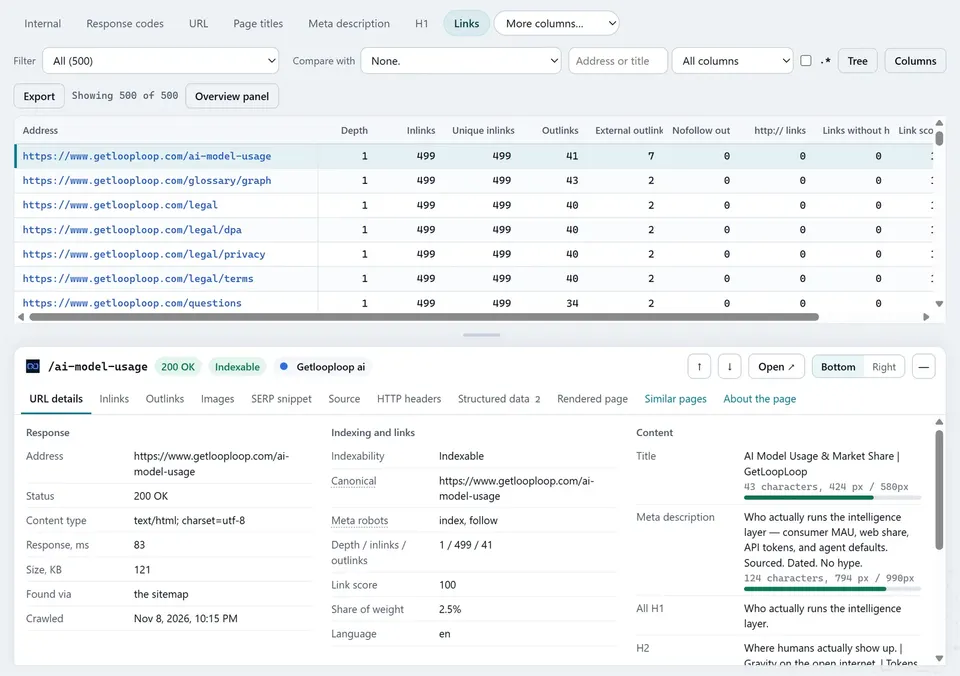
| Page | Share of weight | Unique inlinks | Depth |
|---|---|---|---|
| /legal | 2.49% | 499 | 1 |
| /legal/dpa | 2.49% | 499 | 1 |
| /legal/privacy | 2.49% | 499 | 1 |
| /legal/terms | 2.49% | 499 | 1 |
| /ai-model-usage | 2.49% | 499 | 1 |
| /glossary/graph | 2.48% | 499 | 1 |
| /questions | 2.48% | 499 | 1 |
| /vectorscope | 2% | 303 | 1 |
| /glossary | 2% | 254 | 1 |
| / | 1.96% | 242 | 0 |
The home page is tenth, with 1.96%. Above it are the seven footer pages — four legal pages, the AI model usage report, the glossary graph and the questions page — at 2.49% each, 17.4% between them. This is the six-page example at the scale of a real site: a link on every page beats a link from the most important page. The legal section has 11 pages and holds 12.7% of the weight; the news section has 98 pages and holds 9.4%.
Share of internal weight by section, % (500 pages)
Weight per page by section, % of the site per page
Weight is concentrated, as the formula predicts
The top 10 pages hold 23.4% of all weight; the top 50 hold 66.2%. If weight were spread evenly, each page would hold 0.2%; the median page holds 0.051%, a quarter of that. This is normal — PageRank is meant to separate pages — but it means the 400-odd pages at the bottom live on what the top passes down.
Languages: the same site, five unequal shares
The site publishes in five languages. English is 41% of the pages crawled and holds 75.7% of the weight; French and Polish together are 7.6% of the pages and hold 1.7%. The reason is visible in the links: every page's footer points to English-only pages, and the French and Polish sections are linked from fewer places.
Share of internal weight by language, %
Pages by click depth from the home page
Depth matters because weight thins out with every hop, and because crawlers get to deep pages less often. The best public figures are Botify's, from its own customer data and therefore correlational, with no published method: "58.2% of pages less than 4 clicks from the homepage are crawled, while only 31.5% of pages more than 8 pages away are crawled" (BotifyCONNECT 2018). Google's own advice is simpler: "Every page you care about should have a link from at least one other page on your site."
6. A plan, recomputed before and after
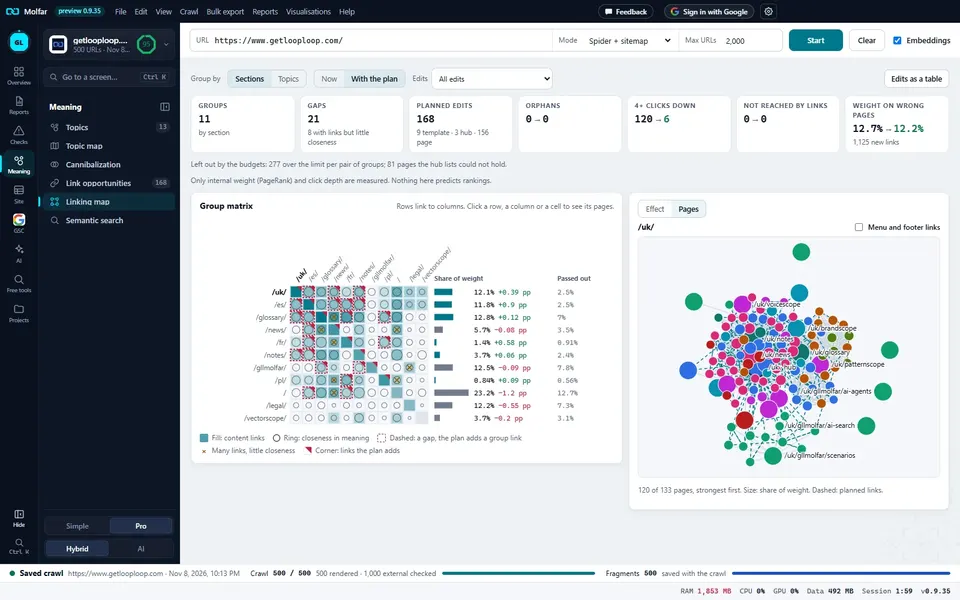
Measuring the weight is half the job; the other half is deciding which links to add and checking that they help before anyone edits a template. GLLmolfar's linking map groups pages (here by section), finds pairs of groups that are close in meaning but barely linked, proposes links within a budget per pair, and then recomputes PageRank and depth with the proposed links added.
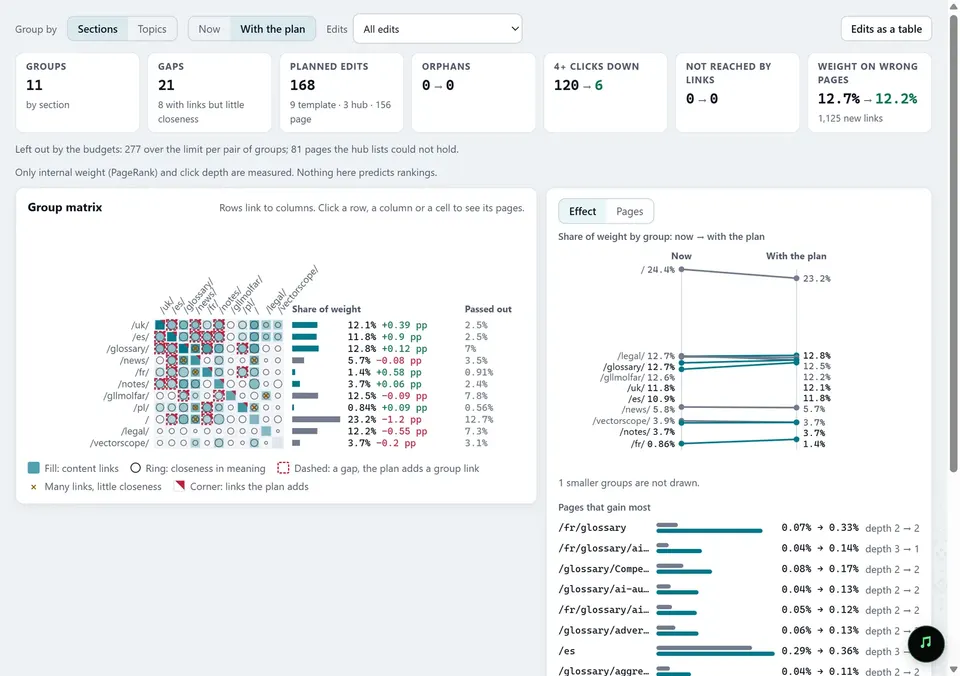
The plan proposes 168 edits — 9 to templates, 3 to hub pages, 156 to individual pages — adding 1,125 links. Recomputed with them:
- pages four or more clicks from home fall from 120 to 6;
- the French section rises from 0.86% to 1.4% of the weight, and the French glossary hub from 0.07% to 0.33% — almost five times;
- weight on pages that should not need it (legal, utility) falls only from 12.7% to 12.2%.
The last line is the honest one. Adding links cannot undo a footer: as long as seven pages are linked from every page, they keep their share. Moving that weight means changing the footer itself — linking the glossary hub and the language versions from it, or moving legal links to a single legal hub. The budgets also left out 277 candidate links over the limit per pair of groups, so the plan is deliberately conservative.
7. What to do with this
1. Measure before you move anything. Crawl the site and compute internal PageRank; sort by it. If the top of the list is privacy, terms and contact, your footer is your linking strategy. 2. Use the footer and header deliberately. They are the strongest links on the site. Link the hubs you want to rank — a glossary, a category, each language's home — and gather legal pages behind one link. 3. Link from the text. In-body links from relevant pages are what the six-page example used to lift Pricing, and what the reasonable-surfer patent suggests count most. Google: "Good anchor text is descriptive, reasonably concise, and relevant to the page that it's on and to the page it links to." 4. Don't nofollow your own pages. It does not redistribute weight; it discards it. 5. Keep important pages within three clicks and give every page at least one link. 6. Check the plan with the formula before editing templates. Recompute after adding the proposed links; if the pages you care about do not move, the plan is wrong, not the formula.
John Mueller put the stakes plainly in a March 2022 office-hours session (as transcribed by Search Engine Journal): internal linking is "one of the biggest things that you can do on a website to kind of guide Google and guide visitors to the pages that you think are important."
What this does not prove
PageRank computed by a crawler is the published model, not Google's current system, which has "evolved a lot". Internal PageRank ignores links from other sites, which bring weight in from outside. Our crawl is a 500-URL sample. And nothing here predicts rankings: a page holding more weight is easier for a search engine to find and is treated as more important within the site, which is necessary for ranking, not sufficient.
Questions about PageRank
Does Google still use PageRank in 2026?
Yes. Google's guide to its ranking systems, last updated 10 December 2025, says PageRank "continues to be part of our core ranking systems", while noting it "has evolved a lot" since 1998.
Why can't I see my PageRank any more?
Google removed the public Toolbar PageRank in 2016; it went dark on 15 April 2016. Google told Search Engine Land at the time that it still uses PageRank internally. A crawler can compute internal PageRank for your own site.
What is the damping factor 0.85?
The probability that the random surfer keeps clicking links rather than jumping to a random page. Brin and Page: "We usually set d to 0.85." At each step, about 15% of a page's weight is not passed along its links.
Does nofollow on internal links save PageRank for other links?
No. Since about 2008, a nofollowed link's share is lost, not redistributed (Matt Cutts, 2009). Since 2019 nofollow is a hint, not a directive.
Do 301 redirects lose PageRank?
Not according to Google: Gary Illyes wrote in July 2016 that "30x redirects don't lose PageRank anymore". Chains still cost crawling, so link to the final URL.
Why do privacy and terms pages have so much internal PageRank?
Because they are linked from every page's footer. In our crawl seven footer pages held 2.49% each, more than the home page's 1.96%. Google may weigh footer links less (the reasonable-surfer patent), so treat that number as an upper bound.
Did the 2024 Google leak confirm PageRank?
It shows fields named after PageRank, including PagerankNS described as "the production PageRank value", and a homepage PageRank stored per document. It does not show how much any field weighs in ranking, and Google warned against out-of-context readings.
Is this measurement independent?
No — GLLmolfar is our crawler and getlooploop.com is our site. The formula is the published one, so another crawler computing classic internal PageRank on the same pages should land close to the same numbers.
Sources
All opened on 9 November 2026. Papers: Brin and Page, 1998 (archive); Page, Brin, Motwani and Winograd, Stanford InfoLab 1999-66 (read through the Wayback Machine). Patents: US 6,285,999, US 7,716,225. Google: ranking systems guide, link best practices, SEO Starter Guide, Evolving nofollow, redirects, canonicalization, S-1, 2004. Statements: Matt Cutts, 2009; Gary Illyes on X, 2016 and 2017; Search Engine Land on Toolbar PageRank and its removal, 8 March 2016. Leak: hexdocs, The Verge, iPullRank. Study: Botify, 2018. Glossary: PageRank, link equity, internal linking, crawl depth, nofollow, anchor text. Crawler: GLLmolfar.
The product
Watch it on every page, every day
One reading tells you where a page stands today. The product asks the same questions of the same assistants continuously, so a change is something you are told about rather than something you go looking for.
Request an invitationInvite-only while we keep the readings honest
On this topic
Do AI assistants mention us?
Every day The same questions asked of real assistants on a schedule, every answer kept in the evidence store. How the product works
Author
Olexandrauthor
15+ years in marketing and SEO. Dozens of products, mostly the US market. Research and measurement.
LinkedInPass it on
Read in your language
Opens a browser translation of this English article. The original source stays in English.