

SEO tools in 2026: what each one actually sees, and a rating of ten
Search Console, Bing Webmaster Tools, Ahrefs, Semrush, SE Ranking, Screaming Frog, Sitebulb, Moz, PageSpeed Insights and GLLmolfar: where each gets its data, how accurate it is, what it does for AI search, and a weighted rating.
The short answer
- what
- A comparison of ten SEO tools on data source, index size, accuracy, AI search features, agent access and cost to start, with a weighted rating.
- why
- AI search added a new column to every tool's feature list in 2025 and 2026, and the old comparisons do not have it.
- who
- Anyone choosing SEO tools: site owners, freelancers, agencies and in-house teams.
- where
- Tools used worldwide; prices as each vendor lists them.
- when
- Facts read on the vendors' and researchers' own pages on 8 November 2026.
- how
- Official pages, vendor and independent studies, and practitioner surveys, each linked; one rubric of seven weighted criteria applied to all ten.
In plain words
SEO tools are like different instruments for looking at a website. Some are the search engine telling you what it saw, some are a big map of the whole internet that a company drew, some walk through every room of your own site, and one times how fast a page opens. None of them sees everything, so most people use a few together. We scored ten of them on the same seven questions.
Every SEO tool answers a narrower question than its homepage suggests. Search Console knows what Google did with your pages and nothing about anyone else's. Ahrefs and Semrush know a great deal about everyone and estimate your traffic from the outside. A crawler such as Screaming Frog reads every page you have and knows nothing about who searches for them. And since 2025 there is a new question none of the old comparisons cover: what do AI assistants say about you, and can your pages be read by them at all?
We read the official pages, pricing and documentation of ten tools on 8 November 2026, gathered the studies that measure them, and scored all ten on one rubric. One of the ten is GLLmolfar, the desktop crawler we make. It is scored by the same rules, and it does not come first.
| # | Tool | Kind | Best for | Score |
|---|---|---|---|---|
| 1 | Ahrefs | Third-party index | Links and competitors, with AI answers tracked | 74 |
| 2 | Semrush | Third-party index | One suite for keywords, ads and AI visibility | 70.5 |
| 3 | SE Ranking | Third-party index | Agencies: AI tracking and MCP in the entry plan | 61 |
| 4 | Google Search Console | Search engine data | The only real Google data about your site | 58.5 |
| 5 | Screaming Frog | Desktop crawler | Deep technical crawls on a small budget | 58.5 |
| 6 | GLLmolfar | Desktop crawler | A crawl your AI agent can run and read | 58.5 |
| 7 | Bing Webmaster Tools | Search engine data | Copilot citations, first-party | 54.5 |
| 8 | Sitebulb | Desktop and cloud crawler | Explained audits of large sites | 51 |
| 9 | Moz Pro | Third-party index | Domain Authority and a low-cost start | 48.5 |
| 10 | PageSpeed Insights | Speed test | Core Web Vitals for one URL | 41 |
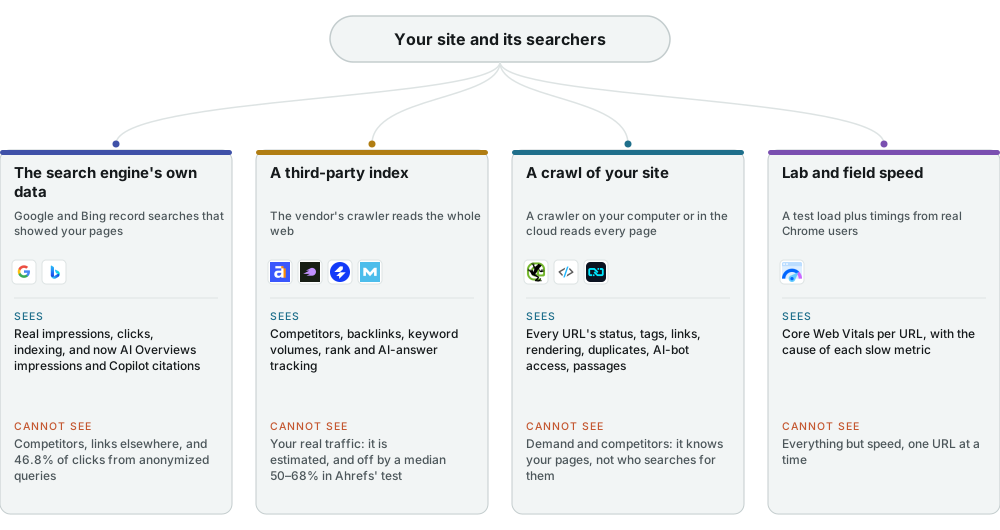
1. Four places SEO data comes from
Before features, look at the source. Each tool gets its data in one of four ways, and the source decides what it can and cannot know. A tool that estimates your traffic is not wrong to be off by half; it is measuring from outside, and the way to check it is with data from inside.
2. What SEO practitioners actually use
There is no recent public survey that counts every tool, so two older and narrower sources have to do. In Aira and Women in Tech SEO's State of Technical SEO report, Search Console and Screaming Frog were the tools technical SEOs relied on most, well ahead of everything else (reported by Digital Information World, January 2023).
Tools technical SEOs rely on, % of respondents (State of Technical SEO, 2023)
Money tells a similar story from the other side. Among businesses that bought SEO software through the spend platform Ramp in the last twelve months, 63% bought Semrush and 30% Ahrefs (Ramp, SEO category, updated 7 November 2026). That counts purchases, not users: Search Console and Bing Webmaster Tools are free and never appear in spend data.
Search Engine Journal's State of SEO 2026 asked 371 professionals in 52 countries about categories rather than brands: 56% use analytics and reporting tools, 51.2% cross-functional platforms, and 42.3% each use AI writing assistants and technical SEO tools.
Share of businesses buying SEO software on Ramp, by vendor, % (last 12 months)
Google does not use scores from third-party SEO tools for search. However, that doesn't mean that they're all useless. Transparently calculated scores can be useful to estimate your website's standing or to point out actual issues.
John Mueller, Google, via Search Engine Journal, 15 August 2023
3. How big the indexes are
The third-party tools compete on the size of their copy of the web. These are the vendors' own figures, read on their pages on 8 November 2026. They are claims, not audits, and each vendor counts a little differently — Ahrefs reports 29 billion keywords after filtering out of 110 billion ever seen, for example.
| Vendor | Keywords | Domains | Backlinks | Markets | Source |
|---|---|---|---|---|---|
| Ahrefs | 29 billion (filtered) | 287 million | 35 trillion external (historical) | 217 locations | ahrefs.com/big-data, ahrefs.com/backlink-checker |
| Semrush | 28.8 billion | 808 million | 43 trillion | 142 databases | semrush.com/kb/999-semrush-data |
| SE Ranking | 5.5 billion | 2.2 billion domain profiles | not stated | 188 databases | seranking.com |
Try it on your own page
See what PatternScope finds on a page of yours
Everything above is measurable on your own work, and the check takes about a minute. Paste one address and read what comes back.
Open PatternScopeFree · no account · one at a time
Keyword database, billions (vendors' own figures, 8 Nov 2026)
4. How accurate the estimates are
A third-party tool does not see your traffic; it multiplies estimated rankings by estimated click-through rates. The largest test we found is Ahrefs' own: estimates for 1,635 sites compared with their real Search Console clicks. The median site was off by 49.5% in Ahrefs and 68.4% in Semrush, while both tracked the real numbers' shape (correlations of 0.76 and 0.74) (Ahrefs, May 2022). It is a vendor-run study, so read it as a measure of the method rather than a verdict on the rival.
Median deviation of traffic estimates from real Search Console clicks, % (1,635 sites)
An older independent test points the same way. Screaming Frog compared 25 UK sites with their Google Analytics visits: against a real 13.4 million, Ahrefs came in 17% low, Semrush 30% low and SimilarWeb 17% high (Screaming Frog, 2016). The practical rule has not changed: use third-party traffic to compare sites with each other, and your own Search Console to know your own numbers.
5. The free data has holes too
Search Console is first-party, but not complete. Google hides queries that "aren't issued by more than a few dozen users over a two-to-three month period", and the share of clicks behind them is large: 46.77% across 887,534 properties and 22 billion clicks in April 2025, up from 46.08% in 2022 (Patrick Stox, Ahrefs, February 2026). The interface exports 1,000 rows; the API gives 50,000 rows a day per site and search type (Google Search Central, October 2022).
Share of Search Console clicks from anonymized queries, %
We're going to have less data than ever on what people searched to come to our own websites.
Patrick Stox, Ahrefs, 11 February 2026
The maximum you can export through the Search Console user interface is 1,000 rows of data.
Daniel Waisberg, Google Search Central, 19 October 2022
6. AI search is the new column
Two things changed the comparison in 2025 and 2026. The search engines started reporting AI answers themselves: Bing Webmaster Tools' AI Performance report (public preview, 10 February 2026) counts citations in Copilot and Bing's AI summaries, and Search Console's generative AI performance reports (announced 3 June 2026, for all sites by 31 August) count impressions in AI Overviews and AI Mode. Neither reports clicks from those answers.
And the tools opened themselves to AI agents. An MCP server lets Claude, ChatGPT or another agent call a tool directly — pull a report, run a check — instead of a person copying tables between windows. Ahrefs, Semrush, SE Ranking and Sitebulb list one on their own pages; GLLmolfar runs one on your computer.
| Tool | AI answers measured | MCP server for agents |
|---|---|---|
| Search Console | Impressions in AI Overviews and AI Mode | No (API only) |
| Bing Webmaster Tools | Citations in Copilot and Bing AI summaries, grounding queries | No (API only) |
| Ahrefs | Brand Radar: Google, ChatGPT, Gemini, Perplexity, Copilot, Claude (add-ons, prompt packs) | Yes, Lite and up |
| Semrush | AI visibility and prompt tracking in every plan | Yes, from Starter |
| SE Ranking | 25 prompts a day across 5 AI engines in Core | Yes, Core and up |
| Moz Pro | AI Visibility, reported in beta | API server, reported in beta |
| Screaming Frog | No (LLM prompts and embeddings run over your own crawl) | None found |
| Sitebulb | No | Yes, every plan |
| GLLmolfar | No (it checks AI-bot access, llms.txt and quotable passages on your pages) | Yes, local, can start crawls |
| PageSpeed Insights | No | No (API only) |
AI is fundamentally changing the way consumers find and engage with brands.
Eugene Levin, President of Semrush, launching its AI Toolkit, 4 March 2025
7. The ten, one by one
Google Search Console. Free, first-party: queries, clicks, impressions, Google's indexing verdict per URL, and now AI impressions. Cannot see competitors; hides anonymized queries; 1,000-row exports in the interface. Every stack starts here. Glossary: Search Console.
Bing Webmaster Tools. Free, first-party for Bing, and the only tool that counts AI citations from an assistant's own logs. Bing is the smaller engine, but its index also feeds Copilot. Glossary.
Ahrefs. The largest link index we could verify, Site Explorer, keywords, Site Audit and Brand Radar for AI answers. A free tier ("Ahrefs Free") covers your verified sites, with 5,000 crawl credits per project a month. Paid plans start at $29 a month (Starter) as listed on 8 November 2026; MCP and API from Lite at $129.
Semrush. The broadest suite: keywords, ads, content, local and AI visibility in every plan. A free tier of 10 reports a day; the SEO plan is $139 a month ($117.33 billed yearly); MCP from Starter.
SE Ranking. Rank tracking first, now with AI visibility (25 prompts a day across five engines) and MCP credits in its Core plan, listed at €109 a month. A 14-day trial, no free tier.
Screaming Frog SEO Spider. The reference desktop crawler for Windows, macOS and Linux. Free up to 500 URLs; £199 per user a year. Even the free version connects to OpenAI, Gemini, Anthropic and Ollama and finds similar pages by embeddings.
Sitebulb. A crawler that explains each finding, on the desktop or in its cloud. Lite audits up to 10,000 URLs, Pro up to 500,000; its MCP server works on every plan. A 14-day trial.
Moz Pro. The long-standing link index behind Domain Authority, keyword research and a site crawl; AI Visibility and an API MCP server are reported to be in beta; Moz's own pages would not load for us to check them or its prices.
PageSpeed Insights and Lighthouse. Free lab tests plus Chrome users' field data for Core Web Vitals, one URL at a time. Lighthouse runs in Chrome DevTools, the command line or Node, so it fits a release pipeline.
GLLmolfar. A desktop crawler for Windows and Macs with Apple silicon: a full technical crawl with JavaScript rendering, AI-bot access per crawler in robots.txt, llms.txt, passages an assistant can quote, topics and near-duplicates from embeddings computed on your computer, and Search Console read into the app and kept there. Its local MCP server lets Claude Code, Codex or another agent start crawls, read the fix list and turn a finding into a Jira task. It is a free preview: builds are not code-signed yet, and it has months of history, not years.
8. The rating
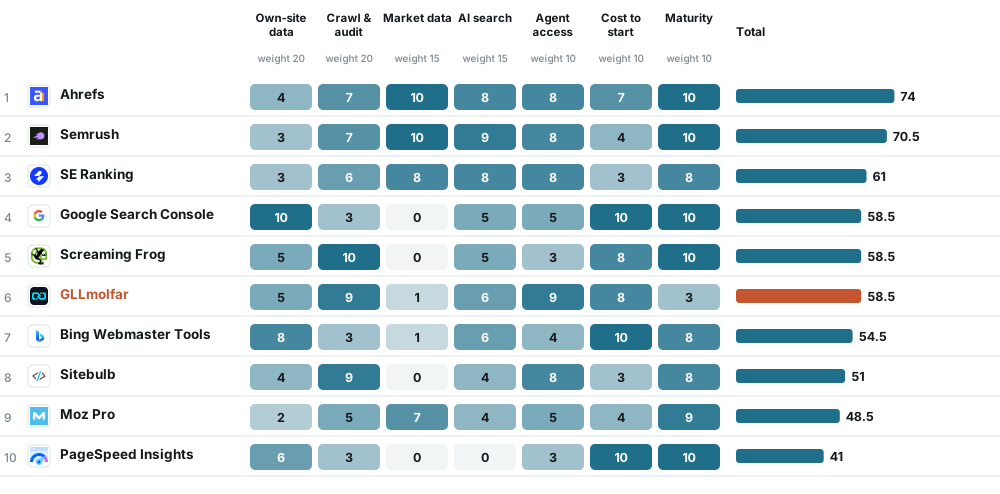
Seven criteria, scored 0 to 10 from the official pages and weighted by how much each matters to a typical site; the total is out of 100. The weights favour breadth, which is why the two suites lead. If you need only one thing, read that column, not the total: for crawling, Screaming Frog, GLLmolfar and Sitebulb score 9–10 and the suites 6–7.
| Criterion | Weight | What earns a 10 |
|---|---|---|
| Own-site data | 20 | Real data about your own site: searches, clicks, indexing, from the engine or read in from it. |
| Crawl & audit | 20 | How deeply it reads every page of your site: status, tags, links, rendering, duplicates. |
| Market data | 15 | Competitors, backlinks, keyword volumes beyond your own site. |
| AI search | 15 | Measuring how assistants cite you, or checking how ready your pages are for them. |
| Agent access | 10 | An MCP server or API your AI agent can use to run it and read its results. |
| Cost to start | 10 | How much you can do before paying: free tier, free limits, trial. |
| Maturity | 10 | Years in use, platforms, stability and signed builds. |
| Tool | Score | Why |
|---|---|---|
| Ahrefs | 74 | Largest public link index we could verify; Brand Radar tracks six assistants; MCP and API from Lite. Its own-site data is estimated. |
| Semrush | 70.5 | 28.8 billion keywords and AI visibility in every plan; the dearest entry plan here, with a free tier of 10 reports a day. |
| SE Ranking | 61 | AI visibility (25 prompts a day) and MCP credits in Core; a smaller database (5.5 billion keywords) and a trial, not a free tier. |
| Google Search Console | 58.5 | First-party clicks, impressions and Google's indexing verdict, free; no competitors; AI reporting is impressions only. |
| Screaming Frog | 58.5 | The reference desktop crawler, with embeddings and LLM hookups even in the free version; no official MCP server we could find. |
| GLLmolfar | 58.5 | A full technical crawl with JavaScript rendering, AI-bot access and passage reading, driven over a local MCP server; a preview, months old. |
| Bing Webmaster Tools | 54.5 | The only first-party AI citation counts (Copilot and Bing); a smaller search engine, and no click data in the AI report. |
| Sitebulb | 51 | Audits that explain each finding, MCP on every plan, up to 500,000 URLs an audit on Pro; trial only. |
| Moz Pro | 48.5 | A long-standing link index and DA; its AI features are reported to be in beta. |
| PageSpeed Insights | 41 | Lab and field speed for one URL at a time, free; nothing else. |
Weighted score out of 100
9. Where GLLmolfar fits
We built GLLmolfar for the column the suites leave thin: what is on every page of your site, read the way a search robot and an AI crawler read it, with the data kept on your computer and an AI agent able to work through it. It scores 9 for crawling and for agent access, and 3 for maturity, because it is a preview. It is not a replacement for Search Console or a link index, and it does not measure whether assistants mention you — it tells you whether they can read you. Use it beside one tool from the first two columns.
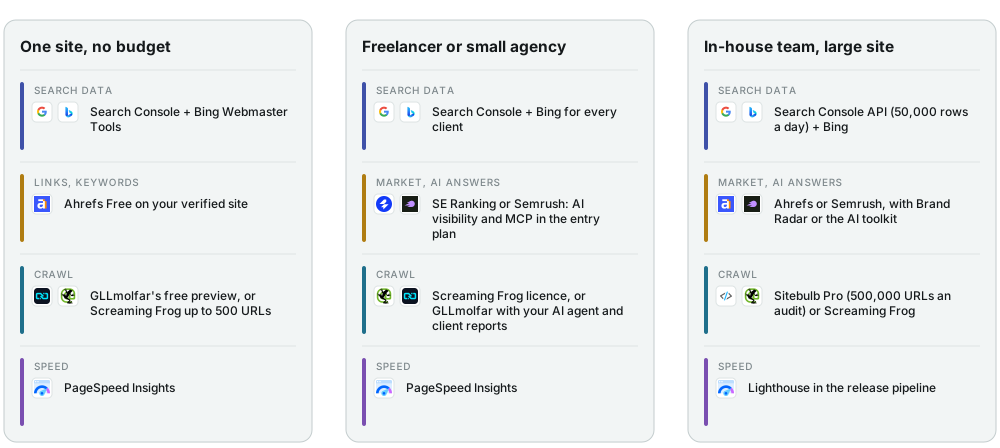
10. A set of tools for your job
The rating ranks tools; a stack is what you actually run. Three typical jobs, one tool per layer, using only what the vendors' own pages confirm.
Questions about SEO tools
What is the best SEO tool in 2026?
There is no single one. In our weighted rating Ahrefs scores 74 and Semrush 70.5 because they cover the most ground, but neither shows your real Google data; Search Console does, for free, and a crawler is the only way to see every page of your site.
Can I do SEO with free tools only?
For one site, yes: Search Console and Bing Webmaster Tools for search data, Ahrefs Free for your verified site's links and keywords, a free crawler (Screaming Frog up to 500 URLs, or GLLmolfar's free preview) and PageSpeed Insights.
How accurate are Ahrefs and Semrush traffic estimates?
In Ahrefs' own test of 1,635 sites against Search Console, the median site was off by 49.5% in Ahrefs and 68.4% in Semrush. Use estimates to compare sites with each other, not to know your own traffic.
Which SEO tools track AI search?
First-party: Search Console reports impressions in AI Overviews and AI Mode, and Bing Webmaster Tools counts citations in Copilot. Third-party: Ahrefs Brand Radar, Semrush's AI visibility, SE Ranking's AI tracking and Moz's reported beta track brand mentions in assistants' answers.
Which SEO tools have an MCP server for AI agents?
Ahrefs (Lite and up), Semrush (from Starter), SE Ranking (Core and up) and Sitebulb (every plan) list one on their own pages; Moz's is reported to be in beta; GLLmolfar runs one locally that can start crawls.
Is GLLmolfar's place in the rating independent?
No — we make GLLmolfar, and we say so. It was scored by the same seven criteria as the others, and it places sixth, tied on 58.5 with Search Console and Screaming Frog, mostly because it scores 3 for maturity.
Sources
All read on 8 November 2026 unless dated. Vendor pricing and feature pages: Ahrefs pricing, Ahrefs Free, Semrush prices, Semrush MCP, SE Ranking plans, Screaming Frog pricing, Sitebulb pricing, PageSpeed Insights API. Studies and reports are linked where they are cited. Moz's pages could not be loaded for checking, so its prices are left out.
The product
Watch it on every page, every day
One reading tells you where a page stands today. The product asks the same questions of the same assistants continuously, so a change is something you are told about rather than something you go looking for.
Request an invitationInvite-only while we keep the readings honest
On this topic
Do AI assistants mention us?
Every day The same questions asked of real assistants on a schedule, every answer kept in the evidence store. How the product works
Author
Olexandrauthor
15+ years in marketing and SEO. Dozens of products, mostly the US market. Research and measurement.
LinkedInPass it on
Read in your language
Opens a browser translation of this English article. The original source stays in English.