

01What it does, and why one sentence matters
A buyer used to arrive at your site carrying a question. Now they arrive at an assistant carrying it, ask what you are and how you compare, and reach you — if they reach you — already holding an answer somebody else wrote. That answer is assembled from whatever the model absorbed about you: a press release from two years ago, a competitor's comparison page, a review site, or nothing at all.
None of it is visible from your side. Analytics show the visit that followed, never the sentence that decided it. A brand can rank first for its own name and still be described to every buyer as something cheaper, smaller or older than it is, and nothing in a marketing stack reports that.
Brandscope makes the sentence visible. It asks each of three assistants the same five questions — what the company is, how it compares, what it costs, what it integrates with, where it is weak — and prints what came back, verbatim and dated, beside the description on the brand's own homepage.
It asks three assistants about your company and shows you their answers next to your own words.
02What the numbers mean
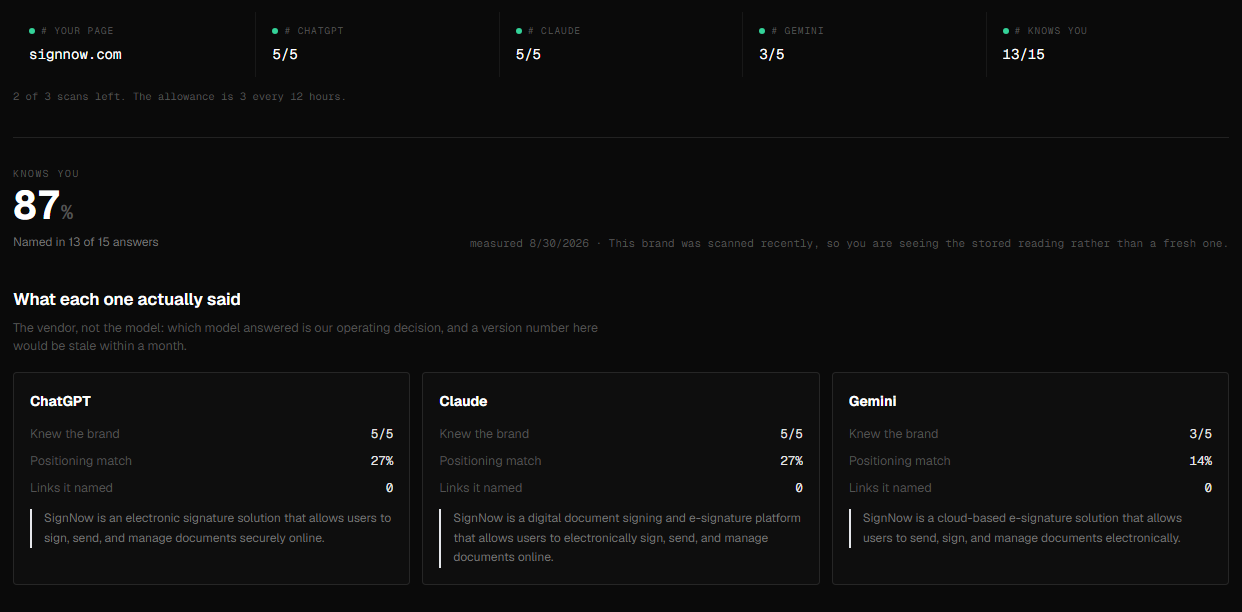
Knows you is how many of the fifteen answers named the brand as something the assistant knows. An answer that repeats your name while saying it has never heard of you does not count — that distinction is the whole reading, and getting it wrong is the easiest way to publish a comforting number.
Positioning match is how much of your own homepage language the assistant's description shares. Low is not automatically bad: a short, specific description can share few words with a long one. It is a prompt to read the two sentences side by side, not a grade.
Links it named counts the addresses written into the answers themselves. It is not a retrieval log — an assistant names a page because it decided to, and one that names none is reported as naming none rather than as failing.
03How to use the output
- Read the three sentences before the three numbers. The description an assistant gives is the thing a buyer actually receives; the percentages only say how far it sits from yours.
- Take a contradicted claim to the page that caused it. A price the assistant states and your page disproves is a fact somebody wrote down once, and the fix is a page that states it plainly enough to be absorbed.
- Treat a low positioning match as a question about your own first sentence. If three models describe you in words your homepage never uses, the words they used came from somewhere else.
- Re-run it after you have changed something, and keep the earlier reading. One scan is a photograph; two are the beginning of an answer about whether the change reached anything.
04Common mistakes
- Reading the percentage as a share of voice. It is the share of fifteen answers on one afternoon that named the brand — not a position against competitors, and not a trend.
- Taking "unverified" as "false". It means we could not check the claim against your page, which is the honest majority of cases; only a price is a claim a machine can check mechanically.
- Assuming an assistant that refuses to answer does not know you. Refusals and admissions of ignorance are counted apart from naming, because a model that hedges about your pricing may describe your product perfectly.
- Deciding a model is wrong about your weaknesses. Those answers are always reported as unverified: what a competitor's page says about you is not something your own page can settle.
05What it cannot tell you
It cannot tell you how many buyers were told this. Nothing here is a volume; fifteen answers were collected, and fifteen is the sample. It cannot tell you what an assistant will say tomorrow — models change under you without an announcement, which is the reason a reading carries its date. It cannot tell you where an answer came from: the models are not asked for sources and the ones they volunteer are claims, not a retrieval log. And it cannot tell you whether an assistant names you when somebody asks about your category rather than about you, which is a different measurement over weeks on a prompt set you choose.
06A worked example
A reading of signnow.com returns thirteen of fifteen answers naming the brand, a positioning match of 27% against its own homepage, and zero links named by any of the three. The 87% is the comfortable half. The interesting half is that the assistants describe an electronic signature solution while the homepage sells signing for an entire organisation, and that in fifteen answers about a company with a large site, not one model volunteered a single address on it.
07Frequently asked questions
Which models does it ask, and why can I not choose them?
One current model from each of three vendors — OpenAI, Anthropic and Google — and the tool names the vendor rather than the model on purpose. Which model answers is our operating decision and it changes; a version number printed on a reading would be stale within a month and would invite comparisons between two readings that used different ones.
Is 87% good?
It is not a grade, and there is no benchmark to compare it against. It says thirteen of fifteen answers treated the brand as something known, which for a small company would be remarkable and for a household name would be a warning. Read it next to the sentences: a high number with a wrong description is worse than a low number with a right one.
Why does it check claims against my homepage rather than the truth?
Because your homepage is the one source we can read on your behalf and you control. Nothing is called false unless your own site says otherwise, and a price is the one claim a machine can check mechanically. Everything else is reported as supported by your page or unchecked, which is less satisfying and considerably more honest.
Does the reading change if I run it again?
Usually a little and occasionally a lot, because the models are not deterministic and they are updated without notice. That is a finding rather than a flaw: a description that swings between runs is one nothing in the model is anchoring, which is itself worth knowing before you plan around it.
Is it free, and what happens to my brand's report?
Free, no account, with an allowance per visitor rather than a paywall. A reading is stored for a week so a link to it keeps working, and reopening a stored one costs nothing — the report belongs to the brand it describes, not to the person who happened to press the button.
08Asked out loud
The same term in the words somebody uses speaking to an assistant rather than typing into a box — written from the situation, which is why each one carries the situation it came from.
Run the brand through this and you will have the sentence in about fifteen seconds, from three assistants rather than one, with the date on it. Take the sentences into the meeting, not the percentage — the description is the thing your buyer receives, and it is what somebody can act on.
Open the tool in a browser, type the brand or its website, and read the answers. No account, no card, nothing to install, and an example report is there if you want to see the shape of the output before spending one of your own scans.
Sometimes, and the reading tells you which case you are in. A price contradicted by your own page is the fixable kind: something stated once, somewhere absorbable, is what a model repeats. A price reported as unverified means the models declined to state one at all, which is a different problem and usually a better one.