

A measurement platform that monitors a brand’s presence in AI-generated search answers and chat outputs.
Marketers and SEO teams read it to monitor a brand's visibility and messaging within AI search results.
01What it does, and why a keyword is not a question
Search boxes taught people to compress. You do not type what you want; you type the two words most likely to be indexed against it, and you do the rest of the work yourself by scanning results. Every keyword tool measures the output of that compression, which is why a keyword list tells you what people typed and never what they needed.
An assistant removes the reason to compress: no box, no ten links, no penalty for a full sentence. So the question that reaches a model carries the urgency, the device, the document and the specific thing going wrong — and usually does not contain the keyword at all.
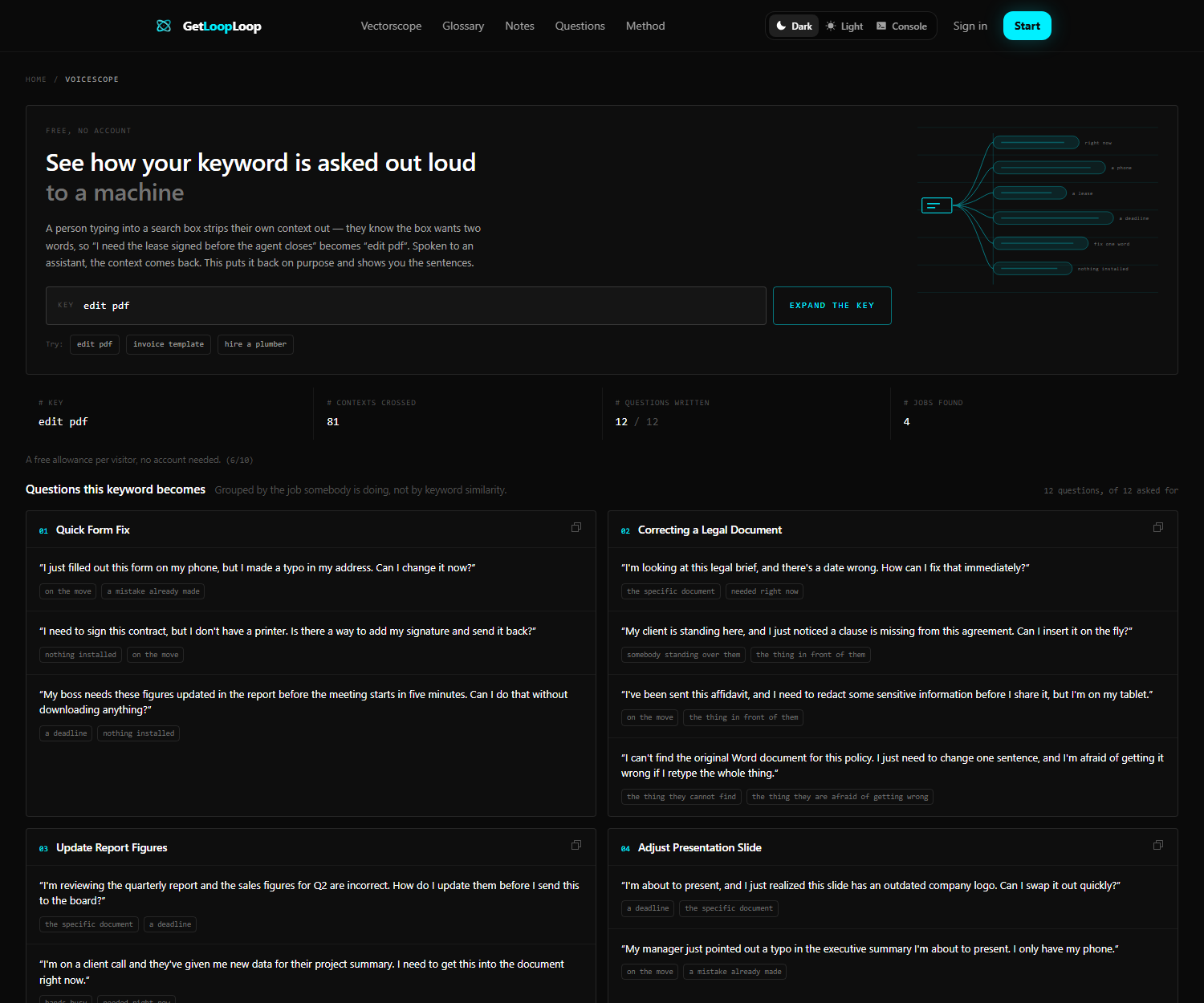
Voicescope works backwards. It takes the compressed keyword, crosses it with four contexts — how urgent it is, who is asking and on what, the thing in front of them, and what is going wrong — and writes the sentences that result. Each question carries the labels of the crossing that produced it, so a whole branch can be discarded at once.
You give it two words somebody would type, and it gives you the full sentences they would say instead.
02What the numbers mean
Contexts crossed is how many combinations the four axes make available — a property of the tool, not of your keyword. Questions written is what came back against what was asked for, so a run that returns nine of twelve says nine. Jobs found is how many distinct situations the questions fell into.
That last one is the number worth reading. A job is something you can write one page for; a cluster of similar wordings is something you can write one paragraph for. Four jobs from one keyword means four candidate pages. One job means the keyword is narrower than it looked.
03How to use the output
- Take one group, not the whole run. One job, one page — a page serving four jobs answers the first sentence of each and is retrieved for none.
- Use the question as the heading, verbatim, including the awkwardness. Smoothing it into marketing language undoes the one thing that made it useful.
- Answer in the first sentence: yes, no, usually, it depends and on what. A paragraph that clears its throat gives a retrieval system nothing to lift.
- Prefer the questions that do not contain your keyword. Those are the ones your existing page probably does not answer and your competitor has not written.
04Common mistakes
- Treating the output as demand data. Nothing here has been counted; every question is a hypothesis about how a need gets phrased, not a measurement of how often it is.
- Pasting all twelve questions into one page. That is precisely how a page ends up serving four jobs and being retrieved for none of them.
- Reading the group titles as keyword clusters. They are situations with a beginning and an end, which is why they map to pages rather than to sections.
- Expecting it to say whether an assistant answers with you. That is a measurement over weeks on a prompt set you choose, and a different product.
05What it cannot tell you
It cannot tell you how many people ask any of these — there is no volume here and none is implied. It cannot tell you that anybody has ever asked one of them: the questions are written from a framework, not harvested from a query log, and this version cross-checks them against nothing. It cannot tell you whether an assistant answers with your page today. And it cannot tell you which question is worth your week; it names the job, and that judgement needs a market you know and we do not.
06A worked example
The keyword "edit pdf" returns twelve questions across four jobs, and not one of the twelve contains the words "edit pdf". One job is somebody who has just filled in a form on their phone and mistyped their address. Another is somebody standing in front of a client who has spotted a missing clause in an agreement. Those are two different pages, in two different tones, for two different readers — and neither of them would have been written from a keyword report that said "edit pdf, 40,000 searches a month".
07Frequently asked questions
How is this different from a keyword tool?
A keyword tool reports what people typed, which is already compressed: the two words most likely to be indexed, with the situation stripped out. This starts from the keyword and reconstructs the situations compressed into it. The output is sentences rather than phrases, most of which do not contain the keyword, and there are no volume figures because nothing here has been counted.
Are these real searches that people have made?
No, and the tool never says otherwise. They are written from a framework rather than harvested from a query log, so each one is a hypothesis about how a need gets phrased out loud. That is genuinely useful for deciding what to write and genuinely useless as a demand estimate, and confusing the two is the mistake this answer exists to prevent.
What is JTBD, and why use it here?
Jobs-to-be-Done is the idea that people do not want a product, they want a job finished. It fits because a spoken question is a job description: the urgency, the constraint and the obstacle are all in the sentence. Grouping by job rather than by wording is what turns the output into a set of pages to write instead of a list of phrases to sprinkle.
Does it work in languages other than English?
Yes. The questions are generated in the language you ask for, written in that language rather than translated out of English — a phrasing translated from English is an English phrasing with foreign words in it, which is the opposite of what this measures.
Is it free, and what is the catch?
Free, with an allowance per visitor so one person cannot spend the day's budget: a rate limit rather than a paywall, and no account. The catch is that it does one thing. It will not measure whether an assistant names your brand, because that takes repeated checks on prompts you choose over weeks.
Can I use the questions on my own site?
Yes, without attribution. Write the pages, use the questions as headings, put them in an FAQ. Two cautions: read each one out loud before publishing, because a question that sounds wrong to you will sound wrong to a reader, and do not put all of them on one page.
08Asked out loud
The same term in the words somebody uses speaking to an assistant rather than typing into a box — written from the situation, which is why each one carries the situation it came from.
That is the symptom this exists for. A keyword list is compressed phrasing, so variations of one phrase are variations of one compression — expand the head term instead and you get situations rather than synonyms. Four jobs from one keyword is four pages; twelve synonyms is one.
There is none, and saying so is the right answer. These are hypotheses about phrasing, not measurements of demand, and no tool can give a reliable volume for a spoken sentence nobody has logged. What you can say is which situations the client is not currently writing for, which is usually the more useful half of the conversation.
Yes. No account, no card, one keyword at a time, and there is an allowance per visitor rather than a paywall. Type the head term and read the group titles first — they are the part that tells you which pages are missing.