

Agent · test
Describes GLLmolfar 0.9.22current release 0.9.23 · checked 1 Nov 2026
A test section where your own models do four jobs on the open crawl: a task plan, page drafts, social posts and a check for risky content. Every result says which model wrote it and what GLLmolfar measured or checked. Why a draft is better is written from the measurements, never by the model.
- Where
- AI › Agent · test
- Mode
- Simple and Pro
- Built from
- The open crawl and the models in Settings › AI models
- Changes
- Each time you run a job
On the screen
The heading carries a test mark and four sections: Analysis and tasks, Content, Social posts and Risks. Beside them, one chip per connected model role. Each section opens with a line on what it does, then its form and its result.
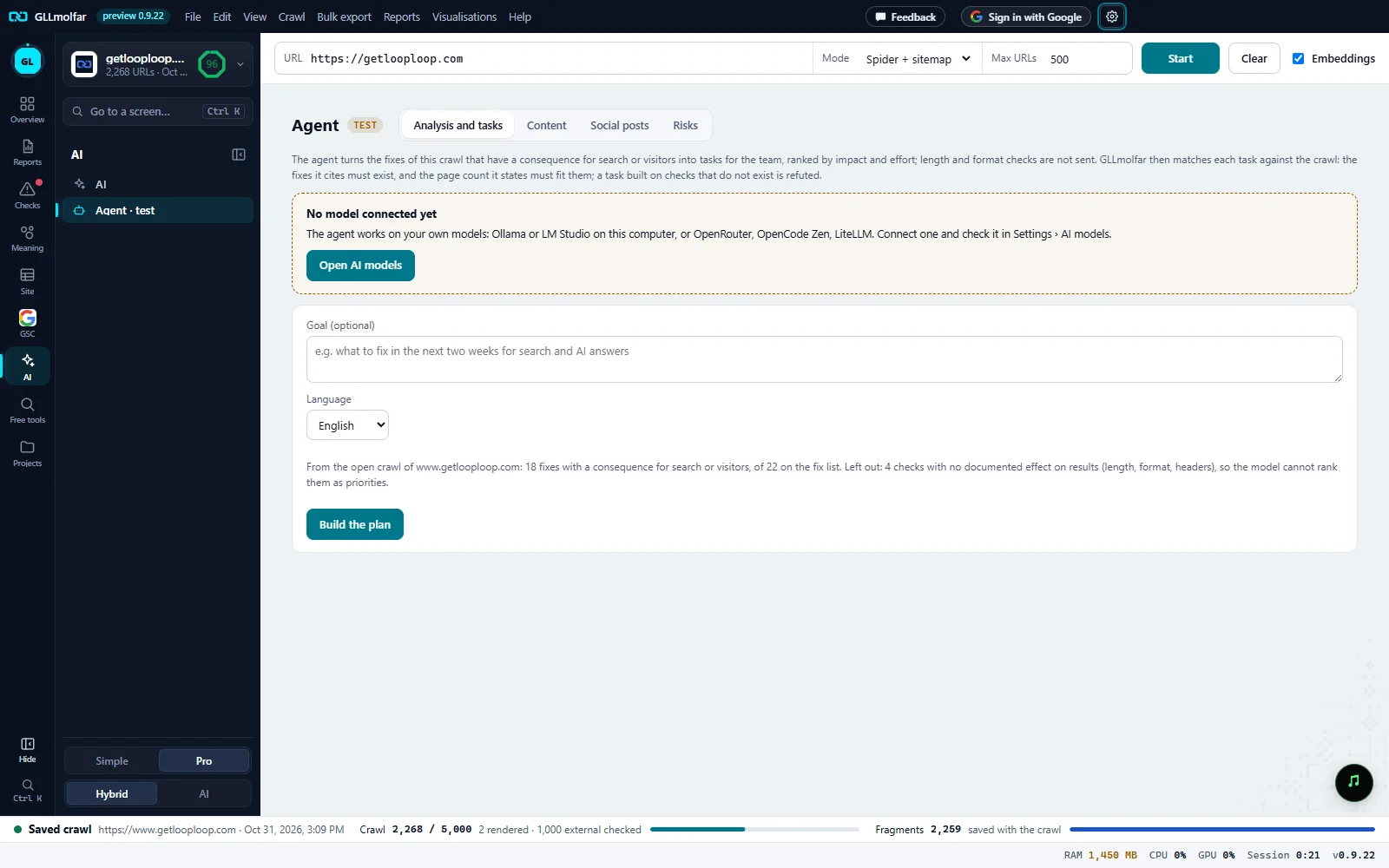
Sections. Analysis and tasks, Content, Social posts, Risks. The screen remembers the last one.
What the section does. One paragraph on the job and on what GLLmolfar checks afterwards.
No model connected yet. Shown until a model is set. Open AI models opens Settings › AI models.
Goal (optional). What the plan should aim at, in your words.
Language. English, Ukrainian, Spanish, French or Polish.
What is sent. How many fixes go to the model and which checks are left out, then Build the plan.
Models
The agent works on your own models: Ollama or LM Studio on this computer, or OpenRouter, OpenCode Zen, LiteLLM. They are connected and checked in Settings › AI models. Each role shows as a chip in the heading — Plans, Writes, Checks facts, Posts — with the model and On this computer or network or Cloud: with its host.
While a job runs: a bar, the step it is on, step N of M, the time, and the model's tokens as they arrive. Stop ends it. A finished job keeps one line: “Done in N s · model calls: N · tokens: N (in N, out N)”. Work is counted, never money.
Analysis and tasks
The model turns the crawl's fixes that have a consequence for search or visitors into tasks for the team, ranked by impact and effort. Length, format and header checks are not sent, and the line above the button counts them.
| Part of a task | What it shows |
|---|---|
| Priority | As the model ranked it; a dash for a refuted task. |
| Title and why | The task in the model's words. |
| First step | When the model gives one. |
| Effort and fixes | effort and the fixes it cites, by name. |
| Verdict | Matches the crawl, Partly matches or Refuted, with the reason under the task. |
Content
Improve a page or Blog article. The model writes a draft with the skills you pick — Answer first, Rewrite for clarity, Add what is missing, FAQ, Title and description, Brand voice — and GLLmolfar measures it and sends the failures back, up to three drafts in all. Then a fact-checking call checks each claim against the source.
| Block | What it shows |
|---|---|
| Form | The page to improve (with Worth improving: suggestions from thin pages and cannibalization pairs) or the page to build on, the topic and reader for an article, search queries to answer, notes for the writer, language, and Write and measure. |
| Write → measure → rewrite | Each draft with its model, time and the checks it failed, or All checks passed. |
| Measured by GLLmolfar | Now against Draft: words, passages against the app's cap of 26, where the best answer to the main query sits, fit to the main query, the closest page on the site, and passages that lean on the one before. Then each query with its impressions, before and after. |
| Why this draft is better | Sentences built from the measurements only. When the best draft still fails a check: “Not ready yet … Do not publish it as is.” |
| Draft | The best draft, with Copy Markdown. |
| Fact check | Each claim marked ✓ supported, ✕ contradicted or ? not settled, with the source's words, and numbers that are not in the source. For a page, The page as it is now in a fold. |
Social posts and Risks
| Section | What it shows |
|---|---|
| Social posts | An article's address, then a row per network — X posts, X thread, LinkedIn post, LinkedIn article, Facebook, Threads, Bluesky, Telegram channel, Reddit — with a narrative (Serious, Hype, Story, Numbers first, Against the grain, A question, How-to) and, where it applies, how many posts or variants. Each post shows its length against the network's limit, numbers not in the article, and Copy. Nothing is posted: copy and publish yourself. |
| Risks | Check the site re-reads every saved page of the open crawl for adult, pharma, gambling, scam, counterfeit or drug content, foreign script and pages that stand out in meaning; nothing is fetched. It lists Pages to look at: N with counts by category, the evidence on each page and a weight. Ask the model about selected (N) has your model judge each one as Harmful, Harmless mention or Unclear, and whether it looks hacked. |
States and messages
No model connected yet
Connect one in Settings › AI models; Open AI models goes there.
Open a finished crawl first: the plan is built from its fix list.
Analysis and tasks and Risks need a finished crawl.
Working…
The step on screen, such as “Ranking the fixes…” or “Checking every number against the crawl…”.
not measured: the crawl has no embeddings
The closest page on the site cannot be measured.
The fact check did not run or failed: connect a model for “Fact checking” or any checked model, then run again. Numbers that are not in the source are flagged anyway.
The draft is shown without the claim check.
Nothing found: no risky words, no foreign script, no page that stands out in meaning.
The Risks list is empty.
The agent stopped: {detail}
The job ended with an error.